The short answer
Five alloys, four hard stops. L80 13Cr holds to about 150 °C in sweet CO2 and is listed in NACE MR0175 only below 1.5 psi H2S. Modified 13Cr (HP1) reaches about 180 °C but carries no sour-service listing at all. Super 13Cr (S41426) is the only martensitic grade in Table A.19, capped at 1.5 psi H2S and pH 3.5. Past that line the answer is not another martensitic steel — it is a cold-worked austenitic: Alloy 2535 (Type 4c, 132 °C, 149 °C on proprietary qualification) or Alloy 2550 (Type 4d, 232 °C).
The mistake that costs the most money in CRA tubing selection is not picking too cheap a grade. It is picking a grade for its corrosion resistance when the well is already outside the envelope that grade is listed for. Modified 13Cr is the usual casualty: it survives CO2 at 180 °C better than standard 13Cr, so it gets written into programmes that also contain H2S, where it has no qualification whatsoever.
This page sets the five grades side by side and states, for each one, the number that stops it. It is not a corrosion handbook; it is the decision table that should be open when the completion is being specified.
The Five Rungs and the Number That Stops Each One
| Grade | UNS | Yield | NACE MR0175 / ISO 15156 | Max service temp. | Chloride |
|---|---|---|---|---|---|
| L80 13Cr | S42000 | 80–95 ksi | Listed, conditional: H2S ≤ 1.5 psi, pH ≥ 3.5 | ~150 °C | ≤ 50,000 mg/L |
| Modified 13Cr 13CRM / HP1 |
proprietary | 80–95 ksi (L80) 95–110 ksi (L95) |
Not listed — sweet service only | ~180 °C | ~100,000 mg/L |
| Super 13Cr | S41426 | 95–110 ksi | Table A.19: H2S ≤ 1.5 psi, pH ≥ 3.5, at 95 ksi | ~200 °C | ~150,000 mg/L |
| Alloy 2535 | N08535 | 110–125 ksi | Type 4c — no H2S partial pressure limit | 132 °C listed 149 °C qualified |
unrestricted |
| Alloy 2550 | N06255 | 110–125 ksi | Type 4d — no H2S partial pressure limit | 232 °C | unrestricted |
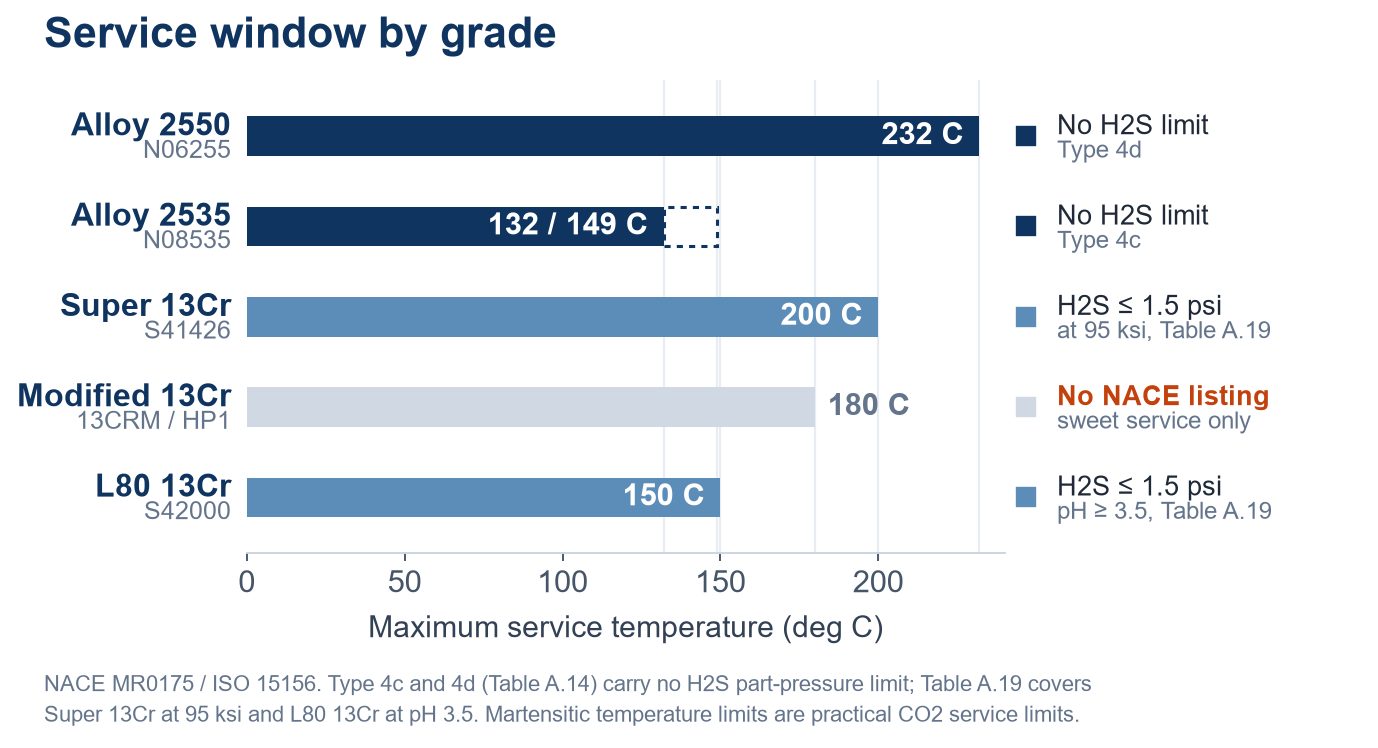
Two things about that table matter more than the rows. First, the left three are martensitic stainless steels and the right two are cold-worked austenitic alloys; the change at the 2535 column is a change of metallurgy, not a step up in the same family. Second, the temperature column is not a corrosion rate — it is the limit of the qualification. A grade does not gradually get worse as it approaches its number; it stops being qualified at it.
13Cr: A Conditional Listing That Is Narrower Than It Looks
L80 13Cr (UNS S42000, 11.5–14.0 % Cr) is the cheapest CRA in the well and the most widely used. Its NACE MR0175 entry is real but tightly fenced: H2S partial pressure at or below 1.5 psi, pH 3.5 or higher, temperature below about 150 °C, hardness capped at 23 HRC, and chloride below roughly 50,000 mg/L.
Put the 1.5 psi figure in context. In a well with a 5,000 psi bottomhole pressure, 1.5 psi of H2S is 0.03 mol % — the sort of number a gas analysis reports as a trace. For practical purposes the listing says: 13Cr is a sweet-service alloy, and the H2S allowance exists for the marginal case, not for a design basis. Completion engineers who treat "NACE listed" as "sour service approved" are reading the fence as a door.
The real limit on 13Cr is CO2 temperature. Above roughly 150 °C the corrosion rate in CO2-saturated brine climbs past 0.1 mm/year, which is where wall-thickness allowance stops being a design convenience and starts being a life-limiting factor. That threshold, not the H2S clause, is what pushes most hot sweet wells to the next rung.
Modified 13Cr: The 180 °C Upgrade With No Sour Ticket
Modified 13Cr — sold as 13CRM, SM13CRM, HP1 or Hyper 1 — adds nickel and molybdenum to the 13Cr base. The molybdenum enriches the Cr2O3 passive film with molybdate species that resist chloride breakdown, which lifts the critical pitting temperature by 15–25 °C against standard 13Cr in CO2-saturated brine. The result is a service envelope of about 180 °C and 100,000 mg/L chloride, at 30–50 % above the cost of standard 13Cr and 40–60 % below Super 13Cr or 22Cr duplex.
It is also, and this is the part that gets missed, absent from NACE MR0175 Table A.19. Modified 13Cr has no sour-service qualification. Not at 1.5 psi, not at 0.5 psi, not at pH 4. It is a sweet-service alloy with a wider temperature window, and a well with any H2S at all is the wrong application for it.
The failure mode when this is got wrong is sulfide stress cracking, and it is not gradual. Cracks initiate in the martensitic lath boundaries and propagate across the wall in hours to days rather than months. Because the alloy is not listed, there is also no code basis to point at afterwards: the material was outside its qualification on the day it was specified.
Super 13Cr: The Only Martensitic Grade With a Sour Ticket
Super 13Cr (UNS S41426, EN 1.4415) adds 5 % Ni and 2 % Mo to the 13Cr base and is the one martensitic OCTG alloy formally listed in Table A.19 — with two conditions that are routinely forgotten.
The first is the pressure limit: 1.5 psi H2S at pH 3.5 or above. The second is the strength limit: that listing is written against the 95 ksi condition. It does not carry to 110 ksi, and it certainly does not carry to 125 ksi. A procurement that specifies "Super 13Cr, 110 ksi, sour service" is asking for a combination the standard does not support.
Within its window, Super 13Cr is genuinely capable: about 200 °C, chloride to roughly 150,000 mg/L, and roughly double the cost of standard 13Cr. Above 200 °C, or above 1.5 psi H2S, or at a strength level past 95 ksi, it stops — and no amount of testing on a single heat converts a listing into an envelope.
Above 1.5 psi: The Switch to a Cold-Worked Austenitic
Alloy 2535 (UNS N08535, ISO 13680 Group 3, category 25-32-3) is an iron-based austenitic alloy at roughly 25 % Cr, 32 % Ni and 3.2 % Mo, strengthened only by cold pilgering — no aging treatment, no precipitation hardening. It is classified as a Type 4c material in Table A.14, which means it is qualified for any combination of H2S partial pressure, chloride concentration and CO2 partial pressure up to 132 °C (270 °F), without environmental restriction. The supplier’s own qualification extends that to 149 °C for fit-for-purpose use, on slow-strain-rate tensile data.
Three properties of 2535 explain its position on the ladder:
- The H2S clause disappears. Unlike every martensitic grade above, there is no partial-pressure ceiling to design against. This is the rung where a sour well stops constraining the completion.
- Strength goes up, not down. The switch from 95 ksi Super 13Cr to 110 or 125 ksi 2535 is a step up in yield, which matters at depth and in collapse design. It is one of the few upgrades in OCTG where corrosion resistance and mechanical capacity improve together.
- The 3 % Mo is a deliberate compromise. Enough molybdenum to stabilise the passive film against H2S pitting at practical temperatures; not enough to carry the cost, hot-working difficulty and intermetallic precipitation risk of a 6 % Mo alloy. That compromise is also the reason the temperature stops at 149 °C.
One exclusion to state plainly: 2535 is not qualified for service in the presence of elemental sulphur, which attacks the passive film through a different mechanism than H2S. A well with free sulphur is a different material problem.
Alloy 2550: Type 4d and the 232 °C Ceiling
Alloy 2550 (UNS N06255, category 25-50-6) moves to roughly 25 % Cr, 50 % Ni and 6 % Mo, and is listed as Type 4d with a maximum service temperature of 232 °C. The doubled molybdenum is what buys the extra 80 °C: at higher temperature the passive film needs more Mo to remain stable against chloride and H2S simultaneously.
The decision between 2535 and 2550 is almost always a temperature decision, not a corrosion decision. Both are unrestricted on H2S partial pressure and both are unrestricted on chloride. If the bottomhole temperature is under about 150 °C, 2550 is over-specified and the money is wasted. If it is above 150 °C and H2S is present, 2535 is outside its qualification and the risk is real. The gap between them is where HPHT sour completions live.
The Three Numbers That Pick the Rung
Grade selection should follow the well data, not the other way round. Three numbers do most of the work:
- H2S partial pressure (bar or psi, not concentration). If it is above 1.5 psi, every martensitic option is out and the ladder starts at 2535. This single number eliminates four of the five rows.
- Bottomhole temperature. Below 150 °C, 13Cr or Modified 13Cr is sufficient if the well is sweet. Between 150 and 200 °C, Super 13Cr if sweet-to-marginally-sour at 95 ksi, or 2535 if sour. Above 200 °C with H2S, 2550.
- Chloride concentration. Above 50,000 mg/L, standard 13Cr starts pitting; above 100,000 mg/L, only Modified 13Cr and above remain in play; above 150,000 mg/L, the austenitic alloys are the only ones left.
pH belongs alongside them because the 1.5 psi listings are written at pH 3.5 or higher. A well with pH 3.0 invalidates the listing regardless of H2S level, which is a detail that turns up in condensate systems more often than expected.
What to Send With the Enquiry
A CRA quotation that can be compared across suppliers has to be built on the same six inputs:
- H2S partial pressure and CO2 partial pressure, in bar or psi, at bottomhole and at wellhead
- Bottomhole temperature and shut-in wellhead temperature
- Chloride concentration and pH of the produced water
- Elemental sulphur: present or absent, and if present, at what rate it deposits
- Size, weight, grade and strength level, with the connection specified
- Whether NACE MR0175 compliance is a contractual requirement, and which revision applies
Without the first three, a supplier is quoting a grade, not a solution. With them, the rung is decided before the price is discussed.
ShunFu Metal supplies the full ladder from an API Q1 certified mill — L80 13Cr, Modified 13Cr in L80 and L95, Super 13Cr to 95 ksi, and the cold-worked austenitics Alloy 2535 and Alloy 2550 in 110 and 125 ksi — with full-length UT, eddy current, PMI and hydrostatic testing documented on EN 10204 Type 3.1 certificates. Send the well data and we will state which rung the numbers support, and which ones they rule out.
Frequently Asked Questions
Is Modified 13Cr suitable for sour service?
No. Modified 13Cr (13CRM, HP1) does not appear in NACE MR0175 Table A.19 and carries no sour-service qualification. It is a sweet-service alloy with a higher temperature and chloride envelope than standard 13Cr, and it should not be specified for any well containing H2S.
Can Super 13Cr be supplied at 125 ksi for sour service?
Not on the basis of the standard. The Table A.19 listing for S41426 is written against 95 ksi. Higher strength levels raise hardness and crack susceptibility, and they fall outside the listed condition — which is why sour programmes that need 110 ksi or above move to a cold-worked austenitic alloy instead.
What is the practical difference between Type 4c and Type 4d?
Temperature. Both are qualified with no limit on H2S partial pressure, chloride or CO2. Type 4c (Alloy 2535) applies up to 132 °C, or 149 °C under proprietary qualification; Type 4d (Alloy 2550) applies up to 232 °C. The move from 4c to 4d is bought with molybdenum, and it is the most expensive step on the ladder.
Does a higher strength grade also give better corrosion resistance?
No, and in martensitic grades the relationship runs the other way: hardness is capped precisely because higher strength means higher cracking susceptibility in H2S. Cold-worked austenitic alloys are the exception where strength and corrosion resistance both improve — 2535 at 110 ksi is both stronger and more resistant than Super 13Cr at 95 ksi.
Related Reading
- L80 13Cr casing and tubing — the base rung, with the NACE limits and heat treatment written out
- L80 Modified 13Cr (HP1) pipe — the sweet-service upgrade, and why it stops there
- Super 13Cr S41426 pipe — the only martensitic with a Table A.19 entry
- Alloy 2535 / N08535 pipe — Type 4c, 110 and 125 ksi, and the manufacturing route behind it
- Alloy 2550 / N06255 pipe — Type 4d to 232 °C for HPHT sour gas