The short answer
API 7-1 fixes the mechanical minimums by outside-diameter band — 758 MPa yield and 965 MPa tensile below 7 in, 689 MPa and 930 MPa at 7 in and above, 285–341 HB hardness and 54 J average Charpy across both bands. That is a floor, not a specification. The six lines that actually decide whether a collar survives a horizontal section — material route, hardness through the wall, impact test temperature, permeability class, thread finishing and NDT acceptance — are left blank for the purchase order to fill.
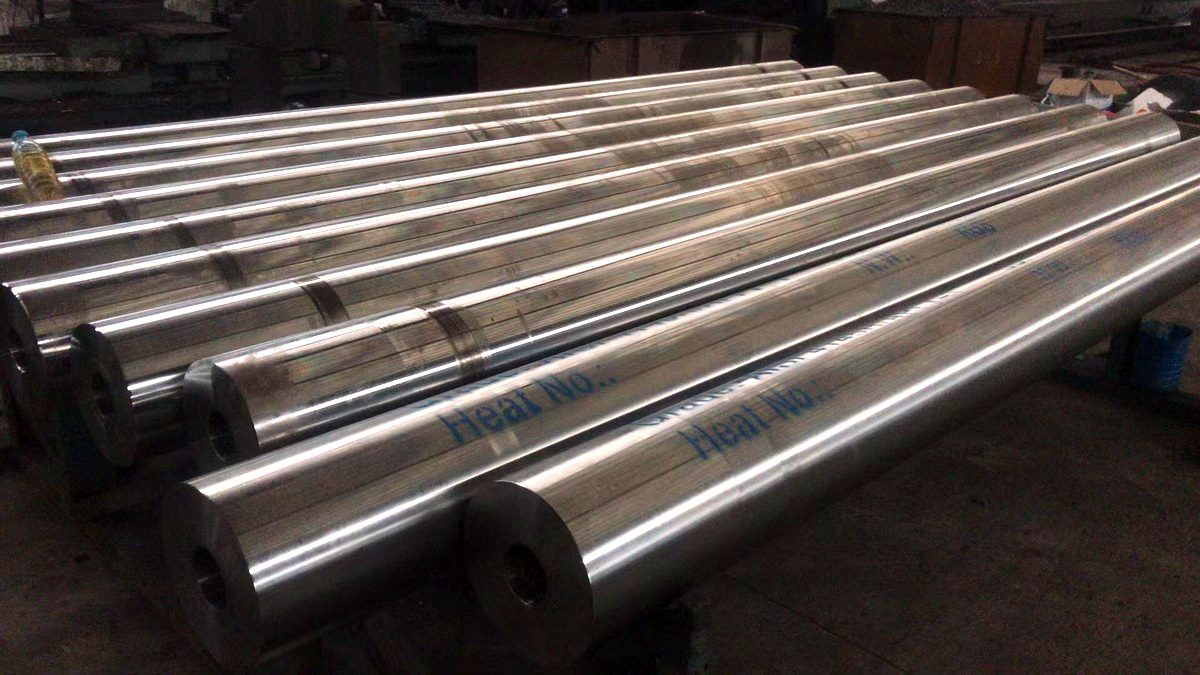
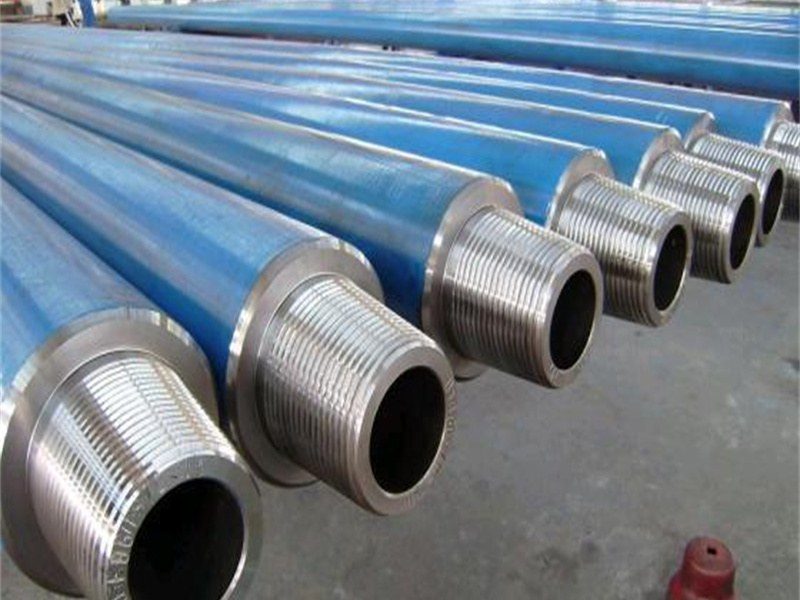
A drill collar does three jobs: it puts weight on the bit, it stiffens the bottom hole assembly, and it keeps the drill pipe above it in tension rather than compression. It also has the least forgiving duty cycle of any component in the string. A collar rotates in compression inside a curved bore, so every revolution takes the thread root through a full stress reversal, and it does that for weeks at a time at loads close to the yield of the material.
The consequence is that two collars can both be correctly described as “API 7-1 compliant” and still differ by a factor of two in fatigue life. The standard does not cause that gap. The gap sits in the parts of the specification that the standard leaves open, and most purchase orders leave them open too.
What API 7-1 Actually Fixes
API Spec 7-1 covers drill stem elements, and for drill collars it sets a property floor that changes with section size. The split at 7 in is deliberate: a heavy section cannot be quenched to the same strength as a light one, so the standard lowers the requirement instead of pretending the metallurgy will cooperate.
| Outside diameter | Yield min. | Tensile min. | Elongation | Hardness | Charpy V-notch |
|---|---|---|---|---|---|
| 3-1/8 – 6-3/4 in (79.4 – 171.4 mm) |
758 MPa (110 ksi) |
965 MPa (140 ksi) |
≥ 13 % | 285–341 HB | ≥ 54 J average ≥ 47 J single |
| 7 – 11 in (177.8 – 279.4 mm) |
689 MPa (100 ksi) |
930 MPa (135 ksi) |
≥ 13 % | 285–341 HB | ≥ 54 J average ≥ 47 J single |
Standard lengths are 9.14 m and 9.45 m, bores run from 1-1/4 in to 3 in on the standard size range, and connections are NC or REG threads manufactured and gauged to API 7-1 and API 7-2. That is the whole of what the document guarantees. Everything below is what it does not.
The Ratio That Decides Fatigue: BSR
Before the six lines, one number that most purchase orders never mention. The bend strength ratio is the section modulus of the connection divided by the section modulus of the collar body. For drill collars it normally sits near 2.5, and that margin exists because the thread root is where bending fatigue initiates: the connection must be stronger than the body it joins, so that a failure, if it comes, happens in a region that can be inspected.
Both terms move with geometry. Increasing the bore reduces the body section modulus and therefore raises BSR; reducing the bore lowers it. This is why bore size is not a free choice. A customer who specifies 6-1/2 in OD, 3 in ID and an NC50 connection has already fixed a BSR — the only question is whether anyone calculated it, or whether the bore was chosen because a tool inside the collar needed the space.
Line 1 — The Material Route
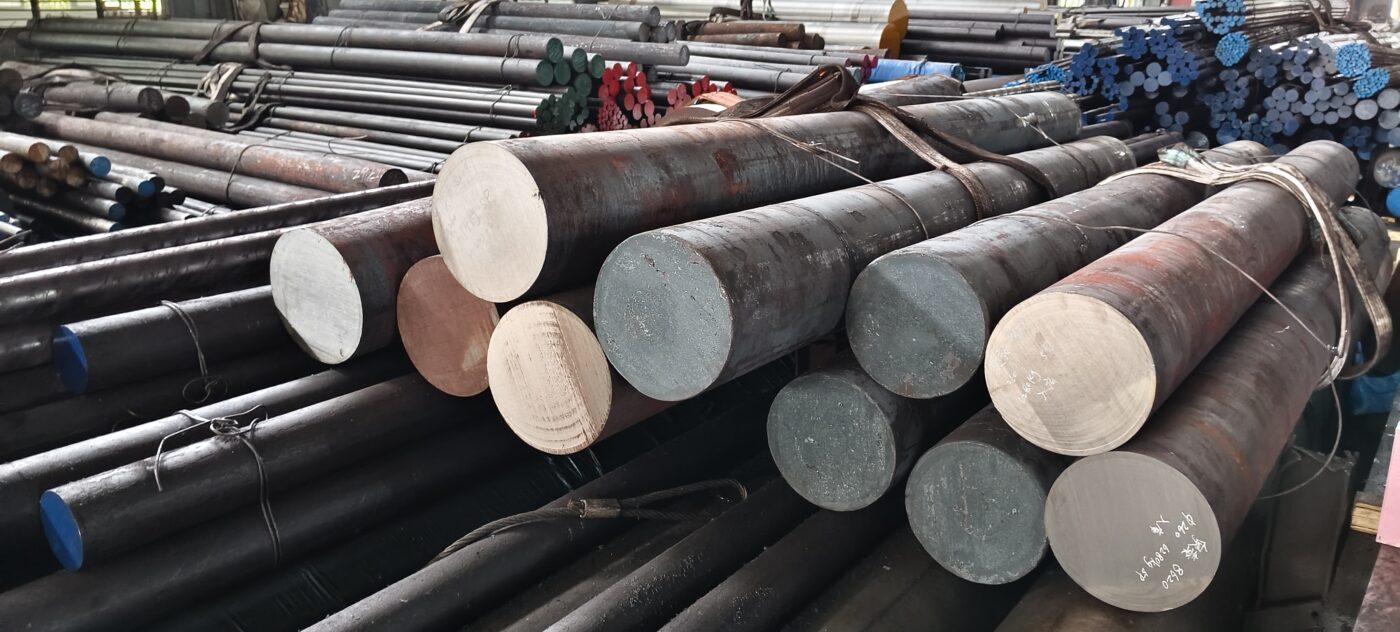
Below 6-3/4 in, the default is AISI 4145H MOD: a 0.42–0.48 % carbon chromium-molybdenum grade with manganese and chromium near 1 % each and 0.15–0.25 % molybdenum. The “H” means the steel is supplied to a hardenability band verified by Jominy end-quench testing to ASTM A304, not just to a chemistry range. The “MOD” is not decoration either: sulphur and phosphorus are held to 0.030 % or lower each, with residual elements controlled, because in a 6 in section the centre cools slowly enough that inclusions and segregation decide the impact result.
An “H” grade quoted without Jominy data is 4145 with a letter after it. That is a reasonable thing to say at the quotation stage, and a very reasonable thing to ask for before the mill rolls.
At 7 in and above, or where the design needs more than the API floor, the route changes to 4330V MOD: nickel, chromium, molybdenum and a vanadium addition, with enough alloy content that the centre of a heavy section still transforms to martensite on quenching. The mechanism is covered in through-hardening in heavy sections, but the purchasing consequence is simple: past a certain wall thickness, paying for 4145H MOD buys a collar that meets the number on the certificate and not the number the design needed.
Line 2 — Hardness Through the Wall, Not on the Surface
This is the failure that passes every incoming inspection. A collar is checked with a portable hardness tester on the outside diameter, reads 302 HB, and is accepted. The bore, which is where the bending stress is highest, may be twenty points softer.
Two mechanisms produce that. The first is inadequate quench severity on a heavy section: the surface transforms, the core does not, and tempering then softens the core further. The second is deliberate — induction-hardened or surface-hardened collars do exist in the market, and they will show the right number on the skin.
API 7-1’s 285–341 HB is a through-section property for quenched and tempered material. If the purchase order does not say so, nothing enforces it. The clause to write is a hardness traverse — OD, mid-wall and bore — on a ring cut from one collar per heat-treatment lot, plus a full-length hardness survey on the finished part. A mill that cannot produce a ring is telling you something about how the hardness was measured.
Line 3 — Impact: Average, Single, and Temperature
Two numbers hide inside “54 J”. The first is the average of three specimens; the second is the minimum for any single specimen, which is 47 J. A supplier reporting a single figure has reported the average, and a collar with one specimen at 41 J can still be inside the API clause.
The variable that matters more is temperature. Charpy energy falls steeply through the transition range, and where that range sits depends on hardness: the same 4145H MOD tempered to 341 HB is considerably closer to the transition than when tempered to 285 HB. A room-temperature test on a hard collar says very little about the same collar at −20 °C on a winter workover in Kazakhstan.
So the clause needs three parts: the test temperature, the single-specimen minimum, and the specimen orientation. Longitudinal specimens are standard; transverse values are lower and are the honest number for a collar loaded in bending. If sub-size specimens are permitted, say so explicitly, because a 10 mm specimen cannot be compared with a 10 × 10 mm one on the same acceptance line.
Line 4 — Non-Magnetic: Which Permeability Number
Two figures circulate in specifications: relative permeability no greater than 1.010, and no greater than 1.005. Both get called “non-magnetic”. The looser number is acceptable for collars that carry the MWD tool but are not themselves in the survey-critical zone; the tighter one is what survey-critical strings and most operator specifications ask for.
Permeability is a measurement, not a chemistry result, and it varies along a collar. A certificate that states composition and a single permeability figure has not demonstrated that the whole length was tested. Specify a 100 % probe test per collar with the printout, plus the magnetic field gradient limit measured at the bore.
There is a second trap here that catches experienced buyers. Non-magnetic grades are cold-worked austenitic alloys, and their hardness sits outside the 4145H MOD band entirely — TWZ-3, the standard choice, typically runs 335–450 HB with a minimum yield of 965 MPa up to 9-1/4 in OD and 900 MPa above it. A purchase order that copies the 285–341 HB clause onto a non-magnetic drill collar creates a non-conformance on a perfectly good part, and the argument usually happens after the goods are on the water.
Line 5 — Threads, and What Happens at the Root
The thread form is fixed: NC and REG connections with the standard V-0.038R and V-0.050R roots, manufactured to API 7-1 and gauged to API 7-2. What is not fixed is the condition of the root surface, and that is where fatigue life is decided.
Cold rolling the roots puts a layer of compressive residual stress into the most highly stressed metal in the assembly. It is the cheapest fatigue life available on a drill collar — no alloy, no heat treatment, just a roller and a control on coverage. Phosphating afterwards protects the surface and improves the friction behaviour at make-up, which is what governs whether the connection reaches its specified torque without galling.
Write both clauses for pin and box, and specify roller coverage rather than “cold rolled threads”. A partially rolled root is worse than an unrolled one, because it leaves a transition between stressed and unstressed metal exactly where the crack wants to start.
Line 6 — NDT and the Dimensions Nobody Checks
API 7-1 references non-destructive testing but does not pin the acceptance level, and that is where two compliant suppliers diverge most. The useful distinctions are: ultrasonic inspection of the bar before machining or of the finished collar (they find different defects), magnetic particle inspection of threads and recesses after machining, and whether any third party witnesses the test.
On dimensions, four items deserve a number in the purchase order: straightness in mm per metre, wall thickness tolerance, concentricity of bore to OD, and the slip and elevator recess dimensions. The recesses are where the elevators bite; a recess cut shallow by 3 mm is not a dimensional curiosity, it is a handling incident scheduled for the next trip.
The Six Lines, Written Out
| Clause | What API 7-1 gives you | What the purchase order should say |
|---|---|---|
| Material | Properties, not the route | 4145H MOD to ASTM A304 hardenability, S and P ≤ 0.030 %, Jominy curve with the MTC |
| Hardness | 285–341 HB | Traverse at OD, mid-wall and bore on a ring per heat-treatment lot, plus full-length survey |
| Impact | 54 J average, 47 J single, at room temperature | State the test temperature and the single minimum; longitudinal specimens unless transverse is specified |
| Permeability | Referenced, not fixed | ≤ 1.005 relative, 100 % probe test per collar with printout, field gradient at the bore |
| Threads | Form and gauge | Roots cold rolled pin and box to a stated coverage, phosphated, API 7-2 gauges, thread protectors |
| NDT | Referenced, level open | UT of the body, MT of threads and recesses, acceptance level named, third-party witness if required |
None of these clauses adds cost on a well-run order. They add cost only when they expose something that was going to be discovered later — at the rig, in a survey, or in a fishing job.
What to Send With the Enquiry
- Outside diameter, inside diameter and overall length, with the connection type
- Required yield class: the API floor for the OD band, or a higher design value
- Magnetic requirement, if any: permeability limit and whether each collar needs a test printout
- Service condition: vertical, directional or horizontal; mud chlorides; bottom hole temperature
- Inspection regime: standards, acceptance levels, and whether a third party witnesses
- Certificate type, and whether a ring cut for hardness traverse is required
ShunFu Metal machines drill collars and non-magnetic drill collars from 4145H MOD, 4330V MOD and TWZ-3 bar, in outside diameters from 3-1/8 in to 11 in, with NC and REG connections cut and gauged in-house, full-length quench and temper, and hardness, impact and permeability records supplied with the collar. Send the string design and we will quote against the clauses above rather than against the floor.
Frequently Asked Questions
Does API 7-1 apply to non-magnetic drill collars?
Yes, to the dimensions, connections and inspection, and to a set of mechanical requirements. But the numbers are not interchangeable with 4145H MOD: non-magnetic grades are cold-worked austenitic alloys, so they reach higher yield at much higher hardness. Carrying the 285–341 HB clause across from a carbon steel collar is the single most common specification error in this product family.
Can 4145H MOD and 4330V collars be run in the same string?
Yes, provided each collar meets its own specification and the connections and dimensions match. The point to watch is that collars of the same OD but different bore have different bend strength ratios, so the string is only as strong as its lowest-BSR joint. Mixing grades is a metallurgical decision; mixing BSRs is a design decision, and the second one is easier to get wrong unnoticed.
Why does a collar read 300 HB on the OD and fail a bore check?
Because the hardness was measured on the surface of a part that was not hardened through the wall — either the quench was too slow for the section, or the collar was surface hardened. A ring cut from one collar per heat-treatment lot, traversed at OD, mid-wall and bore, is the only check that answers the question.
What is the difference between API 7-1 and DS-1?
API 7-1 is a manufacturing specification: what a new part must be when it leaves the mill. DS-1 is an inspection standard that adds acceptance criteria for new and used drill stem components, and operators frequently cite both on the same purchase order. They are not alternatives — one defines the part, the other defines how it is judged.
Related Reading
- AISI 4145H MOD alloy steel bar — the standard drill collar grade, with hardenability and impact data
- Non-magnetic drill collar for MWD — TWZ-3 and TWZ-4 bodies, connections and permeability testing
- Through-hardening in heavy sections — where 4145H stops and 4330V starts
- Hollow bar vs solid bar — why the bore is drilled before or after heat treatment
- 4130 vs 4140 vs 4145H MOD — the grade comparison behind the material route