
Project Description
Alloy 2550 (UNS N06255, proprietary trade designations SM2550-110 and SM2550-125 by Nippon Steel, also traded as DMV2550, CRA 2550E, CRA2550, 25Cr50Ni, M2550, and Alloy 2250/2050 in earlier-generation variants, classified under ISO 13680 Group 4 Category 25-50-6) is the industry’s benchmark cold-worked, solid-solution-strengthened nickel-based CRA pipe engineered for the most extreme well conditions combining high CO₂, high H₂S, and high chloride concentrations at elevated temperatures — the definitive Type 4d alloy under NACE MR0175/ISO 15156. Launched in the mid-1980s by Nippon Steel as a premium answer to the expanding frontier of deep sour gas developments, SM2550 has since accumulated an unmatched installed base across thousands of the world’s most critical HPHT wells. Its metallurgical architecture — nominally 25% Cr – 50% Ni – 6% Mo on a sub-0.03% carbon base, cold-worked to precisely controlled dislocation densities through pilgering of VOD/AOD-melted hollows — delivers a uniquely balanced combination of high yield strength (110–145 ksi, 758–1000 MPa), unambiguous NACE Type 4d sour-service qualification to 149 °C (300 °F) with no H₂S restriction, and resistance to 300 psi H₂S at 218 °C (425 °F) — all without the precipitation-hardening heat-treatment complexity, the weld-HAZ softening susceptibility, or the age-hardening cost premium of fully precipitate-strengthened nickel-base superalloys. Nippon Steel, drawing on four decades of proprietary CRA manufacturing know-how, certifies SM2550 for service to 177 °C (350 °F) in the absence of elemental sulfur — a temperature envelope 28°C beyond the ISO 15156 default limit — and the electro-slag remelted CRA 2550E variant extends performance further through ultra-tight compositional control and microstructural cleanliness that suppresses hydrogen embrittlement at all standard strength levels. SHUNFU METAL supplies Alloy 2550 seamless CRA OCTG pipe manufactured to API 5CRA/ISO 13680, backed by 100% full-length ultrasonic testing, eddy-current testing, positive material identification, hydrostatic testing, and EN 10204 Type 3.1 material certification.
Similar Grades — Premium Nickel-Based CRA OCTG Family
| Alloy | UNS | ISO 13680 | Key Alloying (wt%) |
Yield (ksi) |
NACE MR0175 |
Max T (°C) |
|---|---|---|---|---|---|---|
| Alloy 2550 / SM2550 | N06255 | Group 4 Cat. 25-50-6 |
25Cr-50Ni -6Mo |
110–125 | Type 4d no H₂S limit |
177¹ |
| Alloy 2535 / SM2535 | N08535 | Group 4 Cat. 25-32-3 |
25Cr-32Ni -3.2Mo |
110–125 | Type 4c moderate H₂S |
149 |
| Alloy 625 / Inconel 625 | N06625 | Group 4 Cat. 22-60-9 |
22Cr-60Ni -9Mo-3.5Nb |
75–120 | Listed wide scope |
− |
| Alloy G3 | N06985 | Group 4 Cat. 22-44-7 |
22Cr-44Ni -7Mo-Cu-W |
45–50 | Listed higher Mo |
− |
| Alloy 925 / Incoloy 925 | N09925 | Group 4 Cat. 21-42-3 |
21Cr-42Ni -3Mo-Ti-Al |
110–125 | Listed age-hardenable |
− |
| Alloy 718 / Inconel 718 | N07718 | Group 4 Cat. 19-52-3 |
19Cr-52Ni -3Mo-5Nb-Ti-Al |
120–150 | Listed age-hardenable |
− |
1 Manufacturer-certified limit in absence of elemental sulfur. ISO 15156 default limit: 149 °C. Alloy 2550 occupies the decisive premium tier of cold-worked CRA OCTG — its 6% Mo threshold, achieved without precipitation hardening, establishes a Type 4d NACE classification (unrestricted H₂S) that no 3% Mo alloy (2535, 28, 825) can match and no age-hardenable alloy (925, 718) delivers at equivalent fabrication simplicity and rig-floor weldability. When SM2535 is metallurgically insufficient for the reservoir’s H₂S/chloride/temperature combination and when SM2550 is the right alloy at the right price, Alloy 2550 is the reference product worldwide.
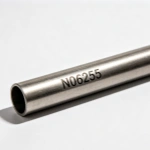
Cold-Worked CRA OCTG Pipe
Oil & Gas Applications — Type 4d Premium Sour-Service Envelope
HPHT Sour Gas Production
Tubing and liner for wells combining CO₂, H₂S ≥1 bar, and concentrated chlorides at bottomhole temperatures to 177 °C (350 °F). The Type 4d classification delivers unrestricted H₂S qualification to 149 °C and proven performance to 300 psi H₂S at 218 °C. Reference product for deep gas developments in the Middle East and North Sea.
Acid Gas Injection (AGI)
Injection tubing permanently exposed to wet H₂S/CO₂ mixtures at high injection pressure and variable temperature. SM2550’s 6% Mo passivation film — composed of Ni-S, Cr-O, and Mo-S layers — resists H₂S pitting initiation and propagation at AGI service conditions where 3% Mo alloys experience passive film breakdown.
Salt Water Disposal & WAG
Disposal wells and water-alternating-gas (WAG) injection strings handling aerated brines with dissolved oxygen. The high Ni+Mo content (PREN 44–67) provides robust chloride pitting resistance in oxygenated saltwater where duplex stainless steels are susceptible to localized corrosion and hydrogen charging.
Downhole Equipment & Packers
Base pipe for sand screens, perforating guns, landing joints, swell packers, extensions, shrouds, maker joints, pipe for VIT, and expandable tubulars — all requiring the combination of high cold-worked strength, Type 4d sour resistance, and immunity to HAZ softening at assembly welds.
Geothermal & CCS Wells
Geothermal production wells with non-condensable gas (H₂S, CO₂) in high-temperature brine, and carbon capture and sequestration (CCS) injection wells where CO₂-saturated formation water creates carbonic acid. The alloy’s 50% Ni base provides stress corrosion cracking resistance at the elevated temperatures characteristic of both applications.
Subsurface Safety & Completions
Subsurface safety valve components, chemical injection mandrels, flow couplings, and completion accessories in HPHT wells. Cold-worked SM2550 maintains its dislocation-strengthened microstructure without the over-aging risk that limits age-hardenable alloys under prolonged downhole thermal exposure.
Supply Range — Seamless CRA OCTG Pipe and Tube
| Parameter | Available Range |
|---|---|
| Product Forms | Seamless pipe, tubing, liner, base pipe |
| Outer Diameter | 2-1/16″ (52.4 mm) to 10-3/4″ (273 mm) Larger sizes available on request |
| Wall Thickness | Per API 5CT/ISO 13680 schedule, max 1.925″ Non-standard WT accommodated |
| Length | R1, R2, R3; up to 70′ (21.3 m) |
| Strength Grades | 110 ksi, 125 ksi (sour service) 140 ksi (sweet service only) |
| End Finish | Plain end, API threads, premium connections |
| Manufacturing | VOD/AOD + cold pilgering Solution annealed + cold worked |
| Specifications | API 5CRA / ISO 13680, API 5CT / ISO 11960, NACE MR0175 / ISO 15156 |
| MTC | EN 10204 Type 3.1 with full traceability |
| Inspection | 100% full-length UT + ET + PMI + hydrotest OES + inert gas fusion chemistry verification |
| Premium Variant | CRA 2550E — electro-slag remelted (ESR) Enhanced microstructural cleanliness and consistency |
Cold-Worked CRA OCTG Pipe
Chemical Composition (wt%, Heat Analysis)
| Element | C | Si | Mn | P | S | Cr | Ni | Mo | Cu | Ti | W | Fe |
|---|---|---|---|---|---|---|---|---|---|---|---|---|
| Min | — | — | — | — | — | 23.0 | 47.0 | 6.0 | — | — | — | BAL |
| Max | 0.03 | 1.00 | 1.00 | 0.03 | 0.03 | 26.0 | 52.0 | 9.0 | 1.20 | 0.69 | 3.00 | BAL |
The alloy’s defining compositional feature is the intentionally elevated nickel content (47–52%) — substantially higher than the 31–32% Ni of Alloy 28/2535 and the 38–46% Ni of Alloy 825 — which thermodynamically suppresses the formation of deleterious sigma and Laves phases during hot working and welding, stabilizes the austenite matrix against martensitic transformation during cold work, and provides the Ni-S passive film component that, together with the Cr-O and Mo-S layers, sustains pitting resistance at H₂S partial pressures and temperatures well beyond the limits of iron-based CRAs. The 6–9% Mo range is the critical threshold that elevates the alloy from Type 4c (moderate H₂S, 2535) to Type 4d (unrestricted H₂S) NACE classification. The titanium addition (≤0.69%) and tungsten addition (≤3%) provide supplementary grain-boundary stabilization and solid-solution strengthening respectively. SHUNFU METAL enforces an internal melt practice requiring VOD (vacuum oxygen decarburization) or AOD (argon oxygen decarburization) refining to achieve ultra-low sulfur and phosphorus residuals (<0.010% S target, <0.020% P target), verified by optical emission spectrometry and inert gas fusion analysis on every heat. For the most demanding applications, the electro-slag remelted CRA 2550E variant is available, delivering the tightest compositional bands and highest microstructural cleanliness in the industry.
Mechanical Properties — API 5CRA / ISO 13680 Group 4 Category 25-50-6
| Grade | Yield Strength Rp0.2, ksi (MPa) |
Tensile Strength Rm, ksi (MPa) min |
Elongation A5, % min |
Hardness HRC max |
NACE MR0175 Sour Service |
Remarks |
|---|---|---|---|---|---|---|
| 110 ksi | 110–140 (758–965) |
125 (862) |
13 | 35 | Type 4d — No H₂S limit ≤149°C |
Primary sour-service grade. Standard for HPHT gas production tubing. |
| 125 ksi | 125–150 (862–1034) |
130 (896) |
10 | 37 | Type 4d — No H₂S limit ≤149°C |
Higher strength for deep-set tubing. Maintains full Type 4d NACE qualification. |
| 140 ksi | 140–160 (965–1103) |
145 (1000) |
9 | 38 | Not recommended for sour service |
Sweet service and non-sour completions only. NACE limits yield strength to 150 ksi max. Non-standard grades available on agreement. |
Room-Temperature Tensile De-rating vs. Temperature
| Temperature | 25°C | 100°C | 150°C | 200°C | 250°C |
|---|---|---|---|---|---|
| TS Retention, % | 100 | 95.1 | 92.5 | 90.7 | 87.8 |
| YS Retention, % | 100 | 96.1 | 93.3 | 92.1 | 90.4 |
SM2550 retains >90% of room-temperature yield and tensile strength to 250°C, confirming its suitability for deep HPHT wells where elevated-temperature strength retention is a first-order design requirement.
Typical Physical Properties (25°C)
| Property | Value | Unit |
|---|---|---|
| Density | 8,220 | kg/m³ |
| Elastic Modulus | 196 | GPa |
| Poisson Ratio | 0.30 | — |
| Thermal Expansion | 13.1 | ×10−6/°C |
| Thermal Conductivity | 9.0 | W/m·°C |
| Specific Heat | 387 | J/kg·°C |
| PREN Range | 44–67 | %Cr + 3.3×%Mo |
| Melting Range | ~1300–1380 | °C |
The cold-worked strengthening mechanism — dislocation accumulation through controlled pilgering reduction of solution-annealed hollows — is the defining advantage of Alloy 2550 over age-hardenable nickel alloys. Cold working produces a dislocation forest that raises yield strength without introducing precipitate phases that can coarsen, dissolve, or transform at service temperature. There is no gamma-prime, gamma-double-prime, or eta-phase to over-age during prolonged downhole exposure; no HAZ softening at field welds; no post-weld heat treatment requirement. The Nippon Steel SM2550-125 dataset confirms that >90% of room-temperature yield strength is retained at 250°C — a thermal stability unmatched by age-hardenable alloys where γ″ dissolution begins at approximately 150°C. This intrinsic microstructural simplicity, combined with 6% Mo for H₂S pitting resistance and 50% Ni for austenite stability, is why Alloy 2550 remains the definitive Type 4d CRA OCTG reference product forty years after its introduction.