
L80 Modified 13 Chrome (tradenames 13CRM, SM13CRM, HP1, 13Cr-HP1, Hyper 1) is a quenched-and-tempered martensitic stainless steel developed as the intermediate upgrade from standard API 5CT L80 Type 13Cr (UNS S42000) toward full Super 13Cr (UNS S41426). The modification — roughly 4% Ni and 1% Mo on a 13% Cr base — turns the classic 13Cr metallurgy from a sweet-CO2, moderate-temperature alloy into a material that handles higher temperatures, higher chloride loads, and deeper wells while retaining the fabrication simplicity and cost structure of a martensitic grade.
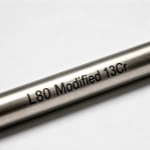
This Ni+Mo package delivers three things standard 13Cr cannot: (1) substantially higher pitting resistance at the elevated well temperatures (150–200°C) where CO2 corrosion rates accelerate, (2) improved SSC resistance at low-H2S micro-sour conditions (though Modified 13Cr remains classified as sweet-service-only under NACE MR0175), and (3) retention of yield strength at HPHT bottomhole temperatures where 13Cr L80 begins to de-rate sharply.
SHUNFU METAL supplies Modified 13 Chrome CRA pipe in the L80 (80–95 ksi) and L95 (95–110 ksi) strength grades per API 5CRA / ISO 13680, manufactured seamless via hot-rolling, quenched from ~980°C, and double-tempered to target hardness ≤27–28 HRC. Every pipe undergoes full-length UT to ASTM E213 / ISO 10893-10, ET to ASTM E426, PMI (XRF), hydrostatic testing at 1.5× design pressure, and receives EN 10204 Type 3.1 certification.
Equivalent Grades — 13Cr Family (Sweet CO₂ Service)
| Alloy | UNS | API 5CT/5CRA | Trade Name | EN / DIN | NACE Sour | Max Temp (°C) |
|---|---|---|---|---|---|---|
| Modified 13Cr | — (proprietary) | 5CRA Gr. 13-5-2 L80 / L95 |
13CRM / HP1 SM13CRM |
— (proprietary) | No — sweet CO₂ only | ~180 |
| Standard 13Cr L80 | S42000 | 5CT Gr. 2 L80 Type 13Cr |
13Cr / 420 Mod | 1.4021 / X20Cr13 | No — sweet CO₂ only | ~150 |
| Super 13Cr | S41426 | 5CRA Gr. 13-5-2 L80 / L95 / L110 |
HP2 / 13CRS SM13CRS |
1.4415 | Yes — H₂S ≤1.5 psi pH ≥3.5 (95 ksi) |
~175 |
| Super 13Cr (Alt.) | S41425 | 5CRA Gr. 13-5-2 | 13Cr-5Ni-2Mo | — | Yes — H₂S ≤1.5 psi pH ≥3.5 (95 ksi) |
~175 |
Oil & Gas Applications of L80 Modified 13 Chrome
Sweet CO₂ HPHT Production Tubing
Deep gas wells with CO2 partial pressure up to ~100 psi and temperatures exceeding 150°C — the Ni+Mo modification maintains pitting resistance where standard 13Cr L80 de-rates. Covers the middle ground between 13Cr and duplex/super-duplex costs.
Production Casing in Deep Gas
Intermediate and production casing strings in sweet CO2 gas fields where bottomhole temperatures exceed 150°C and standard 13Cr L80’s corrosion rate (typically >0.1 mm/year at 175°C/30 bar CO2) is unacceptable.
Downhole Completion Equipment
Landing nipples, flow couplings, blast joints, pup joints, and sliding side doors in sweet HPHT completions — the controlled hardness (≤27 HRC at L80, ≤28 at L95) enables safe galling-resistant make-up of premium threaded connections.
Expandable Tubulars
Solid expandable liners and clad pipe for monobore well designs — Modified 13Cr’s balanced ductility (elongation typically 20–25%) and work-hardening behaviour support controlled downhole expansion without splitting.
Base Pipe for Sand Screens
Perforated base pipe for standalone and gravel-pack sand-control screens in CO2-containing reservoirs — the alloy tolerates the elevated chloride levels in formation water without the cost premium of Super 13Cr or 22Cr duplex.
Geothermal Production (Sweet Brine)
Production casing and liner in geothermal wells where the brine is CO2-rich but H2S-free — Modified 13Cr handles temperatures up to ~180°C with high-chloride geothermal brine at a material cost well below duplex stainless.
Packer Bodies & Mandrels
Production and liner packers, seal-bore extensions, and polished-bore receptacles (PBRs) in sweet CO2 completions — high yield strength at L95 (≥655 MPa) withstands setting forces without plastic deformation.
VIT (Vacuum-Insulated Tubing)
Inner and outer strings for vacuum-insulated tubing used in steam-injection and deepwater thermal management — the alloy’s lower thermal expansion vs austenitics (10.6 vs 16–18 μm/m·°C) reduces thermal stress in the VIT annulus.
Perforating Gun Carriers
Hollow carrier gun bodies and loading tubes for TCP operations in CO2-rich wells — the alloy’s high strength-to-weight ratio supports deep-penetration gun designs with minimum wall thickness.
L80 Modified 13 Chrome Pipe Supply Range (OCTG & Mechanical)
SHUNFU METAL supplies L80 Modified 13 Chrome (13CRM / HP1 / SM13CRM) martensitic stainless steel CRA pipe and tube in seamless form to API 5CRA / ISO 13680, manufactured by hot-rolling with controlled quench-and-temper heat treatment. Seamless pipe (OCTG): OD 2-1/16″ to 10-3/4″ (52.4–273 mm), wall thickness up to 1.925″ (48.9 mm), in R1, R2, and R3 lengths per API 5CT. Mechanical tube: additional sizes available on enquiry for downhole tooling, mandrels, and completion accessories.
All material is austenitized at 950–1000°C, quenched in oil or polymer, and double-tempered — the first temper at ~680°C precipitates fine M23C6 and Mo-rich carbides for strength; the second temper at ~650°C stress-relieves the martensite lath structure and locks in the target hardness band (≤27 HRC for L80, ≤28 HRC for L95). This double-temper cycle is the critical quality step that prevents the untempered martensite embrittlement responsible for premature SSC failure in field service.
SHUNFU targets a fully tempered martensite microstructure with zero retained austenite and a prior austenite grain size of ASTM 7 or finer, verified by optical microscopy per ASTM E112 on every heat. Premium connections: SHUNFU supplies pipe with API EUE, NUE, and BTC threads, plus premium gas-tight connections (VAM TOP, FOX, JFEBEAR, Hydril 563, TenarisBlue) upon request — all connections receive phosphate or copper-based anti-galling treatment mandatory for Cr tubulars.
NACE MR0175 / ISO 15156: Modified 13Cr (HP1 / 13CRM) is classified as sweet-service-only; it does NOT appear in NACE MR0175 Table A.19 and is not qualified for sour H2S service. For environments with any H2S partial pressure, use Super 13Cr (UNS S41426, HP2) or higher-grade CRA. Users operating near the H2S threshold should consult SHUNFU’s metallurgy team for fitness-for-service assessment per NACE TM0177 Method A (tensile) and Method C (C-ring).
Products come with EN 10204 Type 3.1 / 3.2 certification, full PMI (XRF), full-body UT to ASTM E213 / ISO 10893-10, ET to ASTM E426 (seamless), hydrostatic testing at 1.5× design pressure, and mill hydrotest witness option. End finishes: plain, beveled, threaded (API and premium), or coupled. Welding consumables: use ER410NiMo (AWS A5.28) matching filler — typically ~12% Cr, ~4.5% Ni, ~1% Mo for GTAW root + GMAW fill passes. Mandatory post-weld heat treatment at 620–650°C (1148–1202°F) for 1 hour per 25 mm thickness to temper the HAZ martensite before service.
Chemical Composition of L80 Modified 13 Chrome (13CRM / HP1)
Composition in wt% per API 5CRA Group 1, Category 13-5-2 and JFE Steel HP1 specification. The chemistry is a textbook martensitic stainless design: enough Cr (12–14%) to form a protective passive film in sweet CO2 environments, just enough Ni (3.5–4.5%) to suppress delta-ferrite without pushing the alloy into the austenitic phase field, and ~1% Mo to raise the breakdown potential in chloride-containing brines.
| Grade / Source | C | Cr | Ni | Mo | Mn | Si | P | S | Fe |
|---|---|---|---|---|---|---|---|---|---|
| HP1 (JFE Steel) | ≤0.04 | 12.0–14.0 | 3.50–4.50 | 0.80–1.50 | ≤0.60 | ≤0.50 | ≤0.020 | ≤0.010 | Bal |
| 13CRM (CRA) | ≤0.03 | 11.0–14.0 | 4.0–6.0 | 0.20–1.20 | ≤1.00 | ≤0.50 | — | — | Bal |
| SHUNFU Target | ≤0.030 | 12.5–13.5 | 4.20–4.50 | 1.10–1.35 | ≤0.50 | ≤0.35 | ≤0.015 | ≤0.003 | Bal |
| Ref: Std 13Cr L80 | 0.15–0.22 | 12.0–14.0 | ≤0.50 | — | 0.25–1.00 | ≤1.00 | ≤0.020 | ≤0.010 | Bal |
The metallurgical logic of the Modified 13Cr composition is clearest when viewed against standard 13Cr L80. Carbon (C): reduced from 0.15–0.22% in standard 13Cr down to ≤0.04% — this is the single most important modification. Low carbon eliminates the chromium-carbide sensitization that depletes grain-boundary Cr at welding HAZ temperatures, making Modified 13Cr far more tolerant of field welding without intergranular attack.
It also shifts the as-quenched hardness away from the brittle >45 HRC range typical of 0.20% C martensites, enabling tempering to the tight 23–28 HRC band needed for sour-resistant OCTG. Nickel (Ni, 3.5–4.5%): non-existent in standard 13Cr (≤0.5%), Ni acts as an austenite stabilizer that suppresses the delta-ferrite formation which can create brittle ferrite stringers in hot-worked pipe — delivering the uniform, fully martensitic microstructure needed for consistent pipe-body mechanicals.
Molybdenum (Mo, 0.8–1.5%): absent in standard 13Cr, Mo is the element that makes Modified 13Cr work at higher temperatures. Mo enriches the passive Cr2O3 film with MoO42− species that resist breakdown by chloride ions, raising the critical pitting temperature by 15–25°C vs standard 13Cr in CO2-saturated brine. SHUNFU verifies every heat via OES for Cr, Ni, Mo, Mn, Si and combustion/inert-gas fusion for C, S, N, O. Heat traceability is maintained through the full manufacturing route: EAF/LF/VD steelmaking → ingot/pierced billet → hot-rolled seamless pipe → quench & temper → finishing → final inspection.
Mechanical Properties of L80 Modified 13 Chrome Pipe
Properties per API 5CRA / ISO 13680, quenched-and-tempered condition at room temperature. The L80 grade (80–95 ksi yield) is the default for general sweet-CO2 service; the L95 grade is specified where higher collapse and burst ratings are needed for deeper, higher-pressure wells.
| Grade | Yield Strength Rp0.2 (ksi) |
Yield Strength Rp0.2 (MPa) |
Tensile Strength Rm (ksi) |
Tensile Strength Rm (MPa) |
Elongation A (%) |
Hardness Max HRC |
NACE Sour |
|---|---|---|---|---|---|---|---|
| L80 (Mod. 13Cr) | 80–95 | 552–655 | ≥90 | ≥620 | Per API formula | ≤27 | No |
| L95 (Mod. 13Cr) | 95–110 | 655–758 | ≥105 | ≥724 | Per API formula | ≤28 | No |
| L110 (Mod. 13Cr) | 110–140 | 758–965 | ≥115 | ≥793 | Per API formula | ≤32 | No |
Elevated-Temperature Strength (HP1-95, typ.)
| Temp | Rp0.2 (ksi) | Rp0.2 (MPa) | Rm (ksi) | Rm (MPa) |
|---|---|---|---|---|
| 50°C (122°F) | ~98 | ~680 | ~117 | ~810 |
| 100°C (212°F) | ~97 | ~670 | ~112 | ~770 |
| 150°C (302°F) | ~96 | ~660 | ~108 | ~740 |
| 200°C (392°F) | ~94 | ~650 | ~106 | ~730 |
Source: JFE Steel HP1-13CR-95. YS de-rating at 200°C is only ~6% vs ambient — critically better than standard 13Cr L80 which loses ~15% at the same temperature. This is the practical reason Modified 13Cr is chosen for HPHT wells.
Physical Constants (QT, 20°C)
| Density | 7.75 g/cm³ (0.28 lb/in³) |
| Elastic Modulus (20°C) | 204 GPa (29.6 × 10⁶ psi) |
| Elastic Modulus (200°C) | ~199 GPa (28.9 × 10⁶ psi) |
| Poisson Ratio | 0.30 |
| Thermal Expansion (20–200°C) | ~10.6 × 10⁻⁶ /°C |
| Thermal Conductivity (20°C) | ~25 W/m·K |
| Specific Heat | ~460 J/kg·K |
| Magnetic | Yes (ferromagnetic) |
| Ac1 Temperature | ~730°C |
| YS De-rating 200°C | ~94% of ambient (typ.) |
Matching strength to well conditions — Modified 13Cr vs standard 13Cr vs Super 13Cr: Each grade occupies a distinct envelope. Standard 13Cr L80 (S42000): the baseline material for sweet CO2 wells with BHT ≤150°C and chloride ≤50,000 mg/L — the lowest cost option but with the narrowest operating window. Modified 13Cr (13CRM / HP1): extends the sweet CO2 envelope to BHT ~180°C and chloride ~100,000 mg/L through nickel and molybdenum additions — 30–50% more expensive than standard 13Cr but 40–60% cheaper than Super 13Cr or 22Cr duplex.
Super 13Cr (S41426 / HP2): the premium martensitic option — adds sour H2S tolerance (≤1.5 psi at 95 ksi), pushes BHT to ~200°C, and handles chloride to ~150,000 mg/L — the cost is roughly double that of standard 13Cr. For projects where the well is certified H2S-free by reservoir geochemistry, Modified 13Cr at L80 or L95 provides the optimal strength/corrosion/cost balance. Warning on sour service: Modified 13Cr is NOT listed in NACE MR0175/ISO 15156 Table A.19 for sour H2S service.
Even trace H2S (low ppm in gas phase) can trigger catastrophic SSC at hardness >22 HRC in the presence of chlorides and low pH — this is a metallurgical constraint inherent to the martensitic crystal structure. If the well prognosis includes ANY hydrogen sulfide, SHUNFU recommends upgrading to Super 13Cr HP2 (S41426, qualified for H2S ≤1.5 psi at pH ≥3.5 per Table A.19) or, for high-H2S fields, to 22Cr duplex (S31803) or 25Cr super duplex (S32750/S32760).
SHUNFU validates mechanical integrity through batch tensile testing per ASTM A370 / ISO 6892-1, hardness per ASTM E18 (HRC + HBW conversion per ASTM E140), Charpy V-notch impact at specified MDMT per ASTM E23, grain size per ASTM E112 (target ASTM 7–10), and microstructure verification via optical metallography for 100% tempered martensite with no delta-ferrite stringers. Dimensional tolerances per API 5CT / 5CRA.
Need L80 Modified 13Cr pipe to the specification above?
Send the size, schedule, quantity and any NACE or PMI requirements — we reply with mill availability, lead time and a priced offer, usually within one working day.