
API L80 13Cr (UNS S42000, EN 1.4021, X20Cr13, GB 20Cr13, also traded as 13 Chrome, 13CR, L80-13Cr, and 420 Mod) is the entry-level martensitic stainless steel CRA pipe for oilfield tubular goods — and by volume the single most widely used corrosion-resistant OCTG grade in global upstream operations. Specified in API 5CT Group 2, Grade L80, Type 13Cr, this quenched-and-tempered alloy delivers a controlled yield strength of 80–95 ksi (552–655 MPa) at a hardness ceiling of ≤23 HRC, with a chemistry as simple as it gets: 12–14% chromium on an iron base with ≤0.50% nickel and a deliberate carbon loading of 0.15–0.22% that supplies the martensitic hardening response.
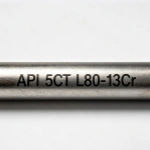
There is no molybdenum, no intentional nickel addition, no copper enrichment — this is the stripped-down, cost-optimized CRA workhorse, designed for one job: resisting sweet CO2 corrosion in production tubing, casing, liners, and downhole completion accessories at well temperatures up to ~150°C (300°F). As the price benchmark against which all higher-alloy CRA pipe is measured, standard 13Cr L80 offers the industry’s most favorable strength-to-cost ratio of any CO2-resistant seamless pipe — typically 3–5× cheaper than 22Cr duplex (S31803) and 10–15× cheaper than nickel alloys like Alloy 825 or Inconel 625 on a per-metre installed basis.
SHUNFU METAL supplies API L80 13Cr Type 13Cr seamless pipe as casing (OD 4.5″ to 13.375″ / 114.3–339.7 mm) and tubing (OD 2.375″ to 4.5″ / 60.3–114.3 mm) in R1, R2, and R3 lengths per API 5CT, manufactured via electric-furnace melting, hot-rolled seamless piercing, controlled quench from 950–980°C, and double tempering to lock in the target hardness band. Every pipe batch receives full-length UT per ASTM E213 / ISO 10893-10, ET per ASTM E426, PMI (XRF), hydrostatic proof-testing at 1.5× design pressure, hardness traverse per ASTM E18, and EN 10204 Type 3.1 certification with full heat traceability to the electric furnace lot.
Equivalent Grades — 13Cr Martensitic OCTG Family
| Alloy | UNS | API Standard | EN / DIN | GB / JIS | Ni+Mo | NACE Sour |
|---|---|---|---|---|---|---|
| 13Cr L80 | S42000 | 5CT Gr. 2 L80 Type 13Cr |
1.4021 X20Cr13 |
20Cr13 SUS420J1 |
None | Yes — Table A.19 H₂S ≤1.5 psi, pH ≥3.5 |
| Mod. 13Cr (13CRM/HP1) | — (proprietary) | 5CRA Gr. 13-5-2 L80 / L95 |
— (proprietary) | — | ~4-5% Ni ~1% Mo |
No — sweet CO₂ only |
| Super 13Cr (HP2) | S41426 | 5CRA Gr. 13-5-2 L80 / L95 / L110 |
1.4415 | — | ~5% Ni ~2% Mo |
Yes — Table A.19 H₂S ≤1.5 psi, pH ≥3.5 (95 ksi) |
| Super 13Cr (Alt.) | S41425 | 5CRA Gr. 13-5-2 | — | — | ~5% Ni ~2% Mo |
Yes — Table A.19 H₂S ≤10 psi, pH ≥3.5 (95 ksi) |
注: Standard 13Cr L80 is the only 13Cr grade listed in NACE MR0175 Table A.19 that carries no Ni+Mo alloying premium — it achieves sour qualification through low-carbon Q&T metallurgy and hardness control alone. Modified 13Cr (13CRM/HP1), despite its superior CO₂ and chloride resistance, is classified as sweet-service-only by NACE.
Oil & Gas Applications of API L80 13Cr
Sweet CO₂ Production Tubing
The primary use case: production tubing in gas and gas-condensate wells where the corrosion mechanism is sweet CO2 with ≤50,000 mg/L chlorides and BHT ≤150°C. In this envelope, 13Cr L80 corrosion rate typically remains below 0.05 mm/year — acceptable for a 20+ year well life.
Production Casing Strings
Intermediate and production casing in sweet CO2 fields — OD 4.5″ to 13.375″, wall thickness to API 5CT schedule. 13Cr L80 provides the collapse and burst ratings needed for deep-set casing at a cost that does not materially impact the well AFE.
Mildly Sour Service (NACE A.19)
Standard 13Cr L80 is listed in NACE MR0175/ISO 15156 Table A.19 for H₂S partial pressures ≤1.5 psi at pH ≥3.5 with a maximum hardness of ≤23 HRC — the only sub-Super-13Cr grade with this qualification. Suitable for wells with trace hydrogen sulfide.
Downhole Completion Accessories
Landing nipples, flow couplings, pup joints, blast joints, seal-bore extensions, polished-bore receptacles (PBRs), and sliding sleeves — standard 13Cr L80 covers the vast majority of completion hardware in sweet wells where the accessory alloy matches the production tubing metallurgy.
Base Pipe for Sand-Control Screens
Perforated base pipe for standalone screens, gravel-pack assemblies, and expandable sand-control systems in CO2-containing unconsolidated-reservoir completions — 13Cr L80 provides the corrosion resistance at the lowest available pipe-body cost.
Packer Bodies & Mandrels
Production packer mandrels, seal assemblies, and anchor latch subs — the 80–95 ksi yield range provides the structural capacity to handle setting forces of 20,000–40,000 lb without plastic deformation, and the 23 HRC max hardness ensures galling-resistant premium-thread makeup.
Moderate-Temperature Geothermal
Production casing and liner in geothermal wells with sweet (CO2-rich) brine at temperatures up to ~150°C — 13Cr L80 is widely used for geothermal production where the fluid chemistry is dominated by dissolved CO2 rather than H2S or extreme chloride.
CO₂ Injection Wells (CCS/EOR)
Injection tubing and casing in carbon-capture-and-storage (CCS) and CO₂-flood enhanced oil recovery projects — dry supercritical CO2 is non-corrosive to 13Cr, and even wet CO2 with moderate chloride is within the alloy’s passive-film stability range at injection temperatures.
Water Injection & Disposal Wells
Injection tubing and casing for produced-water re-injection and saltwater disposal — where the chloride level is ≤50,000 mg/L and dissolved oxygen is rigorously excluded, 13Cr L80 delivers decades of service at the lowest installed cost of any CRA option.
API L80 13Cr Pipe Supply Range (OCTG Casing & Tubing)
SHUNFU METAL supplies API L80 13Cr Type 13Cr (UNS S42000) martensitic stainless steel seamless OCTG pipe manufactured to API 5CT Group 2, produced via electric arc furnace (EAF) / basic oxygen furnace (BOF) steelmaking, hot-rolled seamless pipe forming, and quenched-and-tempered heat treatment. Production tubing: OD 2-3/8″ to 4-1/2″ (60.3–114.3 mm), wall thickness per API 5CT Tables C.33/C.34, in R2 and R3 lengths (typical R2: 8.53–10.36 m).
Production casing: OD 4-1/2″ to 13-3/8″ (114.3–339.7 mm), wall thickness per API 5CT Tables C.31/C.32, in R3 lengths (typical R3: 10.36–14.63 m). Heat treatment: austenitized at 950–980°C, quenched in oil or polymer, tempered at 650–730°C — the tempering temperature is the critical process variable. Tempering ~650°C produces the highest strength within the L80 band (target ~90 ksi yield) while maintaining ≤23 HRC; tempering ~730°C sacrifice some strength for maximum microstructure stability in the deepest, hottest wells.
SHUNFU’s quality protocol requires a hardness traverse across the full pipe-body wall thickness at both pipe ends — no individual reading above 23 HRC (241 HBW) is accepted for NACE-compliant material. Threading and connections: SHUNFU supplies pipe with API EUE (External Upset, 8-round) and NUE (Non-Upset, 10-round) threads per API 5B, plus API Buttress (BTC) for casing. Premium gas-tight connections — VAM TOP, VAM 21, FOX, JFEBEAR, Hydril 563, TenarisBlue, and TS-HP — are available to order with ISO 13679 CAL-IV qualification.
All Cr-steel premium connections receive phosphate-based anti-galling compound (per API 5C3 Annex B) — essential because martensitic Cr steels gall aggressively during makeup without proper surface treatment. End finishes: plain-end (PE), threaded-and-coupled (T&C), and integral-flush joint upon request. NACE MR0175 / ISO 15156 compliance: standard 13Cr L80 is listed in Table A.19 for H₂S partial pressures ≤1.5 psi (0.1 bar) at pH ≥3.5 and a maximum hardness of ≤23 HRC.
For wells exceeding these sour limits, upgrade to Super 13Cr HP2 (UNS S41426) or, for high-H₂S fields, to 22Cr duplex (S31803) or 25Cr super duplex (S32750/S32760). Qualification testing per heat: tensile per ASTM A370 / ISO 6892-1 (longitudinal strip or full-section), hardness per ASTM E18 (HRC + HBW conversion per ASTM E140), Charpy V-notch impact at specified MDMT per ASTM E23, grain size per ASTM E112 (target ASTM 7 or finer), and full-length NDE per API 5CT Clause 10 (UT for longitudinal/laminar + ET for transverse).
Every pipe receives EN 10204 Type 3.1 certification with heat chemistry, mechanical test results, NDE records, and hydrotest chart.
Chemical Composition of API L80 13Cr (UNS S42000)
Composition in wt% per API 5CT Group 2, Grade L80, Type 13Cr. The chemistry is the simplest of any CRA OCTG grade: just enough chromium to form a protective Cr2O3 passive film in sweet CO2 environments, enough carbon to produce a hardenable martensite upon quenching, and deliberately no nickel or molybdenum addition — a design philosophy that prioritizes raw material cost and heat-treatment simplicity over the extended corrosion envelope that Ni+Mo brings in Modified and Super 13Cr.
| Element | C | Mn | Si | P | S | Cr | Ni | Cu | Fe |
|---|---|---|---|---|---|---|---|---|---|
| API 5CT L80 13Cr | 0.15–0.22 | 0.25–1.00 | ≤1.00 | ≤0.020 | ≤0.010 | 12.0–14.0 | ≤0.50 | ≤0.25 | Bal |
| SHUNFU Target | 0.18–0.20 | 0.40–0.60 | 0.30–0.50 | ≤0.015 | ≤0.003 | 12.5–13.5 | ≤0.30 | ≤0.15 | Bal |
| Ref: Mod. 13Cr (HP1) | ≤0.04 | ≤0.60 | ≤0.50 | ≤0.020 | ≤0.010 | 12.0–14.0 | 3.50–4.50 | — | Bal |
The carbon content tells the whole story of standard 13Cr L80 versus Modified 13Cr. Carbon (0.15–0.22%): this is the element that makes 13Cr L80 a martensitic steel in the first place. At 0.15–0.22% C, the austenitize-and-quench cycle produces a hard, strong martensite lath structure that tempers back to the 80–95 ksi yield band with good ductility. The relatively high carbon is also the alloy’s key limitation — it restricts the maximum service temperature to ~150°C because chromium carbides (Cr23C6) begin to coarsen and deplete the grain-boundary chromium reservoir above ~480°C in service, degrading both strength and corrosion resistance.
Modified 13Cr solves this by drastically cutting carbon to ≤0.04% (which eliminates sensitization risk) and compensating for the lost martensitic hardening with Ni and Mo. Chromium (12.0–14.0%): the minimum 12% Cr threshold is the textbook definition of “stainless” — enough Cr atoms oxidize at the surface to form a continuous, adherent Cr2O3 film ~2–5 nm thick that passivates the steel against electrochemical attack in oxygenated or CO2-acidified aqueous environments.
Below ~11.5% Cr, the passive film becomes discontinuous and the alloy transitions to non-stainless behavior. Nickel (≤0.50%) and Copper (≤0.25%): deliberately kept at residual levels. Neither element is added intentionally — they appear as tramp elements from scrap steel in the EAF charge. The ≤0.50% Ni cap is important because Ni is an austenite stabilizer: too much Ni would suppress the martensite start (Ms) temperature below the quench endpoint, leaving untransformed (retained) austenite in the as-quenched microstructure that cannot be hardened by tempering.
No molybdenum: this is the single biggest cost vector separating standard 13Cr from Modified and Super 13Cr. Molybdenum at current commodity prices costs approximately ¥300,000–400,000 per tonne of ferro-molybdenum alloy, contributing roughly 8–12% to the raw material cost of a Mo-bearing CRA. Eliminating Mo from the specification is what makes standard 13Cr L80 the industry’s most affordable CRA OCTG grade. SHUNFU verifies every heat via OES for Cr, Ni, Mn, Si, Cu and combustion analysis for C and S.
Heat traceability is maintained from EAF/BOF melt → ingot/billet → hot-rolled seamless pipe → Q&T → finishing → final inspection.
Mechanical Properties of API L80 13Cr Pipe (Q&T Condition)
Properties per API 5CT Group 2, Grade L80, Type 13Cr — quenched-and-tempered condition at room temperature. The L80 grade is a controlled-yield-strength product: the 80–95 ksi window must be met on every production joint, not averaged over a batch.
| Property | Imperial | Metric | Notes |
|---|---|---|---|
| Yield Strength Rp0.2 | 80–95 ksi | 552–655 MPa | Controlled-range — both min and max enforced |
| Tensile Strength Rm | ≥95 ksi | ≥655 MPa | Minimum per API 5CT Table C.6 |
| Elongation A | Per API formula | Per API formula | Function of specimen cross-sectional area per API 5CT 10.13.5 |
| Hardness HRC (max) | ≤23 HRC | ≤23 HRC | NACE MR0175 Table A.19 limit for sour service |
| Hardness HBW (max) | ≤241 HBW | ≤241 HBW | Equivalent to ≤23 HRC per ASTM E140 |
| Yield/Tensile Ratio | ≤0.93 (L80) | ≤0.93 (L80) | Per API 5CT 10.13.5 — ensures strain-hardening capacity |
Elevated-Temperature Strength (L80 13Cr, typical)
| Temperature | Rp0.2 (MPa) | Rp0.2 (ksi) | Rm (MPa) | Rm (ksi) |
|---|---|---|---|---|
| 20°C (ambient) | ~590 | ~86 | ~720 | ~104 |
| 100°C (212°F) | ~555 | ~80 | ~690 | ~100 |
| 150°C (302°F) | ~525 | ~76 | ~660 | ~96 |
| 200°C (392°F) | ~485 | ~70 | ~610 | ~88 |
At 200°C, YS de-rates ~18% from ambient — this is the thermal limit of standard 13Cr L80 for strength-critical applications. Modified 13Cr (HP1) loses only ~6% at the same temperature due to its Mo solid-solution strengthening retention.
Physical Constants (Q&T, 20°C)
| Density | 7.72 g/cm³ (0.279 lb/in³) |
| Elastic Modulus (20°C) | 200 GPa (29.0 × 10⁶ psi) |
| Elastic Modulus (200°C) | ~193 GPa (28.0 × 10⁶ psi) |
| Poisson Ratio | 0.29 |
| Thermal Expansion (20–200°C) | ~10.8 × 10⁻⁶ /°C |
| Thermal Conductivity (20°C) | ~25 W/m·K |
| Specific Heat | ~460 J/kg·K |
| Magnetic | Yes (ferromagnetic) |
| Ac1 Temperature | ~820°C |
| Ms Temperature | ~280°C (at 0.18% C) |
Where API L80 13Cr fits — the CRA cost-performance hierarchy for CO₂ wells: Oilfield material selection for sweet-CO₂ wells is fundamentally an economic optimization between the installed cost of the pipe and its projected corrosion life. The decision tree reads from left to right: Standard 13Cr L80 (S42000): the baseline choice for wells with ≤50,000 mg/L chlorides, ≤150°C BHT, and CO₂ partial pressure up to ~30 bar. At roughly ¥20,000–30,000 per tonne for plain-end pipe, this is the cheapest CRA OCTG option available and the correct default choice when well conditions fall within its envelope.
Modified 13Cr (13CRM / HP1): selected when BHT exceeds 150°C, or chloride crosses 50,000 mg/L, or the well design requires L95-grade yield (95–110 ksi) for collapse/burst — roughly 30–50% more expensive than standard 13Cr. Super 13Cr (HP2 / S41426): selected when the well has any H₂S in the gas phase (even trace amounts) or when BHT approaches 200°C with high chloride — roughly 2× the cost of standard 13Cr. 22Cr Duplex (S31803): the first non-martensitic option in the ladder — selected when H₂S exceeds 1.5 psi, chloride exceeds 100,000 mg/L, or the operator wants a material with a demonstrated 40-year subsea track record — roughly 3–5× the cost of standard 13Cr.
Super Duplex (S32750/S32760) and nickel alloys (Alloy 825, Alloy 625): top-tier for extreme sour, extreme chloride, and extreme temperature — 8–15× the cost of standard 13Cr. The 13Cr L80 operating envelope in practice: the critical parameter is the combined effect of temperature and chloride on the pitting breakdown potential. At 100°C in 20,000 mg/L Cl⁻, 13Cr L80’s passive film is thermodynamically stable and corrosion rate is below 0.01 mm/year.
At 150°C in 50,000 mg/L Cl⁻, the film remains stable but electrochemical noise (indicating metastable pit initiation) becomes detectable — the material is still serviceable but is approaching the edge of its envelope. At 180°C in 80,000 mg/L Cl⁻, the film destabilizes and the corrosion rate can accelerate rapidly to >0.1 mm/year — this is the transition point where Modified 13Cr or duplex becomes mandatory. SHUNFU validates mechanical integrity through batch tensile testing per ASTM A370 / ISO 6892-1, hardness per ASTM E18, Charpy V-notch impact at specified MDMT per ASTM E23, grain size per ASTM E112, microstructure verification by optical microscopy, and full-length NDE per API 5CT Clause 10.
Need API L80 13Cr OCTG pipe to the specification above?
Send the size, schedule, quantity and any NACE or PMI requirements — we reply with mill availability, lead time and a priced offer, usually within one working day.