The short answer
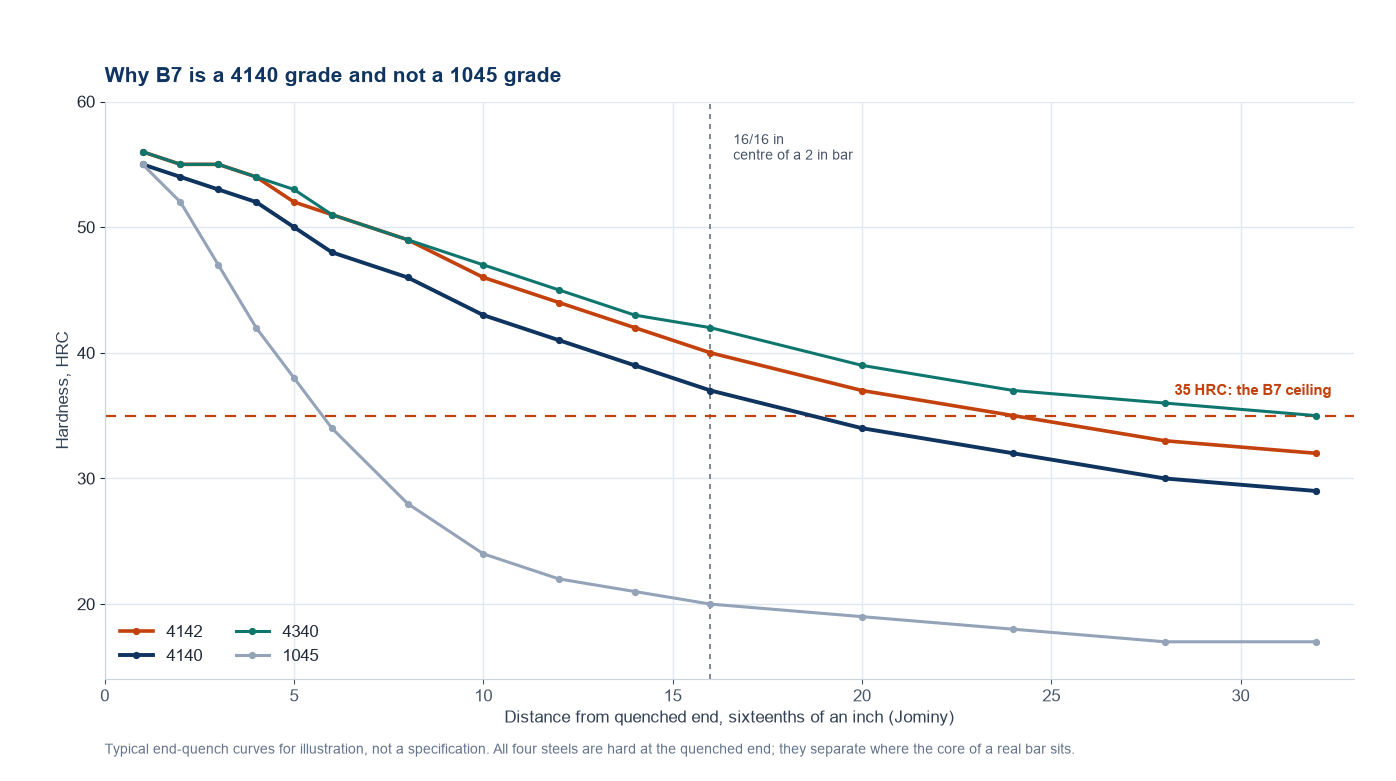
Up to about 150 mm section, 4140 will do what the drawing asks. Past that, the constraint stops being strength and becomes hardenability — whether the centre of the block cools fast enough to transform to martensite at all. The answer is not a higher carbon grade; it is more nickel and molybdenum. In practice: 4130 for thin-wall and weldable structures, 4140 for sections to roughly 150–200 mm, 4330V where impact toughness must survive at 150–155 ksi, 4340 for the highest strength in moderate sections, and 8630 mod for heavy wellhead forgings where a 400 mm block still has to be uniform at its core.
Two drawings can call for the same yield strength and require two completely different steels. The reason is that yield strength, as written on a purchase order, is a room-temperature tensile result measured on a small specimen that was quenched faster than the part it represents. The part itself cools from the centre outward, and in a heavy section the centre may never see a cooling rate fast enough to form martensite.
That is the whole problem in one sentence. This article ranks the five grades used for downhole tools, wellhead bodies and BOP components by how deep they harden — and states the inspection evidence that should accompany any claim about it.
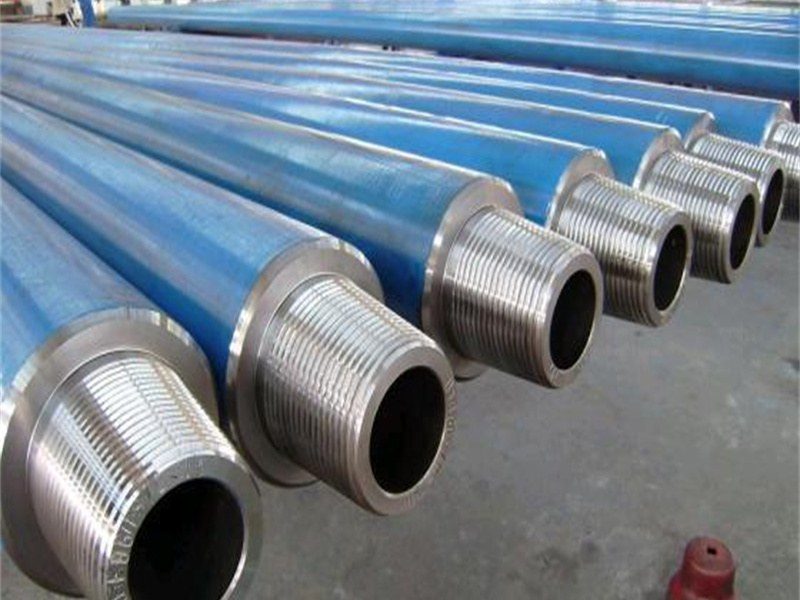
Why Section Size Changes the Answer
A steel hardens by transforming to martensite, and martensite only forms if the steel is cooled fast enough through the transformation range. Cooling rate falls with distance from the surface: the outside sees the quenchant directly, the centre only sees what the outer layers let through. In a 50 mm bar the difference is negligible. In a 400 mm forged block it is the difference between a fully martensitic core and a core containing pearlite or coarse bainite.
The consequence is not a small loss of strength. A block that is fully martensitic at the surface and partly pearlitic at the centre has a hardness gradient across its section, and hardness maps to strength and toughness. When the part is later machined into a wellhead body, the bore may sit in the soft zone and the flange in the hard zone — the same certificate, two different materials in one component.
Hardenability is controlled by alloy content, not carbon. Carbon sets the maximum hardness that martensite can reach; nickel, chromium, molybdenum and manganese set how slowly the steel can be cooled and still get there. Raising carbon to fix a through-hardening problem raises hardness at the surface without moving the centre, and makes cracking more likely in the process.
The Five Grades, Ranked by Depth
| Grade | Core alloying | Practical section | Typical strength | Where it belongs |
|---|---|---|---|---|
| 4130 G41300 / 1.7218 |
Cr-Mo, no nickel | Thin to moderate | 75–95 ksi | Thin-wall BOP and wellhead parts, weldable structures, line components |
| 4140 G41400 / 1.7225 |
Cr-Mo, no nickel | to ~150–200 mm | 75–110 ksi | Drill collar blanks, valve bodies, BOP components, general heavy machining |
| 4330V G43306 |
Ni 1.65–2.00, Cr, Mo, V | Large | 135 / 150 / 155 ksi | Drill collars, jar bodies, HWDP, tool joints, pressure-control parts |
| 4340 G43400 / 1.6580 |
Ni 1.65–2.00, Cr, Mo | Moderate to large | to ~150 ksi | High-stress shafts and downhole tools where strength outranks toughness |
| 8630 mod G86300 / 1.6591 |
Ni, Cr 0.85–1.50, Mo 0.35–0.65 | Very large, to 1,000 mm block | 60–75 ksi class | Wellhead bodies, subsea connectors, valve bodies, heavy forged blocks |
The ranking is not a quality ranking. 8630 mod sits at the bottom of the strength column and at the top of the section column, and that is exactly the point: it is chosen for depth, not for strength.
4140: The Default, and Where It Stops
4140 is the most useful alloy steel in oilfield manufacturing because it does three things adequately at once: it hardens through a respectable section, it machines well in the quenched and tempered condition, and it is available everywhere. For drill collar blanks, valve bodies and BOP components in the 100–200 mm range, it is usually the right first answer.
Where it stops is predictable. Because 4140 carries no nickel, its hardenability depends on chromium and molybdenum alone, and above roughly 200 mm the centre cooling rate falls below what those two elements can compensate for. The symptom is not a failed tensile test — the test bar will pass. The symptom is a hardness drop between the surface and the core of the actual part, and impact toughness at the core that is far below the certificate value.
The usual fix specified on drawings is "4140, 110 ksi, through-hardened". That is a combination that only works below a certain section, and the drawing rarely states the section limit. If the part is thick, the honest options are to move to a nickel-bearing grade or to accept a lower strength class at the core.
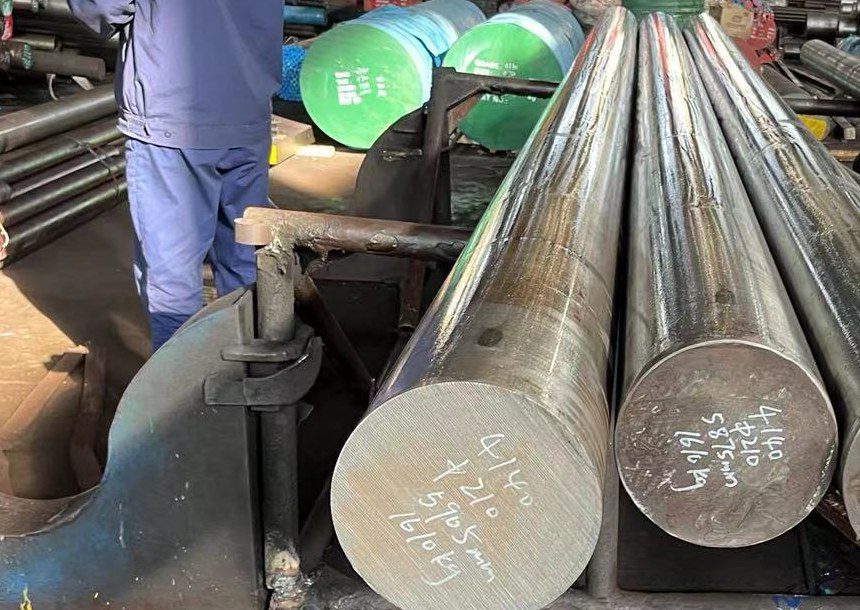
4330V: Nickel and Vanadium Instead of Carbon
4330V keeps carbon at 0.30–0.34 % — deliberately below 4140 — and puts 1.65–2.00 % nickel and 0.05–0.10 % vanadium in its place. The chemistry is the argument:
| Element | Range | What it is doing |
|---|---|---|
| C | 0.30–0.34 % | Carries the strength. Above 0.35 % toughness and weldability fall away; below 0.28 % the 155 ksi class needs over-alloying to reach. |
| Ni | 1.65–2.00 % | The toughness element. Lowers the ductile-to-brittle transition and is the main reason 4330V holds Charpy values a 4140 at the same strength cannot. |
| Cr | 0.75–1.00 % | Hardenability and the carbides that survive tempering. |
| Mo | 0.40–0.50 % | Suppresses temper embrittlement and holds strength at 120–175 °C downhole service temperature. |
| V | 0.05–0.10 % | Grain refinement and secondary hardening during tempering — what separates 4330V from plain 4330. |
4330V is a family, not a single specification: it is supplied in 135, 150 and 155 ksi minimum-yield classes, each with its own hardness and Charpy requirement. "4330V" alone on a purchase order leaves the class to the supplier, which is how two mills can both be compliant and deliver different products.
For heavy sections there is one process rule that matters more than the chemistry: normalise before austenitising. Skipping the normalise is the usual cause of scattered impact results in bars over about 250 mm, because the as-forged grain structure is not homogeneous and a direct austenitise inherits it.
8630 and 8630 mod: Two Different Steels Under One Name
This is the point on which more wellhead procurement goes wrong than any other. Standard AISI 8630 under ASTM A29 is a low-alloy Ni-Cr-Mo steel with roughly 0.40–0.60 % Cr and 0.15–0.25 % Mo. What the oilfield actually buys for heavy forgings is 8630 mod, and its specification is not the same:
| Element | Standard 8630 (ASTM A29) | 8630 mod as supplied for wellhead forgings |
|---|---|---|
| C | 0.28–0.33 % | 0.28–0.33 % |
| Mn | 0.70–0.90 % | 0.75–1.00 % |
| Ni | 0.40–0.70 % | to 1.00 % |
| Cr | 0.40–0.60 % | 0.85–1.50 % |
| Mo | 0.15–0.25 % | 0.35–0.65 % |
Roughly doubling chromium and molybdenum is what allows a 400 mm to 1,000 mm forged block to be uniform after quenching and tempering. Standard 8630 at those sections will not harden through, and a supplier quoting "8630" against a heavy block drawing without saying which one is being quoted is either quoting mod or quoting something that will not pass a core hardness check.
The practical consequence: write the mod into the purchase order, with the Cr and Mo ranges stated, and require the mill certificate to show the actual heat analysis against those ranges. A certificate that says only "8630" tells you nothing about which of the two steels you received.
Typical properties for 8630 mod in the quenched and tempered condition are a 0.2 % proof stress of 517 MPa (75 ksi) minimum, tensile strength of 655 MPa (95 ksi) minimum, elongation of 18 % minimum, reduction of area of 35 % minimum, and Charpy V-notch impact of 54 J at 23 °C and 27 J at −60 °C, at 207–234 HB. The heat treatment window is a normalise at 870–925 °C, austenitise at 830–870 °C with oil or water quench, temper at 540–675 °C, and stress relieve at 550–650 °C for one hour per 25 mm of thickness.
4340: The Most Strength, the Least Margin
4340 carries the same 1.65–2.00 % nickel as 4330V but with carbon at 0.38–0.43 %, which is where its higher attainable strength comes from — and where its lower toughness comes from. It is the right choice for high-stress shafts and downhole tools where the design is strength-driven and the section is moderate.
The trade is straightforward. At equal strength, 4330V holds better Charpy values because it reaches that strength with less carbon and more nickel plus vanadium. At equal carbon, 4340 is stronger. A design that specifies 4340 for a part with impact requirements and a heavy section is asking the grade to do something it was not optimised for.
4340 is also less forgiving in heat treatment: it is more sensitive to quench cracking in complex sections and more sensitive to temper embrittlement if the tempering cycle is cut short. Where the part has thick-to-thin transitions, slow the quench or accept a lower strength class.
4130: The Grade That Should Not Be Forgotten
4130 has no nickel and the lowest carbon of the five, which makes it the weakest and the most weldable. That combination is exactly what a BOP body, a manifold or a welded structural part needs when the wall is thin: adequate strength, predictable welding, and no hard-zone problem in the heat-affected zone.
It is the wrong grade for heavy sections and for any part whose design depends on deep through-hardening. The failure pattern is a drawing that specifies 4130 for a 300 mm block because 4130 was used successfully on a 60 mm tube: same grade name, different metallurgy at that section.
How to Verify Through-Hardening on the Certificate
Every claim about through-hardening should be backed by four pieces of evidence, and a supplier who cannot produce them is describing an intention rather than a product:
- Hardness traverses, not single values. A single hardness reading on the outside of a forged block proves nothing about the core. Ask for traverses from surface to centre, on at least two diameters.
- Four-quadrant hardness testing on heavy blocks. Readings taken at four positions around the section expose asymmetry from quenching — one side of a block that was stacked or shielded during the quench will read differently from the other.
- Charpy specimens from the core or quarter-thickness. Specimens cut from the surface will pass on almost any heat. The specification should state the sampling position, and it should be 1/4 T or deeper for heavy sections.
- Grain size and microstructure. A metallographic check confirms the structure is tempered martensite rather than a mixture, and a grain size per ASTM E112 catches the under-normalised forging that will scatter on impact.
Ultrasonic testing belongs alongside these because it addresses a different failure: internal soundness. A block can be perfectly hardened and still contain a shrinkage cavity or a forging lap at its centre, which is why 100 % UT to a stated acceptance level is standard for wellhead and BOP material.
What to Put on the Purchase Order
- The grade and the variant (8630 or 8630 mod; 4330V class 135 / 150 / 155)
- The governing standard, and whether ASTM A29 chemistry or a modified chemistry applies
- Section size at the heaviest point, not nominal diameter
- Required hardness range, and the maximum permitted spread across the section
- Charpy temperature and sampling position
- UT acceptance level and the standard it is tested to
- Whether normalising before austenitising is mandatory
- Certificate type: EN 10204 3.1, or 3.2 with third-party witness
ShunFu Metal supplies all five grades from an API Q1 and ISO 9001 certified mill, in round bar to 500 mm, forged block to 1,000 mm thickness, and pre-drilled hollow bar, with four-quadrant hardness testing on heavy cross-sections and full traceability to the heat number. Send the drawing and the section size and we will state which grade actually hardens through it.
Frequently Asked Questions
Can 4140 be through-hardened at 300 mm diameter?
Not reliably. Without nickel, 4140 depends on chromium and molybdenum for hardenability, and at that section the core cooling rate is too low for a fully martensitic structure. The tensile test will still pass because it is measured on a smaller specimen. If the part is genuinely 300 mm, specify a nickel-bearing grade or accept a lower core strength.
Is 8630 the same as 8630 mod?
No. Standard 8630 under ASTM A29 has about 0.40–0.60 % Cr and 0.15–0.25 % Mo; 8630 mod raises these to roughly 0.85–1.50 % Cr and 0.35–0.65 % Mo specifically to harden heavy forged sections. The two are not interchangeable on a large block, and the purchase order should say which one is required.
Why does 4330V have lower carbon than 4340 but similar strength?
Because it gets there with nickel and vanadium instead of carbon. Lower carbon plus 1.65–2.00 % Ni and 0.05–0.10 % V gives the 150 and 155 ksi classes with better impact toughness. 4340 can reach higher strength, but at the cost of toughness and heat treatment margin.
Do I need normalising before quenching?
For sections above roughly 250 mm, yes. The as-forged structure is not homogeneous, and austenitising directly from it inherits the segregation, which shows up later as scattered Charpy results. Normalising is an extra furnace cycle and it is the one most often deleted to save cost.
Related Reading
- A193 B7 bolting from 4140 bar — what hardenability and decarburisation must do before a stud is machined
- AISI 8630 / 8630 mod bar and forging — chemistry, heat treatment window and heavy-section capability
- 4330V data sheet — the three strength classes and the AMS 6411 limits in one table
- AISI 4340 alloy steel bar — the high-strength option and its heat treatment limits
- AISI 4130 hollow bar — the weldable, thin-wall end of the same family
- 4130 vs 4140 vs 4145H MOD — the same comparison driven by load case instead of section
- Hollow bar vs solid bar — when the core should come out before machining starts
- Drill collar specification — what API 7-1 fixes, and the six clauses it leaves to the purchase order