
Why AISI 4130 Rules Offshore High-Pressure Piping
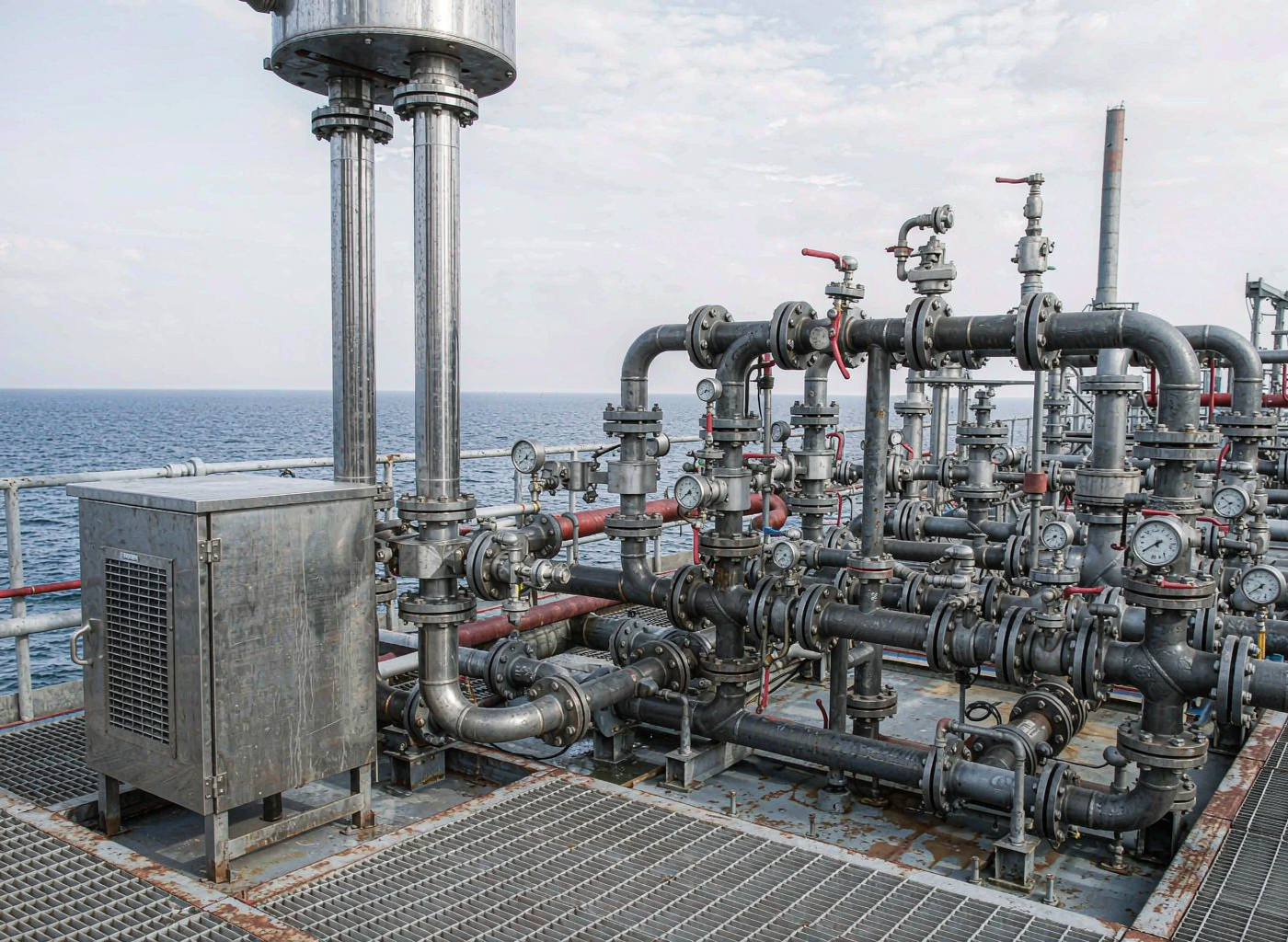
Wellhead systems are the heart of every offshore oil and gas platform. Mud lines, cementing lines, choke lines and kill lines all depend on high-pressure piping that routinely sees design pressures of 50–100 MPa. The material of choice for these lines is AISI 4130 chrome-moly steel — and for good reason: it combines high strength, decent toughness and reliable hardenability after quenching and tempering.
But the same service environment that makes these lines critical also makes them unforgiving. Piping on a modern drilling platform must survive pulsating pressure loads, seawater corrosion on the outside, sour-service exposure inside, and design service temperatures down to −20 °C. Compliance spans a stack of codes: ASME B31.3 for process piping, ASME BPVC Section IX for welding qualification, API Spec 16C and 16A for drill-through and choke/kill equipment, NACE MR0175 for H2S service, and the ABS MODU rules for the class Society.
Welding Procedure for AISI 4130 High Pressure Piping of Offshore Platform, a technical paper published by engineers of CSSC Huangpu Wenchong Shipbuilding together with the American Bureau of Shipping in Guangdong Shipbuilding (2015, No. 6), documented exactly how this challenge was solved for an R-550D platform. The lessons from that qualification campaign remain a solid template for any fabricator welding 4130 today. Below we walk through the procedure, the reasoning behind every step, and the mechanical test results that proved it out.
Weldability: Why AISI 4130 Demands Respect
AISI 4130 is supplied under ASTM A519 and sits outside the ASME material catalogs. It is a medium-carbon Cr-Mo steel used in the quenched-and-tempered (Q&T) condition, with a carbon equivalent (CE) and crack-susceptibility parameter Pcm that typically exceed 0.4%. In practical terms, that means a pronounced hardening tendency in the heat-affected zone and a real risk of cold (hydrogen-induced) cracking.
Cold cracking in high-strength steel weldments is governed by three factors:
- Diffusible hydrogen in the weld metal;
- Hard microstructure — untempered martensite formed in the HAZ and weld; and
- Restraint stress across the joint.
The continuous-cooling-transformation (CCT) diagram for 4130 pipe explains the metallurgical strategy. At different cooling rates, the same joint can solidify into martensite, bainite or pearlite with very different properties. By slightly increasing heat input and holding time, a fabricator can shift the transformation away from brittle martensite toward bainite and pearlite, raising the toughness and ductility of the joint without sacrificing strength.
Baseline Mechanical Properties of Q&T AISI 4130 Pipe
The pipe used on the R-550D lines, tested in the quenched-and-tempered condition, showed the following properties:
| Yield strength (Rp0.2) | Tensile strength (Rm) | Elongation (A) | Reduction of area (Z) | Hardness (HRC) |
|---|---|---|---|---|
| 625 MPa | 774 MPa | 26% | 64% | 19–20 |
Step 1: Filler Metal Selection for H2S Service
When 4130 piping carries H2S-bearing media, sulfide stress cracking (SSC) becomes the governing threat. To prevent stress-corrosion cracking and satisfy ABS MODU and NACE requirements, the qualification campaign selected low-hydrogen, low-nickel alloy consumables with weld-metal nickel content below 1%.
After repeated trials, the winning combination was a GTAW (TIG) root pass plus SMAW fill and cap, using OK 55 TIG wire for the root and an E10018-D2 type (Hoballoy 10018D2) low-hydrogen electrode for fill and capping. All-weld-metal properties:
| Consumable | Yield strength (MPa) | Tensile strength (MPa) | Elongation (%) | Impact energy |
|---|---|---|---|---|
| TIG wire (OK 55) | 680 | 750 | 27 | 69 J @ −60 °C |
| Electrode (Hoballoy 10018D2) | 674 | 754 | 24 | 42 J @ −52 °C |
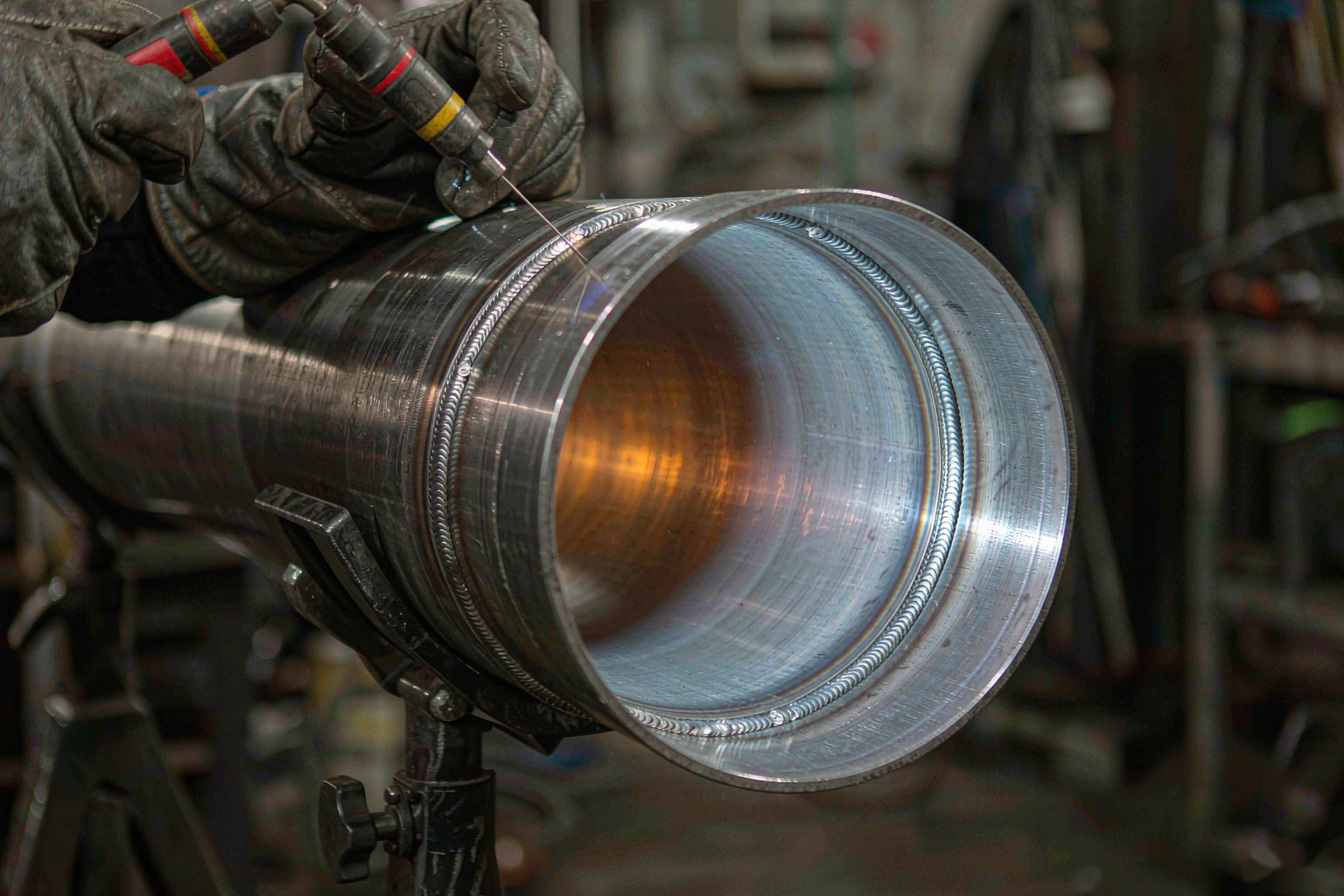
The TIG root gives full-penetration, clean internal bead profiles that are easy to inspect — essential for high-pressure service — while SMAW fill passes build strength quickly with basic, low-hydrogen coverage.
Step 2: Preheat and Interpass Temperature Control
Preheat is the first defense against cold cracking. Its main job is to raise the T100 parameter of the weld thermal cycle, giving diffusible hydrogen time to escape from the joint before it can do damage. Working from the thickness-versus-preheat guidance in Table 3.2 of AWS D1.1, the campaign set the preheat window at 150–230 °C, with a hard rule that interpass temperature must never fall below the preheat range while welding continues.
Step 3: Post-Weld Heat Treatment (PWHT)
PWHT serves two purposes at once: it drives residual hydrogen out of the weld, and it tempers both the HAZ and weld metal, restoring toughness. Requirements in Table 331.1.1 of ASME B31.3 and ASME Section IX point the way for 4130, and the adopted cycle was:
- Heating rate: 150 °C/h (from 400 °C up to soaking temperature);
- Soak: 620 °C ± 20 °C for 2 hours;
- Controlled cool-down: 150 °C/h down to 200 °C, then air cool.
The slow, controlled ramp on both ends is what prevents thermal stress from reintroducing the very cracking risk the treatment exists to remove.
Step 4: Groove Fit-Up
Root gap was controlled at 2–4 mm with a 60° groove angle. Overwide bevels and misalignment were treated as defects in their own right — both invite incomplete fusion, slag entrapment and lack of penetration in the root, the classic failure initiation points in high-pressure pipe welds.
Step 5: Heat Input Control
High-strength steel is sensitive to heat input, and 4130 is no exception. Too much heat coarsens the HAZ grains and drops impact toughness and crack resistance; too little accelerates cooling, pushing the joint toward as-quenched martensite and raising crack tendency. Drawing on prior experience with specialty steels and filler-metal supplier data, the qualified parameters were:
| Process | Pass | Diameter (mm) | Current (A) | Voltage (V) | Travel speed (cm/min) | Heat input (kJ/cm) |
|---|---|---|---|---|---|---|
| GTAW | Root | 2.4 | 102–134 | 13–15 | 5 | 15.9–24.1 |
| SMAW | Fill | 3.2 | 101–113 | 23–25 | 5–7.5 | 18.6–23.5 |
| SMAW | Cap | 3.2 | 101 | 23 | 8.2–8.5 | 16.4–17.5 |
Welding Procedure Qualification: The Proof
The procedure was qualified under ABS MODU Rule (2014), ASME Section IX (2013) and ASME B31.3 (2013). Because the platform’s design service temperature is −20 °C — and API Spec 16C and 6A call for test temperatures of −29 °C where service temperature ranges from −29 °C to 121 °C — all toughness testing was performed at −29 °C. Results:
| Test | Result | Requirement | Verdict |
|---|---|---|---|
| Transverse tensile (2 specimens) | 739 / 745 MPa | ≥ 724 MPa | Pass |
| Side bend (4 specimens) | No cracks | Cracks/indications ≤ 3 mm | Pass |
| Charpy V-notch @ −29 °C (5 sets) | WM face: 62/64/68 J; WM root: 62/49/51 J; FL: 70/100/80 J; FL+2: 69/71/70 J; FL+5: 100/111/104 J | ≥ 34 J | Pass |
| Macro examination (3 specimens) | No defects | No cracks, no undercut | Pass |
| Hardness traverse (1 specimen) | Average HRC 20 | Max HRC 22 | Pass |
Every parameter landed inside the code acceptance window, confirming that the qualified welding procedure was sound and production-ready.
Key Takeaways for AISI 4130 Piping Fabricators
- Fight hydrogen on every front: low-hydrogen basic consumables, correct preheat (150–230 °C for 4130), and PWHT that actually bakes the joint.
- For H2S service, keep weld-metal nickel below 1% and follow NACE MR0175 alongside ABS MODU requirements.
- GTAW root + SMAW fill is a proven, inspection-friendly combination for 4130 high-pressure lines.
- Hold the heat input window: roughly 16–24 kJ/cm balanced the cold-cracking risk against HAZ grain coarsening.
- Don’t skip PWHT discipline: 150 °C/h up, 620 °C ± 20 °C × 2 h, 150 °C/h down to 200 °C.
- Test at the code-mandated temperature — −29 °C Charpy per API 16C/6A — not merely at the design temperature.
The campaign closed with hardness testing and NDT on every completed spool of the R-550D high-pressure piping system — and not a single weld defect was found. That is what a disciplined, qualified procedure buys you.
Source AISI 4130 Pipe from a Qualified Manufacturer
Hunan Shunfu Metal Material Co., Ltd. is an API Q1 certified manufacturer of seamless steel pipe and CRA tubing for oil and gas service, including alloy grades such as AISI 4130 in the quenched-and-tempered condition. For enquiries about 4130 pipe supply, third-party testing to ASTM A519 or project-specific requirements, contact our sales team — we respond to RFQs within 24 hours.