The short answer
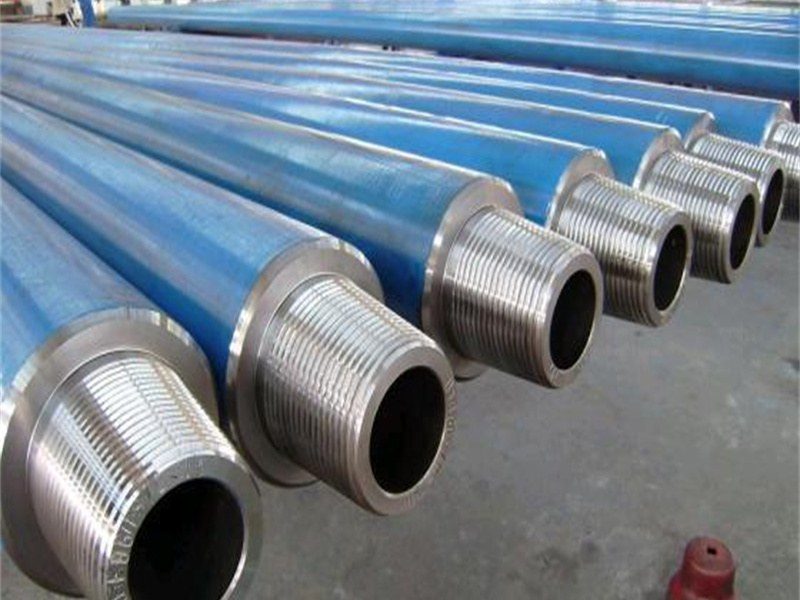
A hollow bar is not a bar with a hole in it — it is a decision about where the material is removed and who removes it. Buying a pre-drilled hollow bar cuts the machining cycle, removes the largest single source of scrap in drill collar production, and moves the risk of a deep-hole drift from your shop to the mill. It pays from roughly 200 mm outside diameter upward, on parts where the bore is large and central. Below that, or on short runs, a solid bar is still the cheaper route.
Most downhole tools start life as a solid round bar and lose a large fraction of their mass before they ever see service. Drill collars, MWD housings, jar bodies, stabiliser bodies and motor housings are all thick-walled tubes in the finished part, and every kilogram that ends up as chips was first bought at alloy steel prices, then forged, then heat treated, then cut away.
Deep-hole drilling is the operation that does the cutting. Understanding what it can and cannot hold — and where the economics turn — is the difference between a hollow bar that saves money and one that creates a scrap part with a straightness problem.
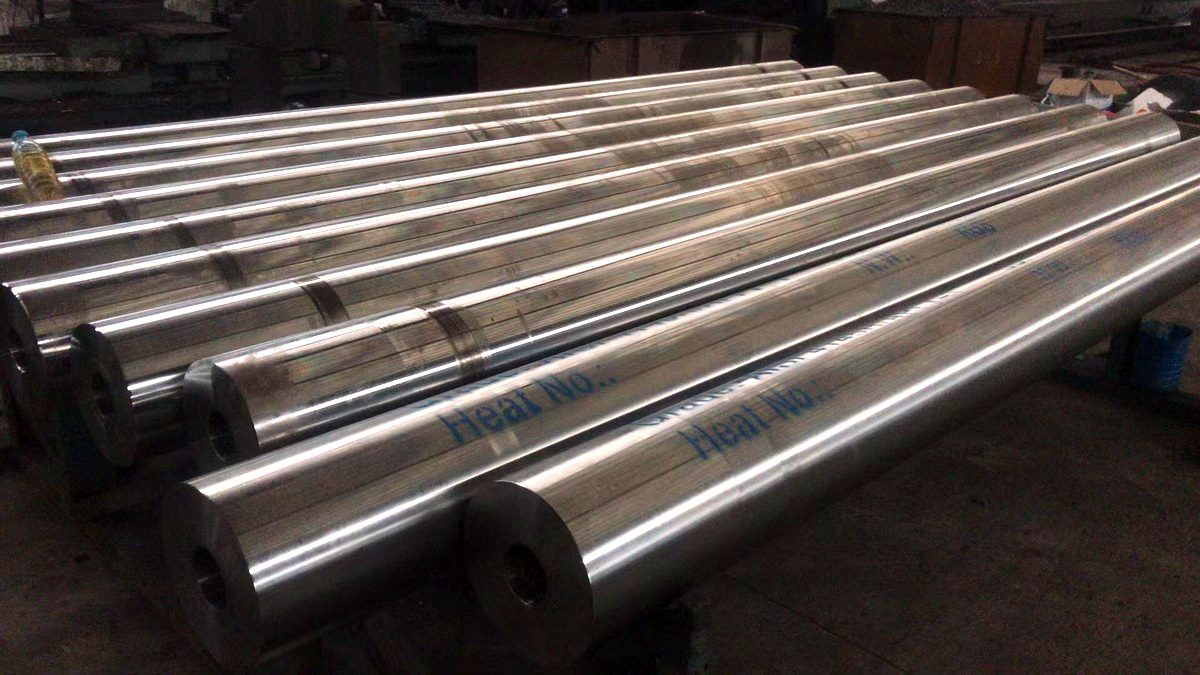
What a Hollow Bar Actually Saves
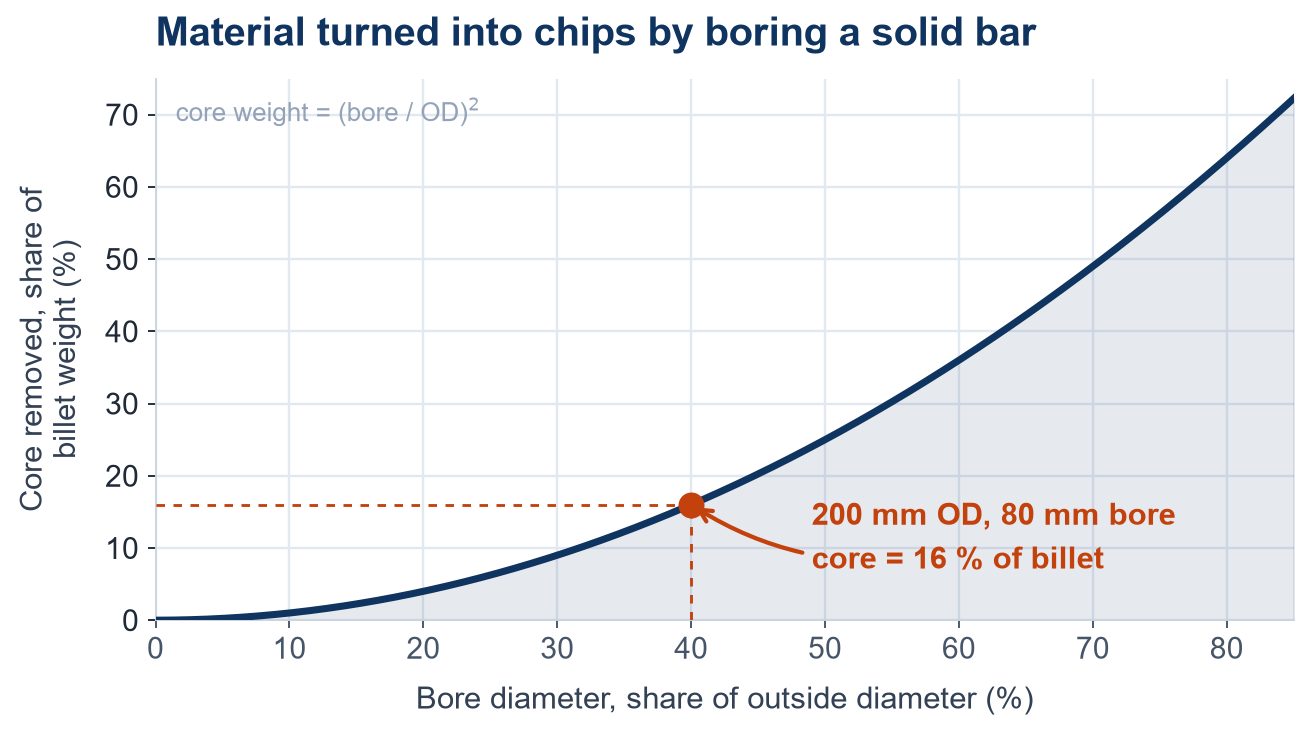
Take a representative drill collar blank: 200 mm outside diameter, 6 m long, with an 80 mm bore through it. As a solid bar that billet weighs about 1,480 kg. The material removed to create the bore is about 237 kg — 16 % of the purchase, converted to chips, plus the machine time to remove it.
| Route | Material bought | Material to chips | Deep-hole operation |
|---|---|---|---|
| Solid bar, bored in-house | 1,480 kg | ~237 kg (16 %) | Full-depth bore, in your shop |
| Pre-drilled hollow bar | ~1,243 kg | Finishing allowance only | Already done, to a stated tolerance |
Three savings follow, and they are not equal in value. The material saving is the smallest and the easiest to see. The machine-hour saving is larger, because deep-hole drilling is slow — a single boring pass through 6 m of alloy steel occupies a machine for a long time, and that machine is usually the constraint in a shop making downhole tools. The third saving is the one buyers underestimate: the risk of a drift. A bore that wanders 3 mm off centre over 6 m cannot be recovered by machining the OD, because the wall will go undersize on one side. That part is scrap, and the cost of one scrapped 6 m blank exceeds the material saving on several good ones.
Where the Saving Disappears
Hollow bar is not automatically cheaper. Four situations push the economics back to solid:
- Small bores. Below roughly 25 mm, the hole is a gun-drilling job rather than a BTA job, and the stock removal is small enough that pre-drilling adds cost without removing much work.
- Thin walls. A tube with a wall under about 12–15 mm is prone to ovality and vibration during drilling, and to distortion during any subsequent heat treatment. The tolerance you need may not be achievable in the hollow form.
- Short runs and one-offs. Pre-drilled hollow bar is a mill product with a mill lead time. If the part is a single piece and the shop has a boring machine idle, boring it in-house is faster than ordering.
- Parts where the bore is not central or not round. Eccentric bores, keyways, and non-circular internal profiles are not deep-hole drilling work at all — they are machined features.
BTA Drilling: The Process Behind the Product
Two processes dominate deep-hole work, and they are not interchangeable. Gun drilling uses an external coolant supply through the drill body and is the standard for small diameters, typically under about 20 mm. BTA (boring and trepanning association) drilling reverses the flow: cutting oil is pumped through the space between the drill tube and the bore wall, and the chips return through the centre of the tool. The reversed flow is what allows BTA to cut much larger diameters at much higher penetration rates, and it is the reason a 200 mm bore through 6 m of alloy steel is a routine job rather than an exotic one.
BTA also enables trepanning, which cuts an annulus and leaves a solid core. On very large diameters or on expensive grades, the core can be recovered and used for smaller parts — a genuine material saving on top of the one the hollow form already delivers.
The limits are physical. As depth-to-diameter ratio rises, chip evacuation becomes harder, the drill tube deflects more, and the bore drifts further from the axis. This is why the tolerance that matters on a hollow bar is not the diameter — diameters are easy — but the position of that diameter relative to the outside surface.
The Four Tolerances That Decide Acceptance
| Tolerance | What it controls | Why it matters downstream |
|---|---|---|
| Wall thickness variation | Difference between maximum and minimum wall around the circumference | Sets the minimum wall left after OD machining; a wall that is thin on one side limits how much the OD can be cleaned up |
| Concentricity / bore runout | Offset of the bore axis from the OD axis | Determines whether the finished part can be machined symmetrically; the usual cause of scrap on long blanks |
| Straightness | Deviation along the length | Affects threading alignment and the ability to pass internal tools; typically specified as a ratio such as 1:1000 |
| Internal surface finish | Roughness and tearing in the bore | Affects fatigue initiation, and whether honing is needed before the part goes into service |
A hollow bar quotation that states only "OD 200 / ID 80" is not a specification. The four numbers above are what decide whether the bar can be made into the part — and the one to ask for first is wall thickness variation, because it silently consumes OD machining allowance.
Which Grade for Which Hollow Bar
| Grade | Typical hollow bar duty | Reason |
|---|---|---|
| AISI 4140 | Drill collar blanks, BOP components, valve bodies | The default: hardens through moderate walls, machines well, widely available |
| 4145H MOD | Drill collars to API 7-1, MWD/LWD housings | Higher hardenability and fatigue resistance than 4140; the grade most drill collar specs call out |
| 4330V | High-strength drill collars, jar bodies, HWDP, tool joints | 135–155 ksi with Charpy toughness that 4140 cannot hold at the same strength |
| 8630 mod | Heavy wellhead and subsea housings with a bore | Deep hardening in very large sections; the hollow form removes the core that would harden least |
There is a metallurgical argument for the hollow form that rarely appears on a cost sheet: the core is the part of a heavy section that hardens least. Removing it removes the region where hardness, toughness and ultrasonic soundness are hardest to guarantee. On a very large forging, a hollow bar can therefore be a higher-integrity product than a solid block of the same grade, not just a cheaper one.
Drill First or Heat Treat First
Both sequences are used, and the choice is a trade, not a rule.
Drill after quenching and tempering is the common route for drill collars. The bar is hardened and tempered as a solid, then the bore is cut. The advantage is that the bore is machined in a stable, already-transformed structure, and the finished wall has the intended tempered martensite throughout. The disadvantage is that deep-hole drilling removes the hardened surface from the bore, and the drilling operation itself leaves residual stress in the wall.
Drill before heat treatment is used where the bore is large and the wall thin, because a thin wall quenched from solid is more likely to distort than a pre-bored one. The risk moves to the quench: a tube with a large bore can ovalise, and the bore may need to be finished after heat treatment anyway.
Either way, one rule holds: if the part will be stress relieved or re-tempered after drilling, say so at the quotation stage. A hollow bar dimensioned for the as-drilled condition and then put through a furnace will not hold its tolerances.
What to Specify on the Enquiry
- Grade and strength class (for 4330V, state 135 / 150 / 155 ksi)
- Outside diameter, inside diameter, and total length — with the finished part dimensions alongside, so the machining allowance can be checked
- Wall thickness variation, concentricity and straightness, each with a number
- Internal surface requirement, and whether honing is included
- Delivery condition: quenched and tempered, normalised, or as-rolled
- Whether UT is required on the bore region and to what acceptance level
- Certificate type, and whether third-party witness is needed
ShunFu Metal produces pre-drilled hollow bar in 4130, 4140, 4145H MOD, 4330V and 8630 mod, with in-house BTA boring, pull boring, skiving and honing, OD turning and CNC machining, in outside diameters from 76.2 mm to 279.4 mm, inside diameters from 25.4 mm to 101.6 mm, and lengths to 15 m. Send the finished part drawing and we will quote the hollow form against it, including the machining allowance the bore tolerance leaves you.
Frequently Asked Questions
How much material does a hollow bar actually save?
It depends entirely on the bore-to-OD ratio. On a 200 mm bar with an 80 mm bore, the removed core is about 16 % of the billet weight. On a thin-walled housing the figure can exceed 40 %. The saving that usually matters more is machine time, because deep-hole drilling occupies a machine for hours per piece.
What is the maximum length available?
For the 4145H MOD hollow bar range, up to 15 m in a single piece. Beyond that, lengths are joined or the part is redesigned — deep-hole drilling accuracy degrades as the depth-to-diameter ratio rises, so very long thin bores are a different engineering problem.
Can a hollow bar be supplied in the quenched and tempered condition?
Yes, and that is the normal delivery condition for drill collar grades. The important detail is the sequence: if the bore is drilled after quenching and tempering, the finished wall retains the tempered martensite structure. If it is drilled before, the heat treatment comes after and the bore may need re-finishing.
Is a hollow bar better than a solid bar for a large forging?
Often yes, for a reason that is metallurgical rather than economic. In a very heavy section the core is the region that hardens least and is hardest to inspect. Removing it removes the weakest part of the block, so the remaining wall is more uniformly hardened and more easily verified by ultrasonic testing.
Related Reading
- 4145H MOD pre-drilled hollow bar — sizes, BTA capability and API 7-1 compliance
- AISI 4140 hollow bar — the general-purpose grade for collars and BOP parts
- AISI 4330V hollow bar — 135–155 ksi with the toughness to match
- Through-hardening in heavy sections — why the grade choice and the hollow form are the same decision
- Drill collar specification — what API 7-1 fixes, and the six clauses it leaves to the purchase order