The short answer
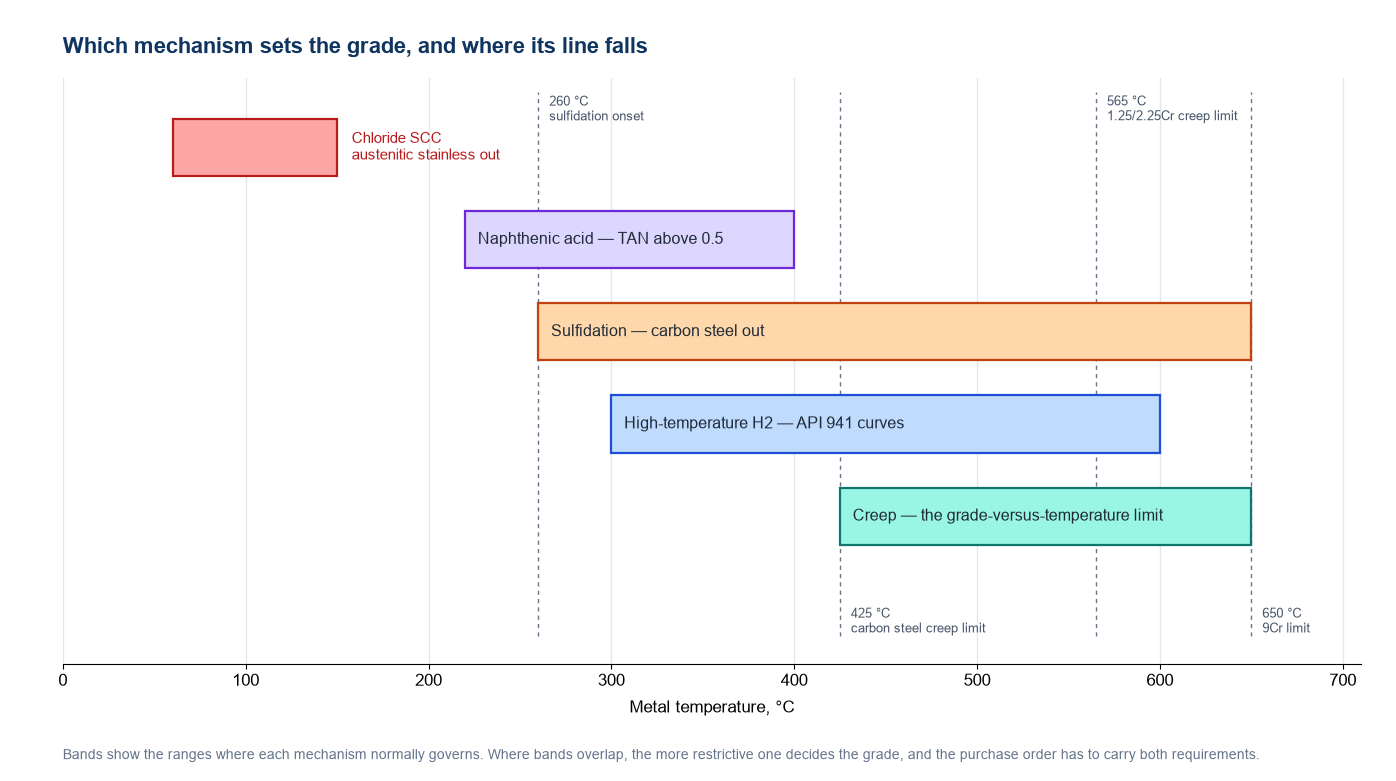
Refinery steel is not selected by temperature. It is selected by damage mechanism, and each mechanism draws its own line: sulfidation pushes carbon steel out at about 260 °C, high-temperature hydrogen attack is governed by the API 941 Nelson curves, polythionic acid SCC eliminates sensitised 304 and 316 during shutdown, and chloride SCC ends the austenitic stainless family at roughly 60 °C in wet chloride service. The grade follows from which of those lines the service crosses. A 2.25Cr forging is not chosen because it is “better” than 1.25Cr — it is chosen because a curve in API 941 says the 1.25Cr curve has been crossed.
Ask three engineers what grade a refinery line should be and you will get three answers, because each one is answering a different question. The piping engineer is looking at a corrosion allowance table. The metallurgist is looking at a Nelson curve. The inspection engineer is looking at what failed last turnaround. All three are right, and none of them is looking at the number that actually decides the order: the mechanism that will consume the wall first.
This page maps the six mechanisms that drive most refinery and petrochemical grade selection onto the Cr-Mo and stabilised austenitic families supplied as bar, forging and tube. It is written for the person who has to write a purchase order, not for the person writing a design basis — which is why every row ends in a grade and a document rather than a corrosion rate.
Six Mechanisms, Six Different Lines
The mechanisms are not interchangeable and they do not stack neatly. A hydrotreater reactor sees hydrogen attack and temper embrittlement at the same time and is solved with one grade. A crude unit overhead sees chloride SCC and wet H2S at ambient temperature and is solved with materials that would be absurd in the reactor. What follows is the short form of each.
| Mechanism | The line it draws | First grade that answers it |
|---|---|---|
| Sulfidation H2S plus H2 at temperature |
Carbon steel is generally acceptable below about 260 °C (500 °F); the rate rises steeply above it and with velocity | 5Cr (F5) for moderate, 9Cr (F9/F91) for high temperature or high velocity |
| High-temperature hydrogen attack H2 partial pressure plus temperature |
Read directly from the API 941 Nelson curve for the grade | 1.25Cr (F11), then 2.25Cr (F22), then 2.25Cr-1Mo-V or 9Cr |
| Temper embrittlement Long hold at 350–575 °C, plus P, Sn, Sb, As |
Applies to 2.25Cr-1Mo and similar; measured by J-factor and step cooling | The same grade with a composition limit, or 2.25Cr-1Mo-V |
| Creep Stress plus temperature over time |
Carbon steel to about 425 °C, 1.25Cr and 2.25Cr to about 565 °C, 9Cr to about 650 °C | F22, then F91, then 347H for tube metal |
| Polythionic acid SCC Moisture plus sulfur deposits during shutdown |
Hits 304 and 316 after welding or long service in the sensitising range | 321 or 347 stabilised, or a low-carbon grade, plus a wash procedure |
| Chloride SCC Chlorides plus tensile stress plus temperature |
Austenitic 300-series becomes vulnerable above roughly 60 °C in wet chloride | Duplex 2205 or 2507, or a nickel alloy where the temperature keeps rising |
| Wet H2S: SSC, HIC, SOHIC Aqueous H2S at ambient to moderate temperature |
Hardness and weld hardness, not grade; HIC resistance is a steel cleanliness property | Carbon steel with PWHT to 22 HRC max, HIC tested per NACE TM0284 |
| Naphthenic acid TAN above about 0.5 mg KOH/g, 220–400 °C |
Attacks carbon steel and low-Cr steels; independent of H2S | 316L or 317L for moderate duty, 9Cr where velocity and TAN are both high |
Two of those rows are often quoted as if they were the same thing. Sulfidation and high-temperature hydrogen attack are different mechanisms with different curves, and a line can be safe on one and unsafe on the other. Hydrogen attack is a reaction between dissolved hydrogen and carbides inside the steel; sulfidation is a corrosion reaction at the surface. A 1.25Cr steel that is perfectly adequate for sulfidation at 350 °C may still be outside its Nelson curve at the hydrogen partial pressure of the same stream.
The Cr-Mo Ladder, With Numbers
The five grades below account for most of the refinery forging and bar demand between carbon steel and the stainless family. The mechanical values are ASTM A182 minimums; the hardness windows matter as much as the strength, because the upper bound on a 2.25Cr forging is what keeps it weldable and what the fabrication shop will argue about.
| Grade | UNS | Cr / Mo, % | Tensile / yield, ksi | Hardness, HBW | Where it is specified |
|---|---|---|---|---|---|
| F12 Class 2 | K11562 | 0.80–1.25 / 0.44–0.65 | 70–95 / 40 | 143–207 | Boiler and refinery fittings, low-pressure steam |
| F11 Class 2 | K11572 | 1.00–1.50 / 0.44–0.65 | 70–95 / 40 | 143–207 | Refinery piping, wellhead bodies, moderate H2 |
| F22 Class 3 | K21590 | 2.00–2.50 / 0.87–1.13 | 75–100 / 45 | 156–207 | Hydroprocessing, hydrocracker, high-temperature H2 |
| F5 | K41545 | 4.00–6.00 / 0.40–0.65 | 70–95 / 40 | 143–217 | Sulfidation service, valve trim, transfer lines |
| F9 | K90941 | 8.00–10.00 / 0.90–1.10 | 85–110 / 55 | 179–217 | Higher-temperature sulfidation, heater tubes and fittings |
| F91 Type 1 | K90901 | 8.00–9.50 / 0.85–1.05 | 85–110 / 60 | 190–248 | Main steam, high-temperature headers, creep-limited piping |
F91 carries vanadium and niobium with controlled nitrogen, which is why its yield minimum sits 15 ksi above F9 at a similar chromium level. That strengthening is also why F91 cannot be treated as “9Cr with a different name”: the welding procedure, the preheat, the post-weld heat treatment window and the hardness ceiling are all different, and a shop that has qualified a 9Cr-1Mo procedure has not qualified a 91 procedure.
Why 2.25Cr Became the Workhorse
F22 sits at the intersection of three curves. It is inside the Nelson curve for the hydrogen partial pressures of most hydrotreating and hydrocracking service. It has enough chromium to hold up in sulfidation where carbon steel and 1.25Cr will not. And it is still fabricable — forgeable, weldable with preheat and PWHT, and available in the section sizes that reactor shells and heavy valve bodies need.
Above it, 9Cr and the vanadium-modified grades buy temperature and creep strength at the cost of a much narrower process window. Below it, 1.25Cr is cheaper and easier but runs out of hydrogen resistance earlier. The reason refinery projects spend so much time arguing about 1.25Cr versus 2.25Cr is that the answer is not a preference; it is a point on a chart that one side has read and the other has not.
Temper Embrittlement: The Test Nobody Orders
A 2.25Cr-1Mo forging that passes every room-temperature tensile test can still fail on a step-cooling specimen, because temper embrittlement is not a strength problem. It is a grain-boundary segregation problem: phosphorus, tin, antimony and arsenic migrate to prior austenite grain boundaries during long service in the 350–575 °C range, and the Charpy transition temperature climbs while every other number on the certificate stays the same.
The industry controls it two ways. The first is composition: the J-factor, built from the residual elements, is limited on the heat analysis, and the X-factor is used for the same purpose in heavy-wall vessel steel. The second is the step-cooling test, which simulates the segregation in a few days and then measures the shift in impact transition temperature. Both are specified on the purchase order, and neither happens unless someone writes them there.
The practical consequence for a buyer is simple. If a 2.25Cr forging is going into a hydrocracker or a reactor that will run for twenty years at 400 °C, the specification has to say so, because the mill’s default certificate will not. If the service is short or the temperature is low, the test is money spent for nothing — which is why the question belongs in the design basis, not in the mill’s inbox.
Polythionic Acid SCC: Why 347H Exists
Polythionic acid forms when sulfur deposits on the inside of a steel surface meet moisture and oxygen during a shutdown. On a sensitised austenitic stainless steel — one that has been held in the 425–815 °C range long enough for chromium carbides to precipitate at the grain boundaries — the result is intergranular cracking that can run through a wall in days.
There are three defences and refineries usually use two of them. The metallurgical defence is to stabilise the steel with titanium or niobium, which ties up the carbon as a carbide that does not deplete the grain boundary: 321 uses titanium at roughly five times the carbon content, 347 uses niobium plus tantalum at roughly ten times, and the H grades raise carbon for creep strength while keeping the stabiliser ratio. The operational defence is an alkaline wash during shutdown, normally a sodium carbonate solution, carried out to a written procedure. The third is to use a low-carbon grade such as 304L or 316L where strength allows.
This is why the tube specification for a heater or a transfer line often reads TP347H rather than 316H, even though both are austenitic and both are available. The difference is not corrosion resistance in service. It is what happens on the day the unit is opened.
Chloride SCC: The 60 °C Line
Austenitic stainless steels under tensile stress crack in the presence of chlorides and moisture above roughly 60 °C. The exact threshold depends on chloride concentration, oxygen, stress level and alloy, which is why the number is quoted as a band rather than a limit — but the direction is not in dispute: as temperature rises, the chloride concentration needed to crack falls.
Duplex stainless steels were developed around this problem. Ferrite plus austenite resists chloride SCC far better than either phase alone, and 2205 covers a large part of the refinery’s wet chloride duty. Above about 150 °C, or where chlorides and H2S combine, super duplex or a nickel alloy takes over. The choice is not about corrosion rate; it is about whether the material can crack at all.
The trap for a buyer is that the failed part is usually not the pipe. It is the instrument fitting, the small-bore valve, the thermowell or the sample point — components bought on a generic stainless specification by someone who was not in the materials meeting. That is why a refinery’s material selection diagram lists small-bore and instrument items separately, and why the same 316L that is correct at 40 °C is wrong at 90 °C.
Wet H2S: A Hardness Specification, Not a Grade
Sour service at ambient to moderate temperature is governed by NACE MR0175/ISO 15156, and for carbon and low-alloy steels the controlling requirement is hardness, not chemistry. The usual ceiling is 22 HRC (250 HB), achieved by heat treatment and verified by a hardness survey of the base metal, the heat-affected zone and the weld.
Hydrogen-induced cracking is a different problem with a different test. It depends on inclusions and centreline segregation in the steel, so it is controlled by steelmaking practice and verified by a NACE TM0284 test in a standard solution. A steel can pass the hardness requirement and fail the HIC test, which is why wet sour service often specifies both and why the plate or bar purchase includes a cleanliness requirement that has nothing to do with strength.
What the Purchase Order Must Carry
Most refinery material disputes are not about the grade. They are about the condition, and the condition lives in clauses that are easy to leave out.
- Standard, grade and class. A182 F22 Class 3 is not the same order as A182 F22; the class sets the tensile and hardness window.
- Heat treatment condition. Normalised and tempered, annealed, or quenched and tempered, with the temperature range stated.
- Hardness. Maximum, minimum, or both, and where it is measured.
- Residual element control. J-factor or X-factor limits for 2.25Cr, and the step-cooling test if the service requires it.
- Grain size. Usually ASTM 5 or finer for forgings, and a stated test method.
- Non-destructive examination. Ultrasonic examination of forgings, magnetic particle or dye penetrant of machined surfaces, and the acceptance level.
- Product analysis and PMI. Whether the certificate is 3.1 or 3.2, and whether the buyer witnesses PMI.
- Sour service. NACE MR0175 stated explicitly, with the H2S partial pressure and the hardness survey requirement.
None of these clauses makes the steel better. They make the certificate match the design basis, which is the only thing that matters when an inspector asks why a 22-year-old forging has a hardness of 240 HB and the file says 207 maximum.
Frequently Asked Questions
Is 2.25Cr always better than 1.25Cr?
No. It is more resistant to hydrogen attack and sulfidation, and it is harder to weld, harder to keep within a temper-embrittlement specification and more expensive. Below the 1.25Cr Nelson curve and below the sulfidation range, the extra chromium buys nothing.
Why does F91 have a higher yield than F9 at similar chromium?
Vanadium, niobium and controlled nitrogen. F91 is a micro-alloyed 9Cr steel, and the strengthening comes from fine MX precipitates. The same alloying is why its welding and heat treatment window is narrower than F9’s.
Can 316L be used in a chloride stream?
Only below the temperature and concentration where chloride SCC becomes credible — roughly 60 °C for wet chloride service, and lower as concentration rises. Above that, duplex or a nickel alloy is the answer, not a thicker wall.
What is the difference between 347 and 347H?
Carbon content. 347H carries 0.04–0.10 % carbon for creep strength at high temperature, with the niobium-plus-tantalum addition still tied to the carbon level. 347 is the lower-carbon version for general corrosive service where creep is not the design case.
Does a 3.1 certificate prove the steel is correct for the service?
No. It proves the heat matches the order. Whether the order matched the design basis is a separate question, and it is the one that decides whether the part survives the turnaround.
Related Reading
- A182 F22 (2.25Cr-1Mo) forged bar for hydrogen service — the workhorse grade, its class options and the hardness window
- A182 F11 (1.25Cr-0.5Mo) forged bar — the first step off carbon steel, and where it stops
- A182 F91 (9Cr-1Mo-V) forging and seamless tube — creep-limited high-temperature duty
- TP321H and TP347H seamless boiler and furnace tube — the stabilised grades behind polythionic acid resistance
- 347H stainless steel bar — the same stabilised chemistry in bar and forging form
- How to set the post-weld heat treatment temperature for T/P91 — the PWHT window that decides whether a 9Cr weld is acceptable
- Where 13Cr stops: the CRA grade ladder — the upstream equivalent of this page, for wells rather than units