
ASTM A182 F22 is a 2.25Cr-1Mo forged alloy steel standardized under ASTM A182/A182M for forged or rolled pipe flanges, forged fittings, valves, and parts for high-temperature service. Its UNS designation is K21590. The 2.25% chromium and 1.0% molybdenum combination provides superior oxidation resistance and retention of mechanical properties at elevated temperatures compared to 1.25Cr-0.5Mo grades. F22 is widely adopted as an upgrade replacement for AISI 4130 in oilfield wellhead equipment, offering enhanced resistance to sulfide stress cracking (SSC) and high-temperature hydrogen attack. SHUNFU METAL manufactures F22 forged bars from electric arc furnace-melted heats with vacuum degassing, followed by precision open-die forging and controlled quenching to achieve fine-grained bainitic microstructures that meet both Class 1 and Class 3 requirements.
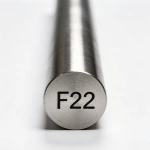
ASTM A182 F22 is a 2.25Cr-1Mo low-alloy forged steel supplied by SHUNFU METAL for wellhead equipment, refinery hydroprocessing units, and high-temperature piping. It is the forged-grade counterpart to A335 P22 seamless pipe, offering combined chromium-molybdenum hydrogen attack resistance (HTHA) and creep strength up to 595°C. Available in two classes, F22 is the preferred forging material for API 6A wellhead connectors, valve bodies, and flanges in sour service where NACE MR0175 compliance is required.
Equivalent & Cross-Reference Grades for F22
| Standard / Designation | Grade / Material | Product Form |
|---|---|---|
| ASTM A182 / ASME SA-182 | F22 Class 1 / Class 3 | Forgings |
| ASTM A335 / ASME SA-335 | P22 | Seamless pipe |
| ASTM A234 | WP22 | Buttweld fittings |
| ASTM A217 | WC9 | Cast valve bodies |
| ASTM A387 | Gr.22 Class 1 / Class 2 | Pressure vessel plate |
| ASTM A213 / A199 | T22 | Heat exchanger tube |
| DIN / EN | 10CrMo9-10 / 1.7380 | Forgings & bars |
| JIS G 3203 / G 3458 | SFVAF22B / STPA24 | Forgings / pipe |
| GB (China) | 12Cr2Mo1 / NB/T 47008 | Forgings |
F22 Applications in Oil & Gas
Wellhead Connectors
Gate Valve Bodies & Bonnets
Casing & Tubing Hangers
Christmas Tree Blocks
Choke Bodies & Stems
Tubing Head Adapters
Compact Flanges
Weld Neck & Blind Flanges
Hydrocracker Flanges
Steam Turbine Rotor Forgings
Refinery Valve Components
Forged Pipe Fittings
F22 Bar Supply Range
SHUNFU METAL supplies ASTM A182 F22 steel in the following forged bar dimensions, produced on our 6,000-ton hydraulic open-die press and GFM radial forging machine:
| Product Form | Diameter / Thickness (mm) | Width (mm) | Length (mm) | Condition |
|---|---|---|---|---|
| Forged Round Bar | 100 – 1,200 | — | 1,000 – 12,000 | N+T or Q+T |
| Hot-Rolled Round Bar | 10 – 500 | — | 3,000 – 9,000 | As-rolled / Annealed |
| Forged Flat Bar | 50 – 500 | 100 – 1,500 | 1,000 – 6,000 | N+T or Q+T |
| Hot-Rolled Flat Bar | 3 – 120 | 20 – 610 | 3,000 – 9,000 | As-rolled / Annealed |
| Forged Rings / Sleeves | OD 200 – 4,000 | Height 50 – 1,000 | Per drawing | Q+T + rough machined |
| Forged Blocks / Discs | Thk 100 – 600 | 200 – 1,500 | 200 – 1,500 | Q+T + machined |
All F22 bars are forged from EAF + LF + VD refined heats at a starting temperature of 1,100–1,200°C with a finishing temperature above 850°C. Forged bars undergo slow cooling in insulated pits to prevent hydrogen-induced flaking. SHUNFU METAL verifies every heat with optical emission spectrometry before release.
Chemical Composition of ASTM A182 F22 (wt.%)
| Element | F22 Class 1 | F22 Class 3 |
|---|---|---|
| Carbon (C) | 0.05–0.15 | 0.10–0.15 |
| Manganese (Mn) | 0.30–0.60 | 0.30–0.60 |
| Phosphorus (P) max | 0.040 | 0.040 |
| Sulfur (S) max | 0.040 | 0.040 |
| Silicon (Si) max | 0.50 | 0.50 |
| Chromium (Cr) | 2.00–2.50 | 2.00–2.50 |
| Molybdenum (Mo) | 0.87–1.13 | 0.87–1.13 |
SHUNFU METAL Controls:
Low residuals: P+S typically ≤0.010% via EAF+LF+VD double refining for Class 3 applications requiring toughness at −29°C.
Tramp elements (Sn, As, Sb, Pb) controlled to ≤0.010% each to minimize temper embrittlement susceptibility.
J-factor = (Si+Mn)×(P+Sn)×10&sup4 ≤ 150 ensures step-cooling embrittlement resistance per API 934 requirements.
Mechanical Properties (ASTM A182)
| Property | Class 1 | Class 3 |
|---|---|---|
| Tensile Strength (min) | 415 MPa (60 ksi) | 515 MPa (75 ksi) |
| Yield Strength Rp0.2 (min) | 205 MPa (30 ksi) | 310 MPa (45 ksi) |
| Elongation in 4D (min) | 20% | 20% |
| Reduction of Area (min) | 35% | 30% |
| Brinell Hardness (max) | 170 HBW | 207 HBW |
Heat Treatment:
Class 1: Normalize ≥900°C + Temper ≥675°C, or Quench ≥900°C + Temper ≥675°C.
Class 3: Quench ≥900°C (oil/water/polymer) + Temper ≥675°C. Tempering must avoid 370–575°C range to prevent embrittlement.
All F22 bars produced by SHUNFU METAL are furnace heat-treated with calibrated temperature uniformity surveys (±10°C) and automated chart recorders, with full-cycle time-temperature data included in each MTC.
NACE MR0175: Max hardness 22 HRC (237 HBW) for sour service when followed by appropriate PWHT proof testing.
Elevated Temperature Strength (typical Q+T): Yield strength at 400°C ≈ 205 MPa; at 500°C ≈ 170 MPa; at 550°C ≈ 140 MPa. Creep rupture strength at 500°C / 100,000 h ≈ 110 MPa.
Certifications: EN 10204 3.1 / 3.2 | API Q1 / ISO 9001 | ISO 14001 | OHSAS 18001 | PED 2014/68/EU Annex I Section 4.3 | NORSOK M-650 QTR | UT per SEP 1921 / EN 10228-3 Class 3 | MT/PT per ASME BPV Section V | Impact at −29°C to −46°C per ASME B31.3 | PWHT documentation per ASME Section VIII Div.2
Need ASTM A182 F22 Steel to the specification above?
Send the size, condition, quantity and any NACE or PMI requirements — we reply with mill availability, lead time and a priced offer, usually within one working day.