
A182 F91 (UNS K90901, W.Nr. 1.4903, also supplied as A213 T91 tube) is a 9% chromium-molybdenum steel micro-alloyed with vanadium and niobium and controlled for nitrogen. The small additions do something large: they raise the allowable stress above 550 °C by roughly 25% compared with Grade 9 or F22, which is why a modern ultra-supercritical unit can run at 600 °C main steam with walls thinner than the previous generation of plants.
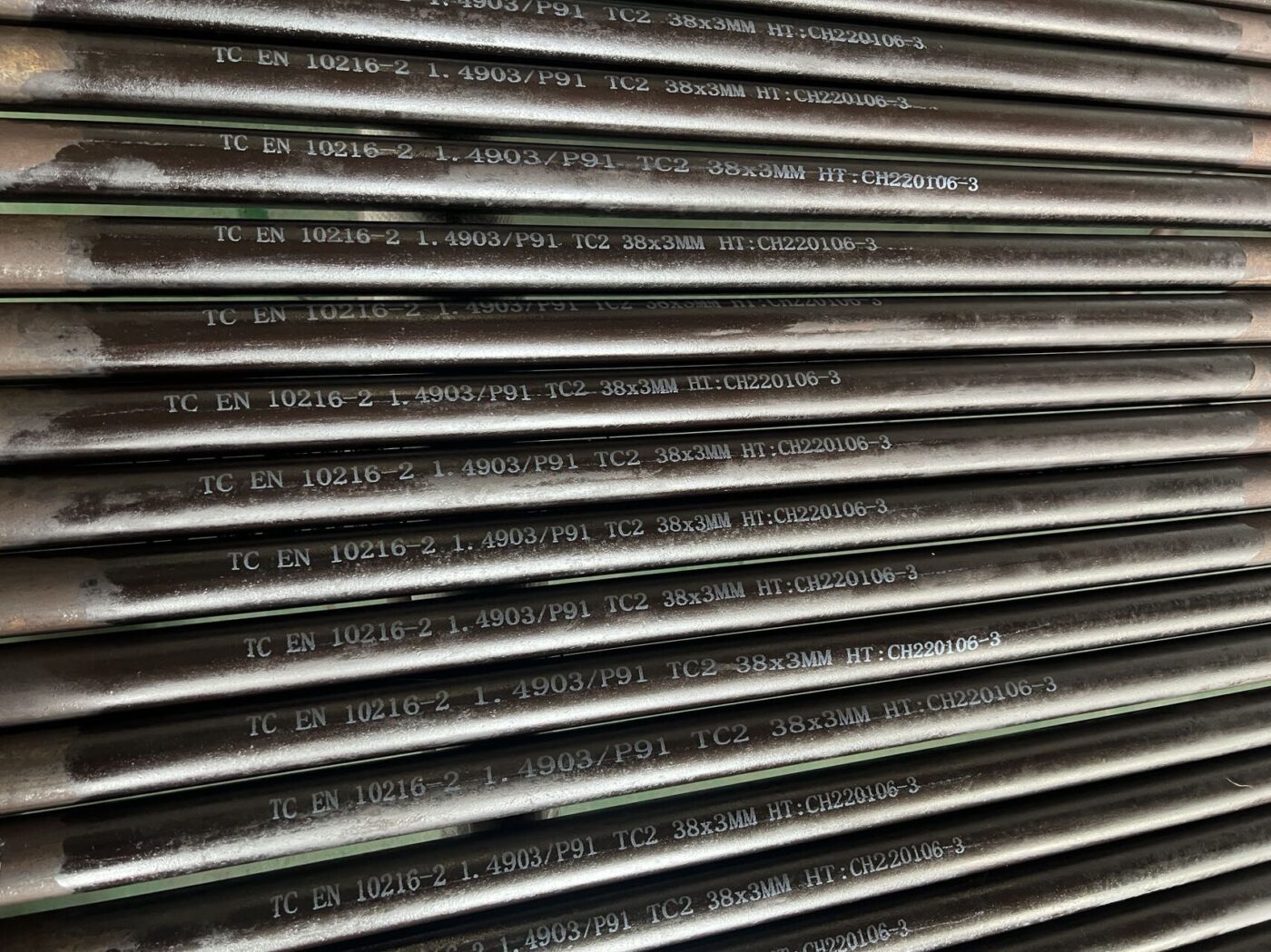
The grade is a modified 9Cr-1Mo steel: carbon is held at 0.08–0.12% — deliberately higher than Grade 9 — while vanadium (0.18–0.25%), niobium (0.06–0.10%) and nitrogen (0.030–0.070%) form fine MX carbonitrides that pin the prior austenite grain boundaries and slow creep damage. The result is a 100,000-hour rupture strength near 68 MPa at 600 °C, against roughly 40 MPa for F22.
For the buyer, the practical consequence is section size. A main steam line designed in F22 at 600 °C needs a wall roughly 40% heavier than the same line in F91, which drives weight, support steel, welding hours and thermal stress during start-up. That is why F91 replaced F22 in supercritical headers and why refinery hydrogen units adopted it for thick-wall outlet piping.
F91 is unforgiving in fabrication. It must be normalised at 1,040–1,080 °C and tempered at 730–780 °C, welded with matching consumables under strict preheat, and post-weld heat treated in a narrow window. A missed tempering step leaves untempered martensite and a hardness above 350 HB, which is a rejection in every specification. We supply forging and tube with hardness mapped across the section and full heat-treatment records.
F91 Equivalent Grades and Product Specifications
The grade appears under different designations by product form: A182 F91 for forging and flanges, A213 T91 for seamless tube, A335 P91 for pipe, A387 Grade 91 for plate, and A234 WP91 for fittings. All share the same chemistry and heat treatment; the mechanical requirements differ slightly between specifications, so the correct one must be named on the order.
In the European system the grade is 1.4903 (X10CrMoVNb9-1) and in the Japanese system STBA 26 / SCMV 28 depending on form. The Chinese equivalent is 10Cr9Mo1VNb (GB/T 5310 for tube).
| System | Designation |
| UNS | K90901 |
| W.Nr. / EN | 1.4903 / X10CrMoVNb9-1 |
| ASTM A182 | F91 — forging, flange, fitting stock |
| ASTM A213 / A335 | T91 tube / P91 pipe |
| ASTM A234 | WP91 wrought fittings |
| JIS | STBA 26 (tube) / SCMV 28 (forging) |
| GB | 10Cr9Mo1VNb |
Where F91 Is Used
Ultra-supercritical boiler headers and manifolds
Outlet headers and connecting pipes operating at 600–620 °C and 26–30 MPa. F91 allows header walls of 60–90 mm instead of 120 mm in F22.
Main steam and hot reheat piping
P91 pipe and WP91 fittings for the high-temperature sections of the steam cycle, where thermal fatigue during two-shift operation governs design.
Refinery hydrogen and hydrocracker piping
Thick-wall outlet lines from hydroprocessing reactors, where the combination of hydrogen partial pressure and 450–550 °C requires both creep strength and resistance to hydrogen attack.
Forged valve bodies and flanges
Main steam isolation valves, NRV bodies and class 2500 flanges, forged and heat treated to A182 F91 with hardness limits on the finished part.
Tube-to-tubesheet joints in heat recovery
T91 tubes in HRSG superheater and reheater bundles, welded to F91 tube sheets with matching filler metal.
Steam drum internals and separators
Internal components exposed to the same steam chemistry, avoiding dissimilar-metal welds between F22 and F91 sections.
Supply Range and Heat Treatment
Forged bars and blocks from 20 mm to 600 mm section; flanges and valve bodies to drawing, up to 3,000 kg per piece; seamless tube from 25 mm to 219 mm outside diameter in wall thicknesses from 3 mm to 30 mm; wrought fittings (elbows, tees, reducers) to A234 WP91.
Heat treatment is normalising at 1,040–1,080 °C followed by tempering at 730–780 °C, with the cooling rate after normalising controlled to avoid free ferrite. Hardness on the finished part should fall between 190 and 250 HB; anything above 250 HB indicates incomplete tempering and is rejected.
Each heat is supplied with chemistry including vanadium, niobium, nitrogen and aluminium (the elements that distinguish F91 from a plain 9Cr steel), room-temperature tensile results, hardness survey, and the actual normalising and tempering records with furnace chart references. Ultrasonic inspection to ASTM A388 or A418, depending on product form, is standard for thick sections.
Chemical Composition of F91 (wt%)
The specification is written tightly around the micro-alloying elements because they carry the creep strength. Vanadium below 0.18% or niobium below 0.06% will still make a 9Cr steel, but it will no longer deliver the 100,000-hour rupture strength that the design assumes — this is the most common substitution risk on the grade.
Nitrogen at 0.030–0.070% must be present; a nitrogen-deficient heat loses the fine carbonitride dispersion. Aluminium is capped at 0.02% because higher levels form aluminium nitride and remove nitrogen from the strengthening reaction, while titanium is capped at 0.01% to avoid coarse TiN particles that act as creep voids.
Residual elements are also constrained: sulphur at 0.010% maximum and phosphorus at 0.020% maximum improve toughness in the weld heat-affected zone, which is where Type IV cracking begins in service.
| Element | Min % | Max % |
| Carbon (C) | 0.08 | 0.12 |
| Manganese (Mn) | 0.30 | 0.60 |
| Silicon (Si) | 0.20 | 0.50 |
| Chromium (Cr) | 8.00 | 9.50 |
| Molybdenum (Mo) | 0.85 | 1.05 |
| Vanadium (V) | 0.18 | 0.25 |
| Niobium (Nb) | 0.06 | 0.10 |
| Nitrogen (N) | 0.030 | 0.070 |
| Nickel (Ni) | — | 0.40 |
| Aluminium (Al) | — | 0.020 |
| Titanium (Ti) | — | 0.010 |
| Phosphorus (P) | — | 0.020 |
| Sulphur (S) | — | 0.010 |
| Iron (Fe) | balance | balance |
Mechanical Properties of F91
Values below are the ASTM A182 F91 requirements for forgings at room temperature; A213 T91 for tube is comparable. The grade is used in the normalised and tempered condition, with no further strengthening treatment available after fabrication.
The high-temperature allowables are what justify the grade: at 600 °C the ASME BPVC allowable stress for F91 is roughly 60% higher than for F22, which is the whole reason a 600 °C header can be built at 90 mm wall instead of 140 mm. Design values must be taken from the current edition of ASME BPVC Section II Part D, not from this page.
| Property (room temperature) | A182 F91 |
| Tensile strength | ≥ 585 MPa |
| Yield strength (0.2%) | ≥ 415 MPa |
| Elongation in 50 mm | ≥ 20% |
| Hardness | 190–250 HB |
Need F91 forging or T91 tube with full heat-treatment records?
Send the section size, quantity, specification (A182, A213, A335 or A234), hardness limits and any impact or step-cooling requirement — we reply with mill availability, lead time and a priced offer, usually within one working day.