
Project Description
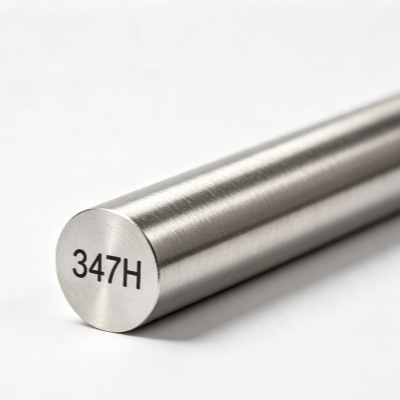
347H (UNS S34709), also designated as 1.4961, X8CrNiNb16-13, and SUS347H, is a niobium-stabilized austenitic stainless steel in the high-carbon (H-grade) variant designed for superior creep strength and long-term microstructural stability at elevated temperatures up to approximately 815°C. The deliberately elevated carbon content (0.04–0.10%) combined with niobium stabilization (10×C minimum) provides effective protection against sensitization and intergranular corrosion during welding while delivering measurably higher allowable design stresses at service temperatures compared to standard 347 — a critical advantage in refinery furnaces, petrochemical heaters, and high-temperature process piping. SHUNFU METAL, certified to ISO 9001:2015 and API Q1, produces 347H bars through controlled electric arc furnace (EAF) melting with AOD refining, precisely calibrating the carbon-to-niobium ratio to ensure effective stabilization and optimized high-temperature performance verified by in-house OES on every heat.
347H Stainless Steel Bar — Overview
347H is the high-carbon evolution of the standard 347 grade, engineered specifically for sustained elevated-temperature service in refinery and petrochemical applications where creep rupture strength governs component life. The niobium (columbium) addition preferentially forms stable niobium carbide (NbC) precipitates during welding and high-temperature exposure, preventing chromium carbide formation at grain boundaries and thereby eliminating the need for post-weld solution annealing — a substantial fabrication cost advantage for complex welded assemblies. The higher carbon content of the H-grade variant (0.04–0.10% vs 0.08% max for standard 347) provides enhanced solid solution strengthening and greater carbide volume fraction, translating to approximately 10–20% higher allowable stress values in the 540–815°C range under ASME Boiler and Pressure Vessel Code rules. In oil and gas operations, 347H is the established material for furnace heater tubes, superheater and reheater tubing, high-temperature reactor internals, ethylene cracking furnace components, hydroprocessing unit piping, and welded pressure vessels operating continuously above 540°C. SHUNFU METAL supplies 347H bars in the solution-annealed condition (minimum 1100°C, water quenched), with full MTC documentation per EN 10204 Type 3.1 and stabilization verification per ASTM A262 Practice C when specified.
347H Equivalent Grades — International Standards
| Standard | Designation |
|---|---|
| ASTM A479 / A276 / A240 / A182 | UNS S34709 / Grade 347H (F347H forging) |
| ASME SA-479 / SA-182 | SA-479 347H / SA-182 F347H |
| EN 10088-3 / DIN | 1.4961 / X8CrNiNb16-13 |
| JIS G4303 | SUS347H |
SHUNFU METAL supplies 347H bars certified to ASTM A479 UNS S34709, ASME SA-479, EN 10088-3 Grade 1.4961, and JIS G4303 SUS347H, with full heat traceability and API Q1 documentation as standard. ASME-certified material with elevated-temperature design allowables is available for pressure vessel and boiler applications.
SHUNFU METAL
347H Applications — Oil & Gas Industry
347H is the material of choice wherever sustained operation above 540°C is combined with the fabrication advantages of niobium-stabilized weldability. Its higher carbon content compared to standard 347 provides enhanced creep rupture strength, directly extending component service life in refinery fired heaters and high-temperature reactors. SHUNFU METAL supplies 347H bars to manufacturers serving the following petroleum and petrochemical applications, with every production lot verified against ASTM A479 and ASME SA-479 requirements:
Supply Range — 347H Bar Dimensions
SHUNFU METAL maintains dedicated production capability for 347H bars across hot-rolled, cold-finished, and forged product forms, processed through ISO 9001:2015 controlled workflows. The niobium-stabilized chemistry demands precise control of solution annealing parameters — minimum 1100°C followed by rapid water quenching — to ensure complete dissolution of niobium carbides and maximize stabilization effectiveness during subsequent welding and high-temperature service. SHUNFU METAL’s metallurgical team verifies each heat treatment batch by stabilization testing and grain size determination:
| Product Form | Diameter / Thickness Range | Width Range | Length (Standard) | Surface Finish |
|---|---|---|---|---|
| Hot Rolled Round | 10 mm – 300 mm | — | 3000 – 6000 mm | Black / Pickled |
| Cold Finished / Peeled Round | 3 mm – 100 mm | — | 2000 – 6000 mm | Peeled / Polished |
| Hot Rolled Flat | 10 mm – 120 mm | 50 mm – 400 mm | 2000 – 6000 mm | Pickled |
| Forged Round | 100 mm – 800 mm | — | 1000 – 6000 mm | Rough Machined / Black |
| Forged Flat / Block | 50 mm – 350 mm | 100 mm – 800 mm | 1000 – 5000 mm | Rough Machined / Black |
All bars are supplied with EN 10204 Type 3.1 Mill Test Certificates documenting heat number, full chemical analysis (including niobium content and stabilization ratio Nb/C), mechanical test results, solution annealing verification, grain size per ASTM E112, and dimensional compliance. Intergranular corrosion testing per ASTM A262 Practice C (Huey test) and Practice E (Streicher test) is available for welded fabrication and ASME Section VIII pressure vessel qualification.
347H Chemical Composition per ASTM A479
The defining metallurgical characteristic of 347H is its niobium (columbium) addition at a minimum of 10 times the carbon content — typically in the range of 0.4–1.0% Nb — which ensures preferential formation of stable niobium carbides (NbC) and prevents the chromium depletion at grain boundaries that causes sensitization and intergranular corrosion during welding and high-temperature service. The H-grade carbon range (0.04–0.10%) provides the additional carbon necessary for enhanced carbide strengthening at elevated temperatures. At SHUNFU METAL, every heat is verified by in-house optical emission spectrometry (OES) against ASTM A479 UNS S34709 limits:
| Element | C | Mn | Si | P | S | Cr | Ni | Nb |
|---|---|---|---|---|---|---|---|---|
| Wt % | 0.04–0.10 | 2.00 max | 1.00 max | 0.045 max | 0.030 max | 17.00–19.00 | 9.00–13.00 | 10×C to 1.00 |
Composition conforms to ASTM A479 UNS S34709 and EN 10088-3 Grade 1.4961. The niobium content of 10×C minimum is the defining quality-control parameter for this grade: for a typical carbon content of 0.06%, a minimum of 0.60% Nb is required. The ratio Nb/C ≥ 10 is verified on every MTC as the primary indicator of stabilization effectiveness. SHUNFU METAL targets the upper half of the carbon range (0.06–0.10%) to maximize the creep strength advantage of the H-grade designation, with API Q1 certified traceability linking every finished bar to its original heat analysis.
347H Mechanical Properties — Ambient & Elevated Temperature
At ambient temperature, 347H exhibits mechanical properties broadly comparable to 347 and 304H, with modest strength and high ductility characteristic of the fully austenitic structure. The H-grade advantage becomes significant at elevated temperatures, where the higher carbon content provides enhanced creep rupture strength and long-term microstructural stability — the properties that govern design life in refinery fired heaters and high-temperature reactors. SHUNFU METAL performs in-house tensile testing (ASTM E8) at ambient temperature and hardness testing (ASTM E18) on every production lot; elevated-temperature tensile and creep data are available from mill qualification records:
| Property (Ambient Temperature) | 347H (S34709) | 347 (S34700) | Test Method |
|---|---|---|---|
| Tensile Strength (MPa / ksi) | 515 min / 75 | 515 min / 75 | ASTM E8 |
| Yield Strength 0.2% (MPa / ksi) | 205 min / 30 | 205 min / 30 | ASTM E8 |
| Elongation in 4D (%) | 30 min | 30 min | ASTM E8 |
| Reduction of Area (%) | 40 min | 40 min | ASTM E8 |
| Hardness (HB) | HB 201 max | HB 201 max | ASTM E10 |
Values per ASTM A479 for bar products in the solution-annealed condition (minimum 1100°C, water quenched). At room temperature, 347H and standard 347 are indistinguishable by tensile testing; the H-grade differentiation is evidenced at elevated temperatures through creep rupture testing.
Elevated-temperature performance: Under ASME Boiler and Pressure Vessel Code Section II Part D, 347H receives higher allowable stress values than standard 347 in the temperature range of approximately 540–815°C — typically a 10–20% advantage — derived from the higher carbon content’s contribution to creep rupture strength. Below 540°C, the two grades share identical allowable stresses. This makes 347H the preferred selection for fired heater tubes and high-temperature reactor components where remaining service life is governed by creep damage accumulation.
Service temperature limits: 347H is suitable for continuous service up to approximately 815°C in oxidizing atmospheres and up to approximately 870°C in reducing or dry environments. The alloy is not recommended for prolonged exposure within the sigma phase formation range (approximately 540–925°C) unless stabilized by prior solution annealing. SHUNFU METAL’s ISO 9001:2015 accredited laboratory validates all mechanical properties on representative test specimens from each heat treatment batch, with API Q1 ensuring full material traceability from melt to end user.