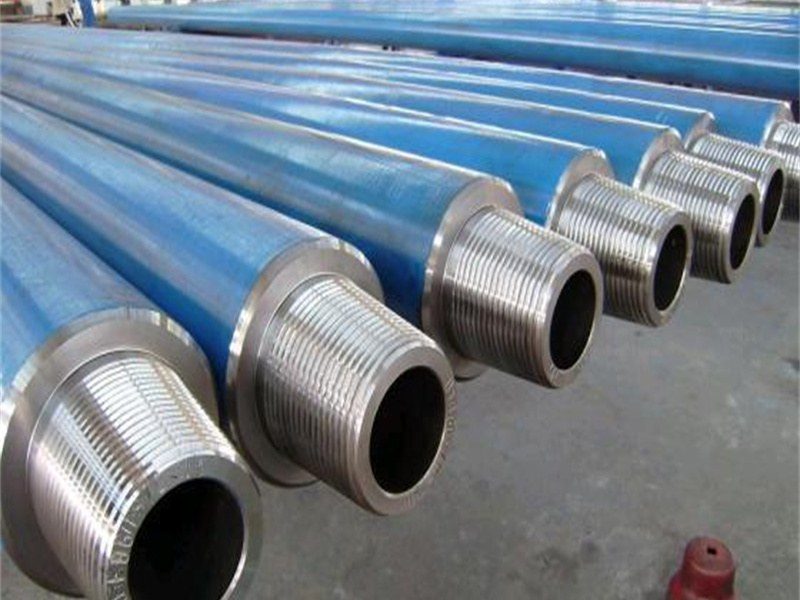
Most non-magnetic collar enquiries do not need the most highly alloyed grade on the market. They need a bar that is guaranteed non-magnetic, holds 758 MPa of yield through a thick section, and comes with a certificate that matches the drawing. That is the job TWZ-2 was designed for, and it is the grade we hold in stock more often than any other.
What TWZ-2 is
TWZ-2 is TISCO's standard manganese-chromium-nitrogen austenitic grade, made to works specification Q/TX 208-2015, and also sold under the mill designation PNM530. It is a low-carbon steel — 0.04 percent maximum — with 17.5 to 23.5 percent manganese and at least 0.48 percent nitrogen. There is no deliberate nickel addition for structure; nickel is present at 0.50 percent minimum and does not carry the austenite.
That composition buys three things at once: an austenitic structure stable enough to stay non-magnetic after machining and cold work, a yield strength of 758 MPa without any heat treatment beyond solution annealing, and enough chromium — 16.0 to 18.5 percent — to survive ordinary drilling mud.
The manganese-nitrogen mechanism, in one paragraph
Austenite is what makes a steel non-magnetic, and in a 300-series stainless it is nickel that holds it there. Nickel is expensive, and the austenite it produces is metastable: cold work converts part of it to martensite and the permeability climbs. Manganese extends the austenite field and dissolves more nitrogen; nitrogen is a strong austenite stabiliser per unit weight, a solid solution strengthener, and it pushes the martensite start temperature far below ambient. The result is a collar that is still non-magnetic after the bore has been trepanned and the threads rolled, which is why the permeability can be certified per bar rather than assumed from the grade name.
Mechanical properties, by diameter band
Strength in this family comes from the composition and the forging route, not from a quenching and tempering cycle, so the guaranteed values are quoted by outside diameter: a large section cannot be worked as hard as a small one.
| Property | TWZ-2, OD ≤ 190 mm | TWZ-2, OD 190–280 mm | TWZ-3 HS, for comparison |
|---|---|---|---|
| Yield strength Re, min. | 758 MPa | 689 MPa | 965 / 900 MPa |
| Tensile strength Rm, min. | 827 MPa | 758 MPa | 1035 / 1000 MPa |
| Elongation A, min. | 18% | 20% | 20% |
| Impact KV, min. | 100 J | 100 J | 100 J |
| Hardness | ≥ 285 HBW | ≥ 285 HBW | ≥ 290 HBW |
| Relative permeability | ≤ 1.005 | ≤ 1.005 | ≤ 1.005 |
| Field gradient | ≤ 0.05 µT / 100 mm | ≤ 0.05 µT / 100 mm | ≤ 0.05 µT / 100 mm |
Minimum guaranteed values from TISCO Q/TX 208-2015. 1 ksi = 6.895 MPa.
Chemical composition
| Element | TWZ-2, % | Element | TWZ-2, % |
|---|---|---|---|
| C | max. 0.04 | Cr | 16.0–18.5 |
| Si | max. 1.00 | Mo | 0.40–0.80 |
| Mn | 17.50–23.50 | Ni | min. 0.50 |
| P | max. 0.040 | Cu | max. 0.60 |
| S | max. 0.010 | N | min. 0.48 |
Boron is capped at 0.0050 percent. The wide manganese range is not sloppiness in the specification — it lets the mill balance manganese against nitrogen while staying inside the strength and structure targets for the size being cast. The certificate carries the actual heat analysis, and that is what to check against the enquiry.
TWZ-2, TWZ-3 and TWZ-4: what changes
TWZ-2 at 758 MPa minimum yield covers the ordinary case: standard directional and horizontal wells, MWD and LWD housings, non-magnetic subs and stabiliser mandrels, and compressive-service drill pipe in benign mud.
TWZ-3 raises chromium to 16.0–18.0 percent and nitrogen to 0.50–0.80 percent, and reaches 965 MPa in HS temper. It is the grade to specify when the well is deeper, the loads higher, or the mud carries enough chloride to matter.
TWZ-4 adds 1.7–2.5 percent molybdenum and 3.0–4.5 percent nickel for pitting resistance in heavy sections. It is not stronger than TWZ-3 in HS temper; it is more corrosion resistant, and it is specified when pitting rather than load sets the service life.
Sourcing: what to verify before release
The certificate matches the specification. Compare the heat analysis line by line against Q/TX 208-2015 — not against a typical analysis from a brochure.
The diameter band is stated. A 758 MPa guarantee means nothing at 250 mm outside diameter if the certificate does not say which band it refers to.
Intergranular corrosion was tested. ASTM A262 Practice A and E on a sample from the heat, with no intergranular cracks after the bend. This is the test that proves the forging and quench route did not sensitise the grain boundaries.
Permeability was proven after machining. Probe test printout per collar, dated after final machining, carrying both the permeability and the field-gradient figure. A certificate issued at the bar stage does not cover the finished tool.
Ultrasonic inspection covers the full volume. API Spec 7-1 clause 12 as a minimum, with the acceptance level written on the order rather than agreed verbally.
Frequently asked questions
Is TWZ-2 enough for a directional well with MWD?
For most standard directional and horizontal wells, yes. The permeability ceiling is the same as the higher grades — 1.005 maximum — and the yield is adequate for ordinary collar bodies and housings. The grade you would step up from is where the mud is chloride-rich, the well is hot, or the loads exceed what 758 MPa covers at your diameter.
Why is the guaranteed yield lower above 190 mm?
Because strength in this family comes from the composition and the forging reduction, and the reduction a mill can put through a large section is limited. The specification recognises that with two diameter bands. A 279 mm bar is not inferior; it is a bar that cannot be worked as hard as a 178 mm bar.
Does TWZ-2 stay non-magnetic after machining?
Yes, provided the nitrogen is inside the specified range. The high nitrogen content suppresses strain-induced martensite, the mechanism that makes ordinary austenitic stainless drift upward in permeability after cold work. Verify with a probe test after final machining, not before.
Next step
Send the outside diameter, bore, length and quantity, plus the permeability ceiling and any sour-service or inspection requirement. We reply with mill availability, the certificate scope and a priced offer, usually within one working day.
Need TWZ-2 collar bars or finished collars?