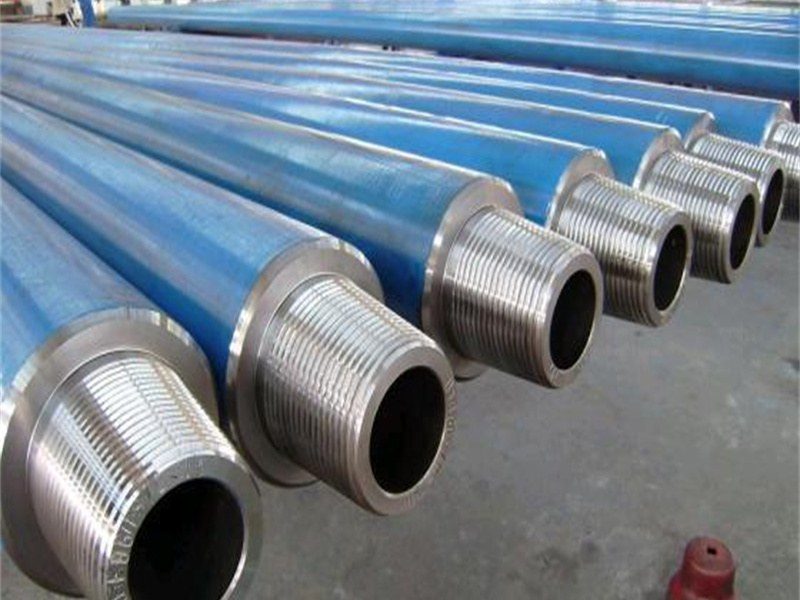
Buying a non-magnetic collar is not difficult. Buying one that still meets its certificate after two years in service is a different exercise, and it turns on four documents rather than on the price per kilogram. This guide sets out what TWZ-4 is, what the certificate has to prove, and the four checks that catch most of the material that should never have left the mill.
What TWZ-4 non-magnetic steel is
TWZ-4 is TISCO's molybdenum-nickel austenitic grade, made to works specification Q/TX 085-2019. It belongs to the same manganese-nitrogen family as the standard collar grades, but with two additions that change what it is good for: 1.7 to 2.5 percent molybdenum and 3.0 to 4.5 percent nickel. Both raise pitting resistance and both cost money, which is why the grade is specified for a reason rather than by default.
In HS temper — cold worked over the full length after solution annealing — it is guaranteed at 965 MPa minimum yield up to 235 mm outside diameter, and 900 MPa from 235 to 280 mm. The LS temper is solution annealed and guaranteed at 900 MPa across the full 80 to 450 mm range, with more ductility. Neither figure is a typical; both are certificate minima, and both are quoted by diameter band because the amount of cold reduction a mill can put through a large section is limited by its press and its cold-drawing equipment.
Engineering low permeability without giving up toughness
The property that matters is relative permeability at the sensor, not on the bar. API Spec 7-1 caps it at 1.010 and the field gradient along the bore at 0.05 microtesla per 100 mm. TWZ-4 is supplied at 1.005 maximum with a probe test printout for every collar, taken after final machining rather than before.
What makes that hold is the nitrogen. At 0.55 to 0.70 percent it suppresses strain-induced martensite far below ambient, so trepanning the bore and rolling the threads does not turn part of the austenite ferromagnetic. That is the difference between a grade that is non-magnetic on the certificate and one that is still non-magnetic when the tool is dressed and ready to run.
Yield and tensile benchmarks, by diameter band
| Property | HS, OD ≤ 235 mm | HS, OD 235–280 mm | LS, OD 80–450 mm |
|---|---|---|---|
| Yield strength Re, min. | 965 MPa | 900 MPa | 900 MPa |
| Tensile strength Rm, min. | 1035 MPa | 1035 MPa | 1035 MPa |
| Elongation A, min. | 20% | 20% | 20% |
| Impact KV, min. | 100 J | 100 J | 100 J |
| Hardness | 330–430 HBW | 330–430 HBW | 330–430 HBW |
| Relative permeability | ≤ 1.005 | ≤ 1.005 | ≤ 1.005 |
Source: TISCO Q/TX 085-2019, minimum guaranteed values. 1 ksi = 6.895 MPa.
What the alloying actually does
Molybdenum is the pitting element. At 1.7 to 2.5 percent it lifts the PREN by roughly four to eight points over the standard grade, which is the difference between surviving chloride mud and pitting in it.
Nickel at 3.0 to 4.5 percent stabilises the austenite further and improves toughness in heavy sections, where a leaner grade becomes difficult to keep fully austenitic through slow cooling.
Nitrogen carries the strength and locks the structure. It also raises the risk side of the ledger: high nitrogen steels are sensitive to cooling rate, so the quench after warm forging is not optional and the mill's process route matters as much as the chemistry.
Carbon is capped at 0.04 percent for one reason — to keep chromium carbides from precipitating at grain boundaries during warm forging, which is the mechanism behind intergranular stress corrosion cracking.
Where it earns its price
Heavy-section collars in wells where cold reduction is limited by bar size; high-chloride mud systems and elevated bottom-hole temperatures; MWD and LWD housings that must stay transparent to a sensor after machining; stabiliser mandrels and subs in corrosive service; and any programme that would otherwise reach for a nickel-based alloy when an austenitic Mn-Cr-Mo-N grade will meet the duty.
Where it does not earn its price is a benign vertical or low-angle well with ordinary mud. TWZ-3 meets the same 965 MPa in HS temper at lower alloy cost, and specifying TWZ-4 there is money spent on corrosion margin nobody will use.
Four checks before you release a heat
One: the chemistry matches the specification, not a typical. Ask for the heat analysis and compare it line by line with Q/TX 085-2019. Nitrogen in particular is often reported as a target rather than a guaranteed range.
Two: the mechanical values carry the right diameter band. A certificate quoting 965 MPa without stating the outside diameter is not a certificate you can accept at 279 mm.
Three: intergranular corrosion has been tested, not assumed. ASTM A262 Practice A and E on a sample from the heat, with no intergranular cracks after the bend. For sour service, add ASTM G36 or G38 C-ring results.
Four: permeability was proven after machining. Probe test printout per collar, dated after final machining, with the field-gradient figure as well as the permeability figure. A certificate from the bar stage does not cover the finished tool.
TWZ-4 inside the family
TISCO's non-magnetic range runs TWZ-2, TWZ-3 and TWZ-4. TWZ-2 is the standard Mn-Cr-N grade at 758 MPa minimum yield. TWZ-3 raises chromium and nitrogen and reaches 965 MPa in HS temper, which covers most directional wells including mildly sour service. TWZ-4 adds the molybdenum and nickel for corrosion margin in heavy sections. Above the family sits custom-melt territory: nickel- chromium austenitics at 14 percent nickel and above, where the chemistry comes from the customer's drawing rather than from a mill grade.
Frequently asked questions
Is TWZ-4 stronger than TWZ-3?
No. Both are guaranteed at 965 MPa minimum yield in HS temper up to their respective diameter limits. TWZ-4 buys corrosion margin, not strength. If the well is benign and the load is ordinary, TWZ-3 is the correct and cheaper answer.
Does the collar stay non-magnetic after threading?
Yes, provided the nitrogen is inside the specified range. The high nitrogen content suppresses strain-induced martensite, the mechanism that makes ordinary austenitic stainless drift upward in permeability after cold work. Verify by probe testing after final machining, not before.
Can TWZ-4 replace a nickel-based alloy?
Sometimes, and the decision should be made on the corrosion data rather than on the alloy family. TWZ-4 covers a good deal of what nickel-based grades are specified for in non-magnetic BHA components, at lower alloy cost. Where the well needs more than that, a custom-melt high-nickel grade is the honest answer and we quote it as such.
Next step
Send the outside diameter, bore, length, temper and quantity, plus the permeability ceiling and any sour-service requirement. We reply with mill availability, the certificate scope and a priced offer, usually within one working day.
Need TWZ-4 bars or finished collars?