Spheroidizing annealing is the quiet step that decides whether a wind turbine bolt can be cold-formed at all – yet it rarely appears in supplier datasheets. The steel in question is AISI 4140, known in Europe as EN 42CrMo4 (W. Nr. 1.7225), in China as GB/T 3077 42CrMo, in Japan as JIS SCM440, and in the United States as UNS G41400 under ASTM A29 or A519. The grade names are familiar; the manufacturing problem behind them is not. This article is based on a study published by Nanjing Iron and Steel in Heat Treatment of Metals, December 2024 (Vol. 49, No. 12), which developed a production spheroidizing route for a strengthened 4140 round bar destined for 10.9-grade wind turbine bolts, and it compares the measured results against the generic parameters found in open literature.
Why a “Simple” Annealing Step Decides Bolt Quality
Wind turbine bolts carry extreme dynamic and low-temperature loads, so most are made by cold extrusion of medium-carbon alloy steel – the process sequence is spheroidizing annealing, cold extrusion, thread rolling, quenching and tempering, and surface treatment. The spheroidizing step exists for one purpose: to convert lamellar cementite into globular carbides, lowering flow stress and strain-hardening rate so the blank fills the extrusion die without cracking and without destroying tooling. Common engineering knowledge treats spheroidizing annealing as a technique for high-carbon grades – tool steels, bearing steels – where it is indeed mature. Medium-carbon fastener steels are rarely discussed, and that is precisely where the pitfalls hide: the as-rolled structure of a Cr-Ni-Mo bar is not the soft ferrite-pearlite textbook assumes, and a standard datasheet recipe can fail completely.
The Material: A Strengthened 4140, Not a Textbook One
To raise bolt strength and cut weight, the end user pushed chromium and molybdenum above the conventional 4140 window and added nickel. The resulting chemistry is given in Table 1 – note that chromium at 1.10-1.30% and molybdenum at 0.20-0.50% sit at or above the top of the standard 42CrMo4 range, and the 0.20-0.50% nickel addition is absent from the classic grade. This is a deliberate strength upgrade, and it makes spheroidizing harder, not easier.
| Element | C | Si | Mn | P max | S max | Cr | Ni | Mo |
|---|---|---|---|---|---|---|---|---|
| Range | 0.40-0.44 | 0.15-0.35 | 0.70-1.00 | 0.015 | 0.015 | 1.10-1.30 | 0.20-0.50 | 0.20-0.50 |
| Std AISI 4140 | 0.38-0.43 | 0.15-0.35 | 0.75-1.00 | 0.035 | 0.040 | 0.80-1.10 | – | 0.15-0.25 |
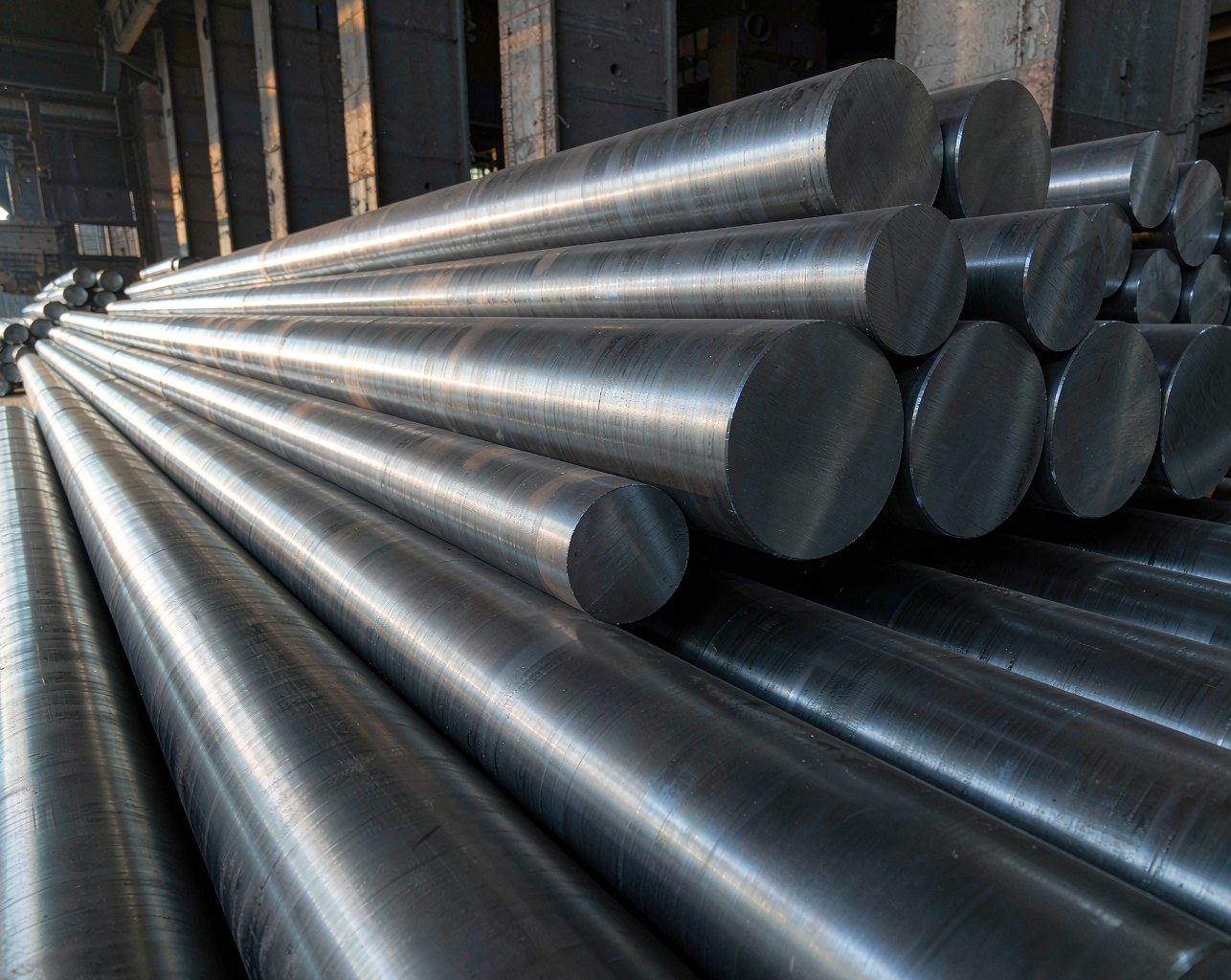
The bar was produced by electric arc furnace melting, ladle refining, vacuum degassing, bloom continuous casting and rolling to Φ60-80 mm rounds. Its as-rolled structure is bainite plus local martensite plus a little retained austenite, with hardness of 381, 385 and 390 HBW – a far cry from the soft ferrite-pearlite that spheroidizing recipes assume. Dilatometry gave Ac1 = 755 ℃ and Ac3 = 786 ℃. The user specification: spheroidization rate ≥ 80%, hardness ≤ 185 HBW, delivered in the annealed condition.
Three Candidate Routes, Measured Results
Gleeble-3800 thermal simulation was used to screen three classical routes, all cooled at ≤ 20 ℃/h – necessary here because the bainitic-martensitic start structure tolerates none of the 40 ℃/h commonly quoted for ferrite-pearlite steels. Table 2 collects the measured spheroidization rate and hardness for every trial, including the improved and production runs.
| Route | Soak temperature (℃) | Soak time (h) | Spheroidization rate (%) | Hardness (HBW) |
|---|---|---|---|---|
| Subcritical (700-740 ℃, 10 h) |
700 | 10 | 17 | 237 / 235 / 240 |
| 720 | 10 | 26 | 219 / 225 / 223 | |
| 740 | 10 | 32 | 210 / 216 / 212 | |
| Step cooling (760-780 ℃, 5 h) |
760 | 5 | 75 | 183 / 175 / 180 |
| 770 | 5 | 53 | 199 / 188 / 199 | |
| 780 | 5 | 47 | 186 / 196 / 187 | |
| Isothermal (760-780 ℃ + 720 ℃ hold) |
760 | 4 + 5 | 82 | 180 / 179 / 182 |
| 770 | 4 + 5 | 76 | 187 / 186 / 185 | |
| 780 | 4 + 5 | 63 | 178 / 183 / 182 | |
| Improved isothermal (700 ℃ preheat + 760/720) |
700 + 760/720 | 2 + 4 + 5 | 90 | 170 / 172 / 173 |
| Production line (continuous furnace) |
700 + 760/720 | 2 + 4 + 5 | 91 | 174 / 171 / 175 |
The story in the numbers is clear. Subcritical annealing, the route a textbook would call safest, delivers only 17-32% spheroidization after 10 h – nowhere near the 80% target. Step cooling improves to 75% at 760 ℃ but the structure is uneven and hardness scatters. Only isothermal annealing at 760 ℃ with a 720 ℃ hold reaches 82%, yet it still leaves local carbide aggregation and too little hardness margin.
Viewpoint 1: Datasheet Parameters Are Grade-Level, Not Microstructure-Level
Open literature and supplier technical sheets typically give one line for 4140 spheroidizing – heat near 750 ℃ and cool slowly, some citing 6-10 ℃/h down to about 665 ℃. Those parameters were built for normalized or forged ferrite-pearlite stock. Applied to the bainitic-martensitic bar tested here, the equivalent 740 ℃ subcritical soak yields a 32% spheroidization rate and 210-216 HBW – both failing specification. The lesson is uncomfortable but valuable: a grade name is not a recipe. The starting microstructure, alloy level and product form must drive the process design, and any supplier quoting a blanket spheroidizing temperature for 4140 should be asked which start structure that temperature was validated on.
Viewpoint 2: The As-Rolled Structure, Not the Chemistry, Is the Bottleneck
Why does subcritical annealing fail so badly? Metallography shows the local martensite regions spheroidize first, because martensite is rich in dislocations and internal stress that accelerate carbon diffusion and carbide rearrangement, while the original bainite regions only begin to spheroidize. The result is a mixed, uneven structure at any practical hold time. Product form matters just as much: cold-drawn wire benefits from deformation-induced vacancies and dislocations that give cementite plenty of dissolution and nucleation sites, but a Φ60-80 mm round bar has no drawing step, limited diffusion paths and coarser grain, so spheroidizing is fundamentally harder. This is why most published medium-carbon spheroidizing work concerns cold-heading wire, and why the mill had to build its own cycle for round bars.
The 700 ℃ Preheat Fix: Calculation Before Trial
The residual problem was retained austenite from the as-rolled structure, which degraded uniformity and left only a small hardness margin. Instead of blind parameter hunting, the mill calculated the isothermal transformation curve with Thermo-Calc and found the austenite transformation “nose” at about 690 ℃. A 700 ℃ preheat stage of 2 h was therefore added before the 760 ℃ soak – long enough to decompose the retained austenite, short enough to avoid coarsening – followed by the 760 ℃ soak (4 h), slow cooling at ≤ 20 ℃/h to 720 ℃ (5 h hold), then slow cooling to 600 ℃ and free cooling. The result: spheroidization rate jumped to 90% and hardness dropped to 170-173 HBW. Transferred to a continuous production furnace (13 independently controlled zones, pulse-fired gas radiant tubes, full nitrogen protection), the same cycle delivered 91% spheroidization and 174/171/175 HBW on Φ80 mm bars – comfortably inside the ≥ 80% and ≤ 185 HBW specification, and even inside the tighter ≤ 175 HBW target the improved cycle was designed for.
The takeaway for bolt makers and cold formers: spheroidization rate is the honest quality index – hardness alone can be met with the wrong structure. A bar at 180 HBW with 82% spheroidization may still extrude poorly if the residual lamellar cementite concentrates strain.
Practical Takeaways
- Ask the mill for the as-rolled microstructure and the Ac1/Ac3 of the actual heat – they, not the grade name, determine the correct spheroidizing window.
- For bainitic-martensitic round bars, subcritical annealing is a trap; isothermal annealing in the intercritical range with a hold just below Ac1 is the reliable route, and a preheat stage based on the calculated transformation nose removes retained-austenite artifacts.
- Specify spheroidization rate per GB/T 38770-2020 (the Chinese rating standard for low- and medium-carbon steel spheroidized structures) or the equivalent SEP 1520 if your certification chain is European – not just a hardness cap.
- Strengthened grades with nickel and raised Cr-Mo are harder to spheroidize than standard 42CrMo4; plan longer cycles and tighter control when strength-upgraded bolt steel is specified.
Article by Harris, technical staff at SHUNFU METAL, a Chinese producer of seamless special steel tubes and bars.