
A drill pipe is a system, not a tube: seamless body, upset ends, friction-welded tool joints and a rotary shoulder connection that carries the load. API 5DP fixes the body; API 7-2 fixes the connection and API RP 7G fixes the make-up. Ordering one without naming the others is how a string arrives that cannot be torqued to specification.
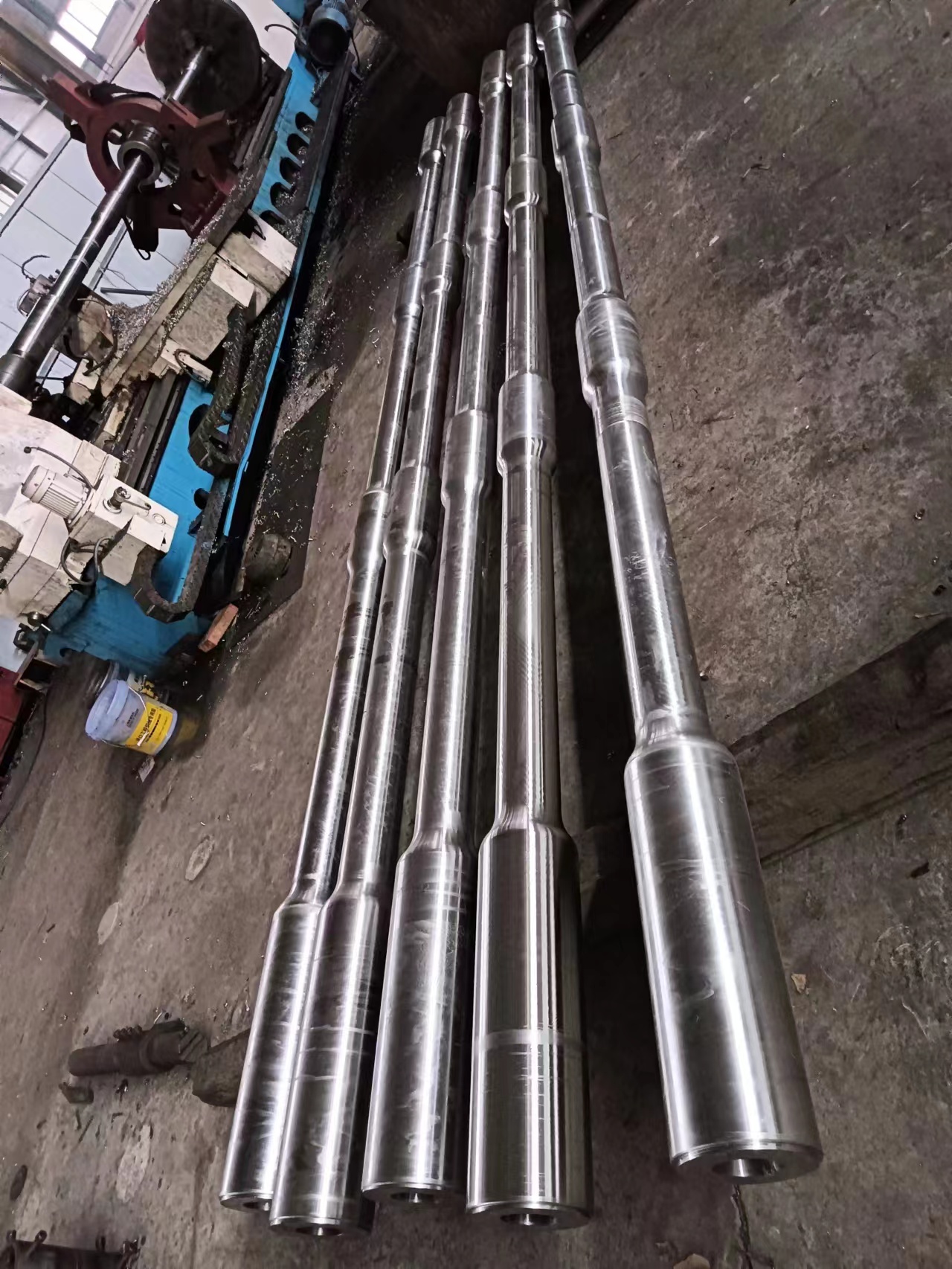
Grades and Mechanical Properties
API 5DP defines four grades. The grade sets yield strength, and the wall thickness converts that yield into tensile capacity and torsional capacity for a given size. The jump from E-75 to S-135 roughly doubles the load a string can carry, which is why deep and extended-reach wells move up the grades rather than up the wall thickness.
| Grade | Yield strength (MPa) | Minimum tensile (MPa) | Where it is used |
|---|---|---|---|
| E-75 | 517–724 | 689 | Shallow and medium wells, workover |
| X-95 | 655–862 | 724 | Deeper vertical and directional wells |
| G-105 | 724–931 | 793 | Deep directional and horizontal wells |
| S-135 | 931–1,138 | 1,000 | Ultra-deep, high-torque, extended reach |
Grade selection is a torque and tension calculation, not a preference. The string has to survive the pick-up load, the rotating torque and the overpull at the stuck point, and the weakest element is usually the tool joint connection rather than the pipe body. That is why a 5 in S-135 body can be limited by an NC50 connection and why the connection has to be selected with the grade, not after it.
Sizes, Tool Joints and Length Ranges
Drill pipe is ordered as a size and weight pair, with a tool joint connection and a length range. The table lists the standard combinations; the connection designation is the API one, and premium and double-shoulder connections are available as alternatives on the same body.
| Outside diameter | Nominal weight (lb/ft) | Standard connection | Typical duty |
|---|---|---|---|
| 2-3/8 in (60.3 mm) | 6.65 | NC26 (2-3/8 IF) | Slim-hole, coiled tubing substitutes |
| 2-7/8 in (73.0 mm) | 10.40 | NC31 (2-7/8 IF) | Slim-hole and workover |
| 3-1/2 in (88.9 mm) | 13.30 | NC38 (3-1/2 IF) | Standard rotary drilling |
| 4 in (101.6 mm) | 14.00 | NC40 (4 FH) | Medium-depth drilling |
| 4-1/2 in (114.3 mm) | 16.60 | NC46 (4 IF) | Deep vertical and directional |
| 5 in (127.0 mm) | 19.50 | NC50 (4-1/2 IF) | Deep and high-torque strings |
| 5-1/2 in (139.7 mm) | 21.90 | 5-1/2 FH | Deep vertical, high tension |
| 6-5/8 in (168.3 mm) | 25.20 | 6-5/8 FH | Large-hole and ultra-deep |
Length ranges are R1 at 18–22 ft (5.49–6.71 m), R2 at 27–30 ft (8.23–9.14 m) and R3 at 38–45 ft (11.58–13.72 m). R2 is the land default; R3 is used offshore and on extended-reach wells where fewer connections mean faster trips and fewer potential leak paths. Mixing ranges in one string is possible but complicates the tally and the handling plan.
Upset, Friction Welding and the Transition
The pipe body is thicker at the ends than in the middle. That upset exists so the tool joint can be attached without reducing the internal bore, and there are three standard forms: internal upset, external upset and internal-external upset. Internal-external upset gives the longest fatigue life because the load path changes gradually in both directions, and it is the default for critical and offshore strings.
Tool joints are attached by friction welding — the joint is spun against the pipe end under axial load until the interface reaches forging temperature, then forged together. The weld line and its heat-affected zone are the most fatigue-sensitive part of the whole assembly, and they sit in the upset transition where the stiffness changes fastest. A drill pipe that fails in service usually fails there, not in the body.
For that reason the purchase specification has to fix more than the grade: upset type, weld process, post-weld heat treatment of the tool joint, and the inspection of the weld zone. API 5DP covers the product; DS-1 covers the acceptance criteria that operating companies actually use for the weld area.
Heavy Weight Drill Pipe
Heavy weight drill pipe sits between drill pipe and drill collar in the string. It has the same outside diameter and connection as the drill pipe above it but a much thicker wall, with integral wear knots machined on the body so that it bears on the casing wall at discrete points rather than along its length. It adds weight on bit without the stiffness of a collar, which is why it is used through the transition zone in directional wells.
We supply HWDP from 3-1/2 in to 6-5/8 in in the same grades, with the same connection options and the same inspection regime as the drill pipe. The full specification, including wear knot dimensions and slip recess requirements, is on the heavy weight drill pipe page.
Inspection, Hardbanding and Documentation
New drill pipe is normally inspected to DS-1 Category 3 or 4, with Category 5 reserved for critical service. The category sets the acceptance limits for wall thickness, eccentricity, straightness and tool joint dimensions — and it is the number that decides whether a string is acceptable to the drilling contractor, not the mill certificate alone.
Tool joints are dimensional-gauged to API RP 7G, with thread profile, taper, lead and shoulder squareness checked before make-up. Hardbanding is applied to the tool joint outside diameter to reduce casing wear: tungsten carbide for maximum wear resistance, chrome carbide or casing-friendly alloys where casing wear is the governing risk. The choice is a trade-off between protecting the tool joint and protecting the casing, and it should be made against the casing program rather than by habit.
Documentation includes mill certificates to EN 10204 3.1 for the tube and the tool joint, friction weld records, hardbanding records, dimensional reports and, where specified, a third-party witness by SGS, BV or TUV. Internal coating for corrosion protection or flow improvement is available and is specified separately.
What a Quotation Needs
Drill pipe is priced on the assembly, not on the tube. Two enquiries for the same size and grade can differ by 25 % on connection, hardbanding and inspection alone. Send:
- Outside diameter and nominal weight
- Grade: E-75, X-95, G-105 or S-135
- Upset type: IU, EU or IEU
- Tool joint: OD, ID and connection designation
- Length range R1, R2 or R3
- Hardbanding type and coverage
- Inspection standard and category: DS-1 Category 3, 4 or 5, with witness
- Quantity in joints or metres, and whether a spare percentage is required
ShunFu Metal supplies API 5DP drill pipe and heavy weight drill pipe from API Q1 certified mills, with friction weld records, tool joint certificates and third-party inspection released against the approved inspection and test plan. Request a quotation.
Frequently Asked Questions
What is the difference between API 5DP and API 5D?
API 5DP is the current specification for drill pipe, aligned with ISO 11961. It replaced the older API 5D and adds requirements for the tool joint and the friction weld rather than covering the tube alone.
Which grade should be used for a deep well?
It follows from the torque and tension calculation. G-105 covers most deep directional wells; S-135 is used where the string length or the overpull requirement exceeds what G-105 can carry. Moving up a grade is usually cheaper than moving up a wall thickness, provided the connection is upgraded with it.
Why does the tool joint matter more than the pipe body?
Because the connection is the weakest element in tension and torsion, and the friction weld next to it is the most fatigue-sensitive point in the assembly. A string is designed around its connection capacity, not around the body capacity printed on the certificate.
What is DS-1 Category 4?
DS-1 is the industry inspection standard for drill stem elements. Category 4 is the normal acceptance level for new drill pipe in critical service; Category 3 is used for standard service and Category 5 for the most demanding wells. The category changes the rejection limits, not the manufacturing process.
Can drill pipe be supplied with premium connections?
Yes. Double-shoulder and proprietary connections can be cut on the same body, with the connection supplier’s qualification and make-up torque data. Name the connection and the make-up torque in the enquiry, because the tool joint OD has to be sized to the connection.
Need drill pipe or HWDP for a specific rig?
Send the size and weight, grade, connection, hardbanding and inspection category. We reply with mill availability, lead time and a priced offer, usually within one working day.