
P110 is the grade that appears when depth and pressure outrun N80: 758 MPa minimum yield, 862 MPa minimum tensile, and a quenched-and-tempered 30CrMo chemistry that holds collapse in wells past 5,000 m. It is also the grade most often misapplied. P110 has no hardness cap, so it is not a sour-service material, and no amount of third-party inspection turns it into one.
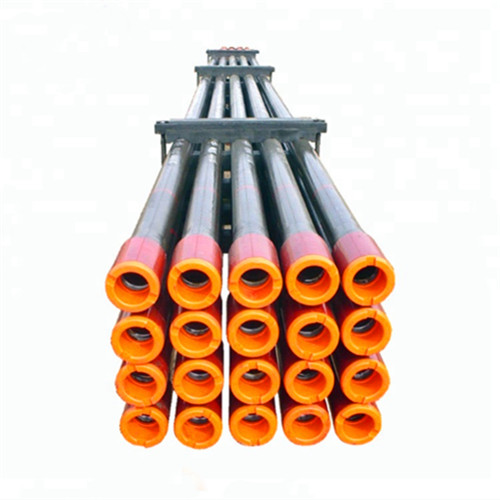
Where P110 Sits in the API 5CT Ladder
API 5CT groups casing and tubing by yield strength, and P110 is the second-highest of the standard carbon and low-alloy grades. The step from N80 to P110 is 206 MPa of yield, which buys roughly 30 % more collapse and burst in the same wall thickness — or the same rating at a thinner wall, which is why deep wells use it. The step from P110 to Q125 exists but is rarely taken: Q125 demands tighter chemistry control, more testing and a mill that will accept the order.
| Grade | Yield strength (MPa) | Minimum tensile (MPa) | Where it is used |
|---|---|---|---|
| H40 | 276–552 | 414 | Shallow, low-pressure strings |
| J55 | 379–552 | 517 | Standard wells, lowest cost |
| K55 | 379–552 | 655 | Same yield as J55, higher tensile |
| N80-1 / N80-Q | 552–758 | 689 | Intermediate depth and pressure |
| L80-1 | 552–655 | 655 | Sour service, hardness controlled |
| C90 | 621–724 | 689 | Sour service, higher pressure |
| T95 | 655–758 | 724 | Sour service, higher collapse |
| P110 | 758–965 | 862 | Deep and HPHT wells |
| Q125 | 862–1,034 | 931 | Ultra-deep, extreme pressure |
The narrow yield window is the point of the grade. P110 is allowed 758 to 965 MPa, and a heat that lands at 950 MPa is legitimate — but it is also harder, less ductile and closer to the point where toughness starts to fall away. For HPHT work where the string will see thermal cycling, buyers increasingly ask for the yield to be held in the lower half of the window and for Charpy data that the grade itself does not require.
Sizes, Weights and Length Ranges
P110 is produced as casing from 4-1/2 in to 20 in and as tubing from 1.05 in to 4-1/2 in. Size and nominal weight are ordered as a pair, because weight fixes the wall and the wall fixes collapse, burst and drift. The table lists the combinations that move in volume; every weight in API 5CT Table C.29 to C.33 exists on paper, but not every mill rolls every one in this grade.
| Outside diameter | Common nominal weights (lb/ft) | Typical duty |
|---|---|---|
| 4-1/2 in (114.3 mm) | 11.6 / 13.5 / 15.1 | Deep tubing, liner |
| 5 in (127.0 mm) | 18.0 / 21.4 / 24.1 | High-pressure tubing and liner |
| 5-1/2 in (139.7 mm) | 17.0 / 20.0 / 23.0 | Production casing, deep wells |
| 7 in (177.8 mm) | 23.0 / 26.0 / 29.0 / 32.0 | Production casing, HPHT |
| 9-5/8 in (244.5 mm) | 40.0 / 43.5 / 47.0 / 53.5 | Intermediate casing |
| 13-3/8 in (339.7 mm) | 54.5 / 61.0 / 68.0 | Deep surface and intermediate |
Length is ordered as R1, R2 or R3: 16–25 ft, 25–34 ft and 34–48 ft respectively. R3 is the offshore default and the usual choice for long intermediate strings, because fewer connections means fewer potential leaks and faster running. R2 dominates onshore where truck transport sets the limit.
Chemical Composition of P110 (wt%)
P110 is a 30CrMo-type steel: about 0.30 % carbon, 1 % chromium and 0.2 % molybdenum. Chromium and molybdenum are there for hardenability, not corrosion resistance — they let a 25 mm wall through-harden on quenching so the tempering step can produce a uniform structure across the section. Carbon supplies the strength and is also the element that makes the grade unsuitable for sour service.
| Element | Range or maximum % |
|---|---|
| Carbon (C) | 0.26–0.35 |
| Silicon (Si) | 0.17–0.37 |
| Manganese (Mn) | 0.40–0.70 |
| Phosphorus (P) | ≤ 0.020 |
| Sulphur (S) | ≤ 0.010 |
| Chromium (Cr) | 0.80–1.10 |
| Molybdenum (Mo) | 0.15–0.25 |
Nickel, copper and vanadium are not given a range in the grade table; they are restricted by agreement because residual levels affect temper embrittlement and toughness. A mill certificate showing 0.25 % Ni and 0.20 % Cu is inside the standard, but a certificate showing 0.8 % Ni is a different steel and should be queried before the pipe is accepted.
Mechanical Properties of P110
Values are the API 5CT requirements at room temperature. P110 is a strength grade, and that is the whole of its specification: there is no hardness limit and no mandatory Charpy test.
| Property | Requirement |
|---|---|
| Yield strength | 758–965 MPa (110,000–140,000 psi) |
| Tensile strength | ≥ 862 MPa (125,000 psi) |
| Elongation | Per formula, from test area and tensile |
| Hardness | No limit specified |
| Impact test | Supplementary requirement only |
The absence of a hardness limit is not an oversight. Hardness control exists in L80, C90 and T95 because those grades are bought for sulphide stress cracking resistance, and SSC resistance is a hardness phenomenon. P110 is bought for collapse and burst in sweet wells, where 30 HRC is an advantage rather than a defect. That single sentence explains why the two grades cannot be substituted for one another.
Elongation follows the API 5CT formula rather than a fixed percentage, so values quoted by different mills are only comparable when the test piece dimensions are known. Where the well design calls for toughness — thermal cycling, HPHT, cold climate — the Charpy requirement has to be written into the purchase order with a test temperature and an energy level, because the grade will not supply it by default.
Why P110 Is Not a Sour-Service Grade
ISO 15156 / NACE MR0175 caps carbon and low-alloy steel at 22 HRC for sulphide stress cracking resistance. A P110 wall sits around 28–32 HRC in the tempered condition. The material is therefore outside the standard, and no amount of inspection changes that: the restriction is metallurgical, not documentary.
Where H2S is present, the grade has to change. The table gives the practical substitutions and what each one costs in strength.
| Option | Yield (MPa) | Hardness limit | Where it fits |
|---|---|---|---|
| L80-1 | 552–655 | 23 HRC (22 HRC to NACE) | The default carbon-steel sour grade |
| C90 | 621–724 | 25.4 HRC | Higher pressure, qualified for sour service |
| T95 | 655–758 | 25.4 HRC | Sour service with higher collapse |
| 13Cr (L80 type 13Cr) | 552–655 | 23 HRC | Sweet CO2 service; H2S only at very low partial pressure |
Note what the substitution costs: dropping from P110 to L80-1 gives up about 200 MPa of yield, which usually means a heavier wall or a shallower setting depth. That is the real price of sour service, and it is better discovered during string design than during a failed SSC test.
Heat Treatment and Testing
P110 is quenched and tempered. The pipe is austenitised, quenched through the wall and tempered in a range that lands the yield inside the 758–965 MPa window; the tempering temperature is chosen by the mill for each heat and recorded on the process card. Two heats of the same chemistry can end up at opposite ends of the yield window simply because one was tempered harder than the other.
Routine testing covers tensile properties, flattening, hydrostatic pressure and dimensional inspection, with non-destructive examination of the body and ends. Full-body ultrasonic inspection, hardness surveys across the wall and third-party witness are available as additions and are normally specified for HPHT or critical-service strings. Certificates are issued to EN 10204 3.1 with heat numbers traceable to the pipe, and the connection is cut either to API round or buttress thread or to a named premium connection under licence.
What a Quotation Needs
A P110 price depends more on weight, connection and length than on the grade. “7 inch P110 casing” is not a specification; it is the start of one. Send:
- Outside diameter and nominal weight, as a pair
- Grade and PSL — P110 PSL1, PSL2 or PSL3
- Service: casing or tubing, and the setting depth
- Connection: STC, LTC, BTC or the named premium connection
- Length range R1, R2 or R3
- Quantity in joints, metres or tonnes — state which
- Inspection: MTC level, NDT scope, third-party witness
- Any supplementary toughness or hardness requirement
ShunFu Metal supplies API 5CT casing and tubing from API Q1 certified mills, with mill certificates, hydrostatic records and NDT reports released against the approved inspection and test plan. Request a quotation.
Frequently Asked Questions
Can P110 be used in H2S service?
No. ISO 15156 / NACE MR0175 limits carbon and low-alloy steels to 22 HRC, and P110 sits around 28–32 HRC. Use L80-1, C90 or T95, or move to a CRA grade if CO2 corrosion is also present.
What is the difference between P110 and K55?
Yield strength. K55 is 379–552 MPa, P110 is 758–965 MPa, so P110 carries roughly twice the load in the same wall. K55 also has a much higher minimum tensile relative to its yield, which is why it is used for surface strings where handling damage matters more than pressure.
Is P110 available as tubing as well as casing?
Yes, from 1.05 in to 4-1/2 in. Tubing is ordered by outside diameter, wall and connection, and the same grade rules apply. Most P110 tubing goes into high-pressure gas wells and deep oil producers.
Why does P110 have no hardness limit?
Because the grade is specified for strength, not for cracking resistance. Hardness limits exist in L80, C90 and T95 precisely because those grades are bought for sour service, where hardness governs sulphide stress cracking. Adding a hardness limit to P110 would make it a different, weaker grade.
What does PSL3 add for P110?
PSL3 adds mandatory impact testing, tighter dimensional control and full traceability from heat to joint, with a defined frequency of tests. It is ordered for HPHT and critical-service strings where the standard PSL2 document set is not considered sufficient.
Need P110 casing or tubing for a deep well?
Send the size and weight, grade and PSL, connection, length range and quantity. We reply with mill availability, lead time and a priced offer, usually within one working day.