
1.7386, designated as X11CrMo9-1 under EN and also referred to as X12CrMo9-1 / 9Cr-1Mo, is a high-chromium martensitic heat-resistant steel bar engineered for sustained elevated-temperature service up to 600°C in oil refinery, petrochemical, and power generation equipment. Equivalent to ASTM A387 Grade 9 / A182 F9 / A335 P9 / A213 T9, this grade delivers exceptional high-temperature oxidation resistance, outstanding creep rupture strength, and reliable resistance to sulfur-bearing and hydrogen-rich process streams. SHUNFU METAL supplies 1.7386 bars in normalized and tempered condition with full EN 10204 3.1/3.2 mill certification.
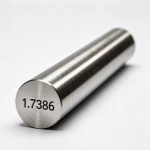
This Cr-Mo alloy, standardized under EN 10216-2, EN 10253-2, and DIN EN 10028-2, is the premium 9% chromium – 1% molybdenum grade for the most demanding high-temperature pressure boundary applications. With its uniquely high Cr content, 1.7386 forms a dense chromium oxide (Cr2O3) layer, delivering markedly superior resistance to high-temperature oxidation and hot corrosion — outperforming the lower-chromium grades in environments exceeding 550°C where oxidation kinetics become life-limiting.
Molybdenum provides solid-solution strengthening against creep deformation, while low carbon control minimizes carbide sensitization risk and ensures excellent weldability. Globally specified as ASTM A387 Gr.9 (plate), A335 P9 (seamless tube), A213 T9 (heat-exchanger tube), A182 F9 (forgings), and JIS STPA26 / SCMV9, 1.7386 is the preferred material for supercritical boiler components, high-temperature heat exchanger bundles, and refinery furnace tubes operating at the upper limit of ferritic steel capability.
At SHUNFU METAL, 1.7386 bars are melted in an electric arc furnace with ladle furnace refining and vacuum degassing, ensuring ultra-low sulfur and phosphorus levels (S ≤ 0.005%, P ≤ 0.015%). For the most critical applications, electro-slag remelting (ESR) and vacuum induction melting (VIM) routes are available to maximize cleanliness and microstructural homogeneity. Bars are hot-rolled or open-die forged on a 6,000-ton hydraulic press with precisely controlled heat input, then normalized at 920–960°C and tempered at 720–800°C to attain uniform tempered martensite across all section sizes. Every bar undergoes 100% ultrasonic testing per EN 10228-3 Class 3, with complete chemical, tensile, impact, and hardness test results documented in EN 10204 Type 3.1 or 3.2 certificates. Third-party inspection by SGS, TÜV, DNV, or Bureau Veritas is available.
Equivalent Grades of 1.7386
1.7386 / X11CrMo9-1 has recognized equivalents under all major international standards for elevated-temperature pressure equipment. ASTM A387 Gr.9 (plate), A182 F9 (forgings), A335 P9 (pipe), and A213 T9 (tube) are the closest cross-references in the ASME pressure vessel and piping code system.
| Standard | Designation | Remarks |
|---|---|---|
| DIN W-Nr. | 1.7386 | German Werkstoff number |
| EN | X11CrMo9-1 / X12CrMo9-1 | Pressure vessel & boiler steel; 9Cr-1Mo |
| ASTM | A387 Gr.9 / A182 F9 / A335 P9 / A213 T9 | Plate, forging, pipe & tube grades |
| JIS | STPA26 / SCMV9 | Alloy steel tube & plate |
| GB | 12Cr1MoV / 15CrMoG | Chinese Cr-Mo heat-resistant steel (approximate) |
| UNS | K90941 / S50400 | Unified Numbering System |
Oil & Gas & Petrochemical Applications
1.7386 / F9 steel bars are the premier material choice for high-temperature components in refinery furnaces, supercritical power boilers, and petrochemical reactors where oxidation resistance and creep strength at 500–600°C are the controlling design parameters. With 9% chromium, this grade delivers exceptional protection against hot flue gas corrosion, steam oxidation, and sulfur-bearing atmospheres, supporting long-term service life in the most thermally demanding oil and gas equipment.
Supercritical Boiler Tubes
Steam Turbine Rotors
Cracking Reactor Liners
Refinery Furnace Tubes
Heat Exchanger Bundles
Superheater & Reheater Tubes
High-Temp Pressure Vessels
Hot Hydrogen Piping
Tube Sheets & Flanges
Nuclear Fasteners
Valve Trim & Seat Rings
Chemical Pump Components
Supply Range — 1.7386 Steel Bar
SHUNFU METAL maintains comprehensive inventory of 1.7386 / X11CrMo9-1 bars in normalized and tempered condition under ISO 9001 & PED 2014/68/EU-certified quality management. Production on a 6,000-ton hydraulic press and GFM radial forging machine ensures exceptional internal soundness and uniform grain structure. All products ship with full EN 10204 3.1 or 3.2 mill certificates.
| Form | Process | Diameter / Thickness | Width | Length |
|---|---|---|---|---|
| Round Bar | Hot-Rolled | ⌀10–500 mm | — | 3000–12000 mm |
| Round Bar | Forged | ⌀100–1200 mm | — | 2000–8000 mm |
| Flat Bar | Hot-Rolled | 3–150 mm | 20–610 mm | 3000–12000 mm |
| Flat Bar / Block | Forged | 50–800 mm | 100–1500 mm | 2000–6000 mm |
Non-standard dimensions, stepped shafts, forged rings (OD 200–2000 mm), discs, tube sheets, custom closed-die forgings, and blocks available upon inquiry. SHUNFU METAL also offers rough machining, saw cutting to length, peeled/ground surface finishes (Ra 0.8–6.3 µm), and full heat treatment services to customer specification.
Chemical Composition of 1.7386
The chemical composition conforms to EN 10216-2 / EN 10253-2 X11CrMo9-1, with tighter residual element controls applied for critical elevated-temperature service. The 9% Cr – 1% Mo alloy design provides outstanding high-temperature oxidation resistance, superior creep rupture strength, and reliable performance in sulfur-bearing, hydrogen-rich, and hot flue gas environments, making 1.7386 the benchmark 9Cr-1Mo grade for refinery and power generation applications.
| C | Si | Mn | P | S | Cr | Mo |
|---|---|---|---|---|---|---|
| 0.08–0.15 | 0.25–1.00 | 0.30–0.60 | ≤0.020 | ≤0.005 | 8.00–10.00 | 0.90–1.10 |
Values in weight percent (wt%). Iron (Fe) balance. Al ≤0.04%; Cu ≤0.30%; Ni ≤0.30%. For critical refinery and supercritical boiler applications, SHUNFU METAL restricts sulfur to ≤0.005% and phosphorus to ≤0.015%. ASTM A182 F9 specification allows slightly broader Si (0.25–1.00%) and Mn (0.30–0.60%) ranges. All heats are verified by optical emission spectrometry (OES) with full traceability to the originating heat number.
Mechanical Properties of 1.7386 / X11CrMo9-1
In the normalized and tempered (+NT) condition per EN 10216-2, 1.7386 delivers high tensile and yield strength with good ductility and impact toughness across varying section sizes. SHUNFU METAL applies controlled normalizing at 920–960°C with air cooling, followed by tempering at 720–800°C to achieve uniform tempered martensite. For thicker sections requiring isothermal annealing (+I), a slower cooling rate yields lower strength with enhanced ductility for machining and cold-forming operations.
| Property | +NT (Normalized + Tempered) | +I (Isothermal Annealed) |
|---|---|---|
| Tensile Strength, Rm (MPa) | 590–740 | 460–640 |
| Yield Strength, Rp0.2 (min, MPa) | 390 | 210 |
| Elongation, A (min, %) | 18 | 20 |
| Impact KV (min, J @ +20°C, long.) | 40 | 40 |
| Impact KV (min, J @ +20°C, trans.) | 27 | 27 |
| Hardness (HBW, typical) | 190–240 | ≤190 HV |
| Heat Treatment | Normalize 920–960°C + Temper 720–800°C | Isothermal anneal 950–980°C, slow cool |
| Elevated-Temp Yield (min, MPa @ 550°C) | ~300 | ~170 |
Creep rupture strength at 550°C: >120 MPa (100,000 h) per Larson-Miller parameter evaluation. Density: 7.85 g/cm³; thermal expansion coefficient: 13 µm/(m·K); thermal conductivity: 26 W/(m·K); solidus temperature: 1410°C. SHUNFU METAL performs room-temperature tensile testing per EN ISO 6892-1, Charpy V-notch impact testing per EN ISO 148-1, and Brinell/Vickers hardness testing per EN ISO 6506-1/6507-1 on every heat treatment lot. Elevated-temperature tensile, creep rupture (ISO 204), and short-term oxidation data (ASTM G54) available upon request for fitness-for-service assessments and remaining life evaluations.
Need 1.7386 X11CrMo9-1 Steel to the specification above?
Send the size, condition, quantity and any NACE or PMI requirements — we reply with mill availability, lead time and a priced offer, usually within one working day.