
2205 forging (UNS S31803 / S32205, A182 F51, EN 1.4462) is the workhorse duplex for valve bodies, flanges and pump casings — roughly twice the yield of 316L at a similar price per kilogram. The forging route is where most projects get into trouble: the alloy must be worked and quenched so the ferrite stays near 50%, because a slow-cooled section turns brittle and gives up the corrosion resistance the grade was chosen for.
The composition — 22% chromium, 3% molybdenum, 5.5% nickel and 0.15% nitrogen — produces a two-phase microstructure that behaves like a composite: the ferrite provides strength and resistance to chloride stress corrosion, the austenite provides toughness and weldability. The balance is not a fixed number in the specification, but every purchaser of a subsea forging asks for it, and 35–55% ferrite is the working acceptance range.
Hot working runs at 1,050–1,120 °C. Below that window the alloy cracks; above 1,150 °C the ferrite content climbs and the grain coarsens. After forging, parts are solution annealed at 1,020–1,100 °C and water quenched. Air cooling a 250 mm section leaves sigma phase and a hardness spike that shows up in the NACE hardness check before it shows up in service.
2205 is not a universal replacement for 316L. Its toughness transitions sharply below −40 °C, it is limited to about 300 °C in long-term service, and NACE MR0175 caps it at 28 HRC. Where those limits bind, the choice moves to super duplex 2507 or back to a 6Mo austenitic.
F51 Forging Standards and Equivalent Grades
A182 F51 covers forged flanges, fittings and valve parts. Bar for machining is A479 or A276; pipe is A790. Both S31803 and S32205 are acceptable under F51 — S32205 is the tighter, nitrogen-controlled version and is what most mills actually produce today, with a minimum PREN of 35 rather than 34.
European enquiries use 1.4462 and the old German designation X2CrNiMoN22-5-3. The Chinese equivalent is 022Cr22Ni5Mo3N (GB/T 21833 for seamless tube).
| System | Designation |
| UNS | S31803 / S32205 |
| W.Nr. / EN | 1.4462 / X2CrNiMoN22-5-3 |
| ASTM A182 | F51 — forged flange, fitting, valve part |
| ASTM A479 / A276 | Bar for machining |
| ASTM A790 | Seamless and welded pipe |
| GB | 022Cr22Ni5Mo3N |
Where 2205 Forgings Are Used
Valve bodies and bonnets
Ball, gate and butterfly valve bodies for seawater, produced water and moderate sour service, where the higher yield allows a lighter body casting.
Weld-neck and blind flanges
A182 F51 flanges from 2 inch to 24 inch, ring rolled and machined, matched to A790 pipe on seawater and process lines.
Pump casings and impellers
Seawater lift and firewater pump components, resistant to crevice attack under gaskets and to erosion at the impeller eye.
Wellhead adapters and spacers
Intermediate components between the wellhead and the tree, where 316L would need a heavier section for the same rating.
Tube sheets and channel covers
Heat exchanger tube sheets for produced water coolers, drilled for duplex or 6Mo tubes.
Mixer and agitator shafts
Shafts and impellers in produced water and chemical dosing tanks, where fatigue strength and corrosion resistance are both required.
Supply Range and Forging Route
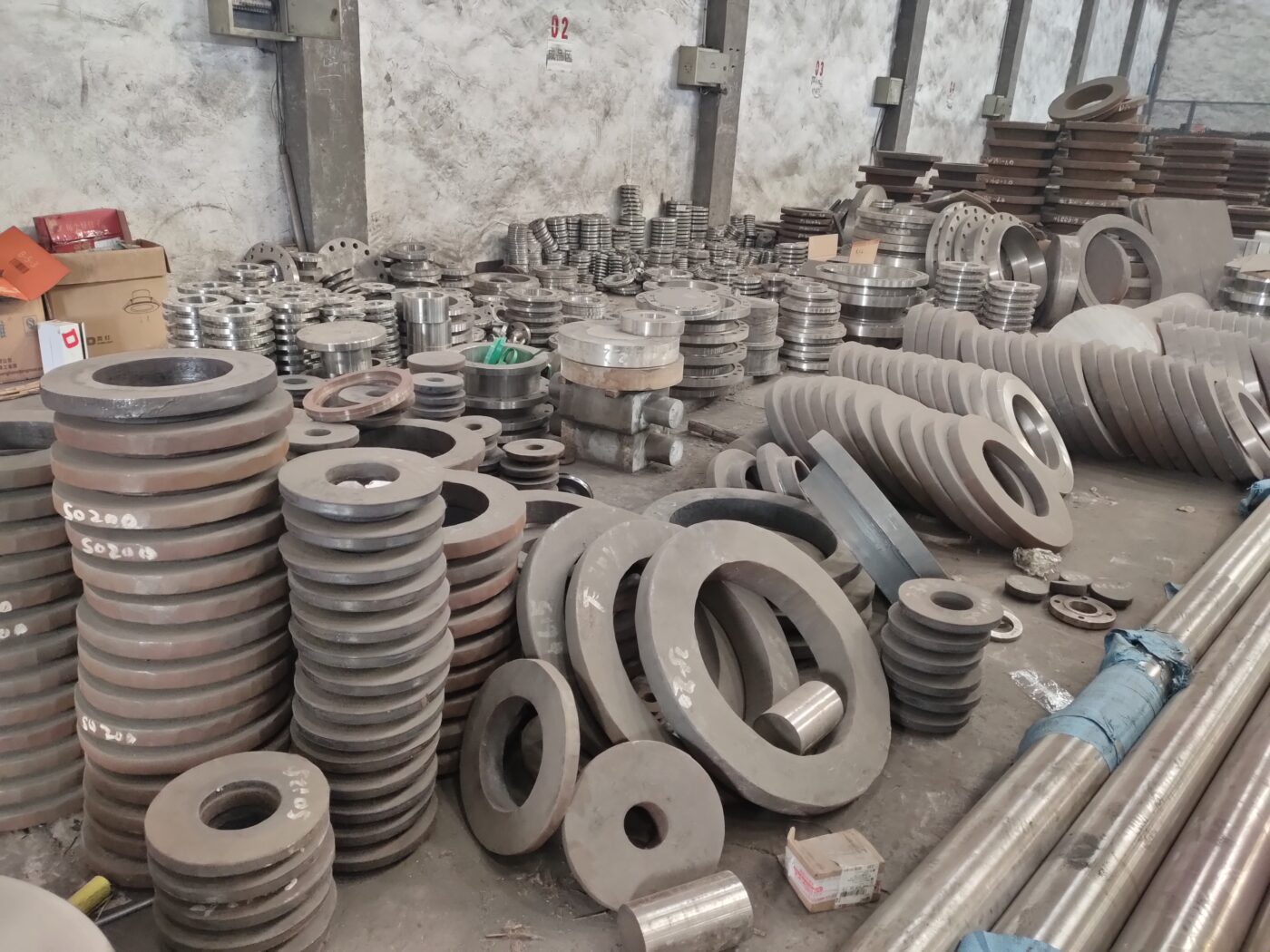
Open-die forged blocks and bars from 80 mm to 600 mm section, up to 3,500 kg per piece; ring-rolled flanges from 2 inch to 24 inch; near-net valve bodies and pump casings to drawing. Bar stock from 20 mm to 400 mm diameter, peeled or rough turned.
Standard route is upset and draw with a minimum forging ratio of 4:1, solution anneal at 1,020–1,100 °C, water quench, then pickling or machining. We do not supply air-cooled F51. Repair welding needs a qualified procedure and a local re-anneal, which should be agreed before the order rather than discovered at final inspection.
Inspection includes ultrasonic testing to ASTM A388 or A745 with agreed acceptance criteria, ferrite content by metallography, ASTM A923 Method A impact and Method C corrosion testing, hardness survey across the section against the 28 HRC NACE limit, and PMI on the finished part. EN 10204 3.1 certificate with heat traceability.
Chemical Composition of 2205 (wt%)
The difference between S31803 and S32205 sits in nitrogen and molybdenum: S32205 requires 0.14–0.20% N and 3.0–3.5% Mo, giving a minimum PREN of 35, while S31803 permits 0.08% N and 2.5% Mo. Buyers who write F51 without naming the UNS can receive either.
Nitrogen is also the element that keeps the weld zone balanced. A low-nitrogen heat welds with excessive ferrite and loses pitting resistance in the heat-affected zone even though the base metal passes.
| Element | Min % | Max % |
| Chromium (Cr) | 21.00 | 23.00 |
| Nickel (Ni) | 4.50 | 6.50 |
| Molybdenum (Mo) | 2.50 | 3.50 |
| Nitrogen (N) | 0.08 | 0.20 |
| Carbon (C) | — | 0.030 |
| Manganese (Mn) | — | 2.00 |
| Silicon (Si) | — | 1.00 |
| Phosphorus (P) | — | 0.030 |
| Sulphur (S) | — | 0.020 |
| Iron (Fe) | balance | balance |
Mechanical Properties of F51 Forgings
Values are the ASTM A182 F51 minima at room temperature for solution-annealed material. There is no ageing treatment; properties come from composition and cooling rate.
The NACE MR0175 hardness ceiling for 22Cr duplex is 28 HRC. Solution-annealed F51 typically lands at 240–270 HB, so the limit is normally met — but a forging that was slow cooled in the centre can exceed it while the surface reads low.
| Property (room temperature) | ASTM A182 F51 |
| Tensile strength | ≥ 620 MPa |
| Yield strength (0.2%) | ≥ 450 MPa |
| Elongation in 50 mm | ≥ 25% |
| Hardness (NACE limit) | ≤ 28 HRC |
Need F51 duplex forgings, blocks or rolled flanges?
Send the drawing or section size, quantity, S31803 or S32205, and any A923, G48 or NACE hardness requirement — we reply with forge availability, lead time and a priced offer, usually within one working day.