
Project Description
S31803 / 2205 / EN 1.4462 is a nitrogen-alloyed ferritic-austenitic (duplex) stainless steel that delivers roughly twice the yield strength of 316L while maintaining cost-competitive corrosion performance. Developed in the 1970s by Sandvik (tradename SAF 2205), 2205 duplex became the definitive “workhorse” CRA in offshore topside, subsea, chemical tanker, and desalination service, filling the enormous gap between commodity 300-series austenitics and high-nickel alloys. The microstructure — approximately 50% austenite pools in a continuous ferrite matrix — is what makes 2205 unique. Ferrite provides high strength, chloride SCC immunity, and good thermal conductivity; austenite contributes toughness, weldability, and general corrosion resistance. The 22% Cr, 3% Mo, 5.5% Ni, and 0.16% N combination yields a PREN of 33–36 — a decisive step above 316L (PREN ~24) and 317L (PREN ~30) — making 2205 the minimum standard for seawater-cooled heat exchangers and produced-water handling in oil & gas. Note: S31803 is the original UNS designation; modern 2205 is typically dual-certified as S31803/S32205, with S32205 imposing tighter N (0.14–0.20%), Cr (22.0–23.0%), and Mo (3.0–3.5%) ranges to guarantee phase balance and weld-zone corrosion resistance. SHUNFU METAL supplies 2205 duplex CRA pipe to ASTM A790 (seamless & welded) and A789 (tube), solution-annealed at 1040–1100°C with rapid water quenching to lock the ~50/50 phase ratio, followed by PMI, full-body UT / ET, hydrostatic testing, and ASTM A923 Method C (etch structure) phase-bad-intermetallic verification. NACE MR0175 / ISO 15156 compliant for sour H2S service with hardness ≤28 HRC up to 232°C for parent material.
Equivalent Grades of 2205 / S31803 Duplex
| Alloy | UNS | EN / DIN | GB | JIS | ASTM Pipe | Family |
|---|---|---|---|---|---|---|
| 2205 Duplex | S31803 / S32205 | 1.4462 / X2CrNiMoN22-5-3 | 022Cr22Ni5Mo3N | SUS329J3L | A790 / A789 | Duplex |
| 2507 Super Duplex | S32750 | 1.4410 / X2CrNiMoN25-7-4 | 022Cr25Ni7Mo4N | — | A790 / A789 | Super Duplex (PREN ≥40) |
| 2304 Lean Duplex | S32304 | 1.4362 / X2CrNiN23-4 | 022Cr23Ni4MoCuN | — | A790 / A789 | Lean Duplex (低Ni) |
| 316L Austenitic | S31603 | 1.4404 / X2CrNiMo17-12-2 | 022Cr17Ni12Mo2 | SUS316L | A312 | Austenitic (PREN ~24) |
| Alloy 825 | N08825 | 2.4858 / NiCr21Mo | NS142 | NCF 825 | B423 / B163 | Ni-Fe-Cr (PREN ~31) |
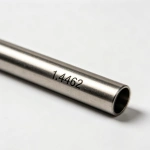
Duplex CRA Seamless Pipe
Oil & Gas and Industrial Applications of 2205 / S31803
Offshore Topside Piping
Seawater cooling, firewater ring mains, produced-water handling, and drain systems on platforms and FPSO vessels — where 316L suffers chloride SCC and chloride pitting at welds.
Subsea Flowlines & Manifolds
Sour-service and sweet subsea production flowlines, manifold pipework, and SURF hardware — 2205’s high strength reduces wall thickness and weight in deepwater installations.
Chemical Tankers
Cargo piping, heating coils, and deck lines on IMO Type II chemical tankers carrying aggressive cargoes — 2205 resists the broad pH and chloride range required for mixed-cargo service.
Desalination (MSF & RO)
Multi-stage flash (MSF) evaporator shells, brine heater tubing, and reverse osmosis (RO) high-pressure piping in thermal and membrane desalination plants — 2205 resists hot-deaerated brine better than 316L.
Pulp & Paper Digesters
Kraft digester blow lines, bleach plant piping (ClO2 and Cl2 stages), and white/green liquor transfer piping — 2205’s chloride SCC resistance is critical in oxidizing bleach environments.
Flue Gas Desulfurization (FGD)
Wet-scrubber absorber vessels, quench piping, and mist eliminator supports in coal-fired power plant FGD systems handling acidic chloride-rich slurries.
Heat Exchangers & Coolers
Tube-and-shell exchangers where the shell side carries seawater, brackish water, or chloride-bearing process streams — 2205’s high thermal conductivity (~19 W/m·K) vs austenitics improves heat transfer.
Oil Country Tubular Goods (OCTG)
Production tubing and casing in moderately sour wells with H2S partial pressure ≤0.1 bar and chloride up to ~100,000 mg/L — NACE MR0175 Level IV certified with HRC ≤28.
Biofuels & Organic Acid Processes
Fermentation vessels, thin-stillage evaporators, and carboxylic acid (formic/acetic) distillation piping in bioethanol and biochemical plants where chloride may co-exist with organic acids.
2205 / S31803 Duplex Pipe Supply Range
SHUNFU METAL supplies 2205 duplex stainless steel (S31803 / S32205 / 1.4462) CRA pipe and tube in seamless and welded forms to ASTM A790, A789, and ASME SA-790. Seamless pipe: OD 6 mm to 610 mm (1/8″–24″ NB), wall thickness 0.5 mm to 60 mm, across SCH 5S through XXS. Welded pipe (longitudinal): OD 5 mm to 1219 mm (1/8″–48″ NB), wall thickness 0.5 mm to 50 mm. All material is solution-annealed at 1040–1100°C (1900–2010°F) with rapid water quenching — this is the mandatory step that dissolves Cr2N, sigma, and chi intermetallics and locks the balanced 40–60% ferrite / 40–60% austenite microstructure. SHUNFU targets ferrite content at 45–55% measured by ASTM E562 point-count and verifies freedom from deleterious intermetallics via ASTM A923 Method C (etch structure) per NORSOK M-650 Edition 4. NACE MR0175 / ISO 15156: fully compliant for sour H2S service with bulk hardness ≤28 HRC (parent metal) and ≤32 HRC (weld metal / HAZ) at service temperatures up to 232°C. Non-NACE material also available at standard hardness ≤290 HBW / ≤31 HRC per ASTM A240. Products come with EN 10204 Type 3.1 / 3.2 certification, full PMI (XRF) traceability, full-length UT to ASTM E213 / ISO 10893-10, ET to ASTM E426, and hydrostatic testing at 1.5× design pressure to ASME B31.3. End finishes: plain, beveled per ASME B16.25, flanged, or threaded. Available to Chinese GB/T 21832 (022Cr22Ni5Mo3N), EN 10216-5 (1.4462 seamless), EN 10217-7 (1.4462 welded), and JIS G3459 (SUS329J3L). Welding consumables: use ER2209 (GTAW/GMAW bare wire) / E2209-16 (SMAW covered electrode) — over-alloyed filler with ~22.8% Cr, ~8.6% Ni, ~3.1% Mo, and ~0.15% N to compensate for nitrogen loss in the weld pool. Control interpass temperature below 150°C, use low heat input (0.5–2.5 kJ/mm), and purge with Ar + 2% N2 backing gas. SHUNFU supplies full WPS / PQR packages with ASTM A923 Method C verification and ferrite count (FN 30–60 per ASTM E562) on all weld procedure qualification coupons.
Chemical Composition of 2205 / S31803 Duplex Steel
Composition per ASTM A240 / A790 (wt%). The nitrogen addition (0.14–0.20%) is the defining alloying element — it stabilizes austenite to maintain the 50/50 phase balance, raises PREN, and retards sigma-phase precipitation during welding.
| Element | Cr | Ni | Mo | N | Mn | Si | C | P | S | Fe |
|---|---|---|---|---|---|---|---|---|---|---|
| S31803 (A790) | 22.0–23.0 | 4.50–6.50 | 3.00–3.50 | 0.14–0.20 | ≤2.00 | ≤1.00 | ≤0.030 | ≤0.030 | ≤0.020 | Bal |
| SHUNFU Target | 22.2–22.8 | 5.30–6.00 | 3.10–3.40 | 0.16–0.19 | ≤1.50 | ≤0.75 | ≤0.025 | ≤0.025 | ≤0.005 | Bal |
The design logic of 2205 duplex is a masterclass in phase engineering. Chromium (22%) partitions primarily to ferrite, delivering the critical passivation threshold for chloride PREN ≥33. Molybdenum (3%) also enriches ferrite, raising PREN by ~11 points and dramatically improving crevice corrosion resistance. Nickel (5.5%) is the primary austenite stabilizer — 2205 uses ~5.5% Ni (vs ~10% in 316L) because the duplex microstructure inherently requires less Ni to achieve the target austenite fraction. This is the key cost advantage: Ni and Mo are the expensive elements, and 2205 delivers PREN 34 with half the Ni of a comparable austenitic. Nitrogen (0.16%) is the unsung hero — it is a potent austenite stabilizer (equivalent to ~10× its weight in Ni), a PREN booster (+16× N%), a solid-solution strengthener, and a kinetic inhibitor of sigma-phase precipitation during welding — all simultaneously. SHUNFU verifies every heat via OES (Cr, Ni, Mo, Mn, Si) and inert gas fusion (C, N, S, O), with N content confirmed within the 0.16–0.19% sweet spot for optimal phase balance. Ferrite content verified at 45–55% by ASTM E562. ASTM A923 Method C ensures freedom from sigma, chi, and Cr2N deleterious phases.
Mechanical Properties of 2205 / S31803 Duplex Pipe
2205 duplex is approximately twice as strong as 316L in yield — the defining performance advantage. The high yield strength permits thinner pipe walls (weight and cost savings) or higher operating pressures. Properties per ASTM A790 / A240 solution-annealed condition at room temperature.
| Form / Specification | Tensile Strength Rm (MPa) | Yield Strength Rp0.2 (MPa) | Elongation A5 (%) | Hardness Max |
|---|---|---|---|---|
| Seamless Pipe (A790) | ≥655 (typ. 750–800) | ≥450 (typ. 520–580) | ≥25 (typ. 30–35) | 290 HBW / 31 HRC |
| 20°C (min. transverse) | ≥620 (typ. 700–760) | ≥450 (typ. 500–550) | ≥20 (typ. 25–32) | 290 HBW / 31 HRC |
| Plate (A240), t ≤ 5 mm | ≥655 | ≥450 | ≥25 | 293 HBW / 31 HRC |
| NACE Sour Service | Same as above | Same as above | Same as above | ≤28 HRC (parent) |
Elevated-Temperature YS (typ.)
| Temp (°C) | Rp0.2 (MPa) | Rm (MPa) |
|---|---|---|
| 100 | ~400 | ~680 |
| 150 | ~370 | ~640 |
| 200 | ~345 | ~610 |
| 250 | ~320 | ~590 |
Physical Constants (Annealed, 20°C)
| Density | 7.80 g/cm³ |
| Melting Range | 1385–1445°C |
| Elastic Modulus | 200 GPa |
| Thermal Conductivity | 19 W/m·K |
| CTE 20–100°C | 13.0 μm/m·°C |
| Poisson Ratio | 0.30 |
| Electrical Resistivity | 0.80 μΩ·m |
| Specific Heat | 480 J/kg·K |
Critical service limits for 2205 duplex: Maximum long-term service temperature is 300°C (572°F) due to 475°C (885°F) alpha-prime embrittlement of the ferrite phase — 2205 must never be held for extended time between 280–520°C. For sour H2S service under NACE MR0175, 2205 is qualified with maximum parent-metal hardness of 28 HRC up to 232°C. The alloy is magnetic (ferrite fraction dictates ferromagnetic response). Impact toughness: Charpy V-notch typically >100 J at room temperature and >60 J at −50°C — important for offshore and cryogenic applications. 2205 vs 316L — the practical decision: if the application involves chlorides above ~200 mg/L, temperatures above 60°C, and tensile stress (including residual weld stress), 316L will suffer chloride SCC — 2205 eliminates this failure mode. If the application requires yield strength above 300 MPa, 316L requires thicker walls — 2205’s 450 MPa yield enables lighter, more cost-effective designs. If the application is fully deaerated with no risk of chlorides, 316L may be adequate. SHUNFU validates mechanical integrity through batch tensile testing per ASTM A370 / E8, hardness per ASTM E18, Charpy impact per ASTM E23 at specified minimum design metal temperature (MDMT), grain size per ASTM E112 (target ASTM 5–8), and IGC per ASTM A262 Practice E (Strauss test). Dimensional tolerances per ASME B36.19M (stainless steel pipe) / B36.10M.