
A 2507 forging is a different problem from a 2507 pipe. Pipe is rolled and annealed in one heat; a valve body or a subsea hub is upset, punched, ring-rolled and then held at temperature long enough for sigma phase to form if the window is missed. F53 forging stock therefore lives or dies on two things — the hot working range and the cooling rate after solution annealing — and both have to be documented, not assumed.
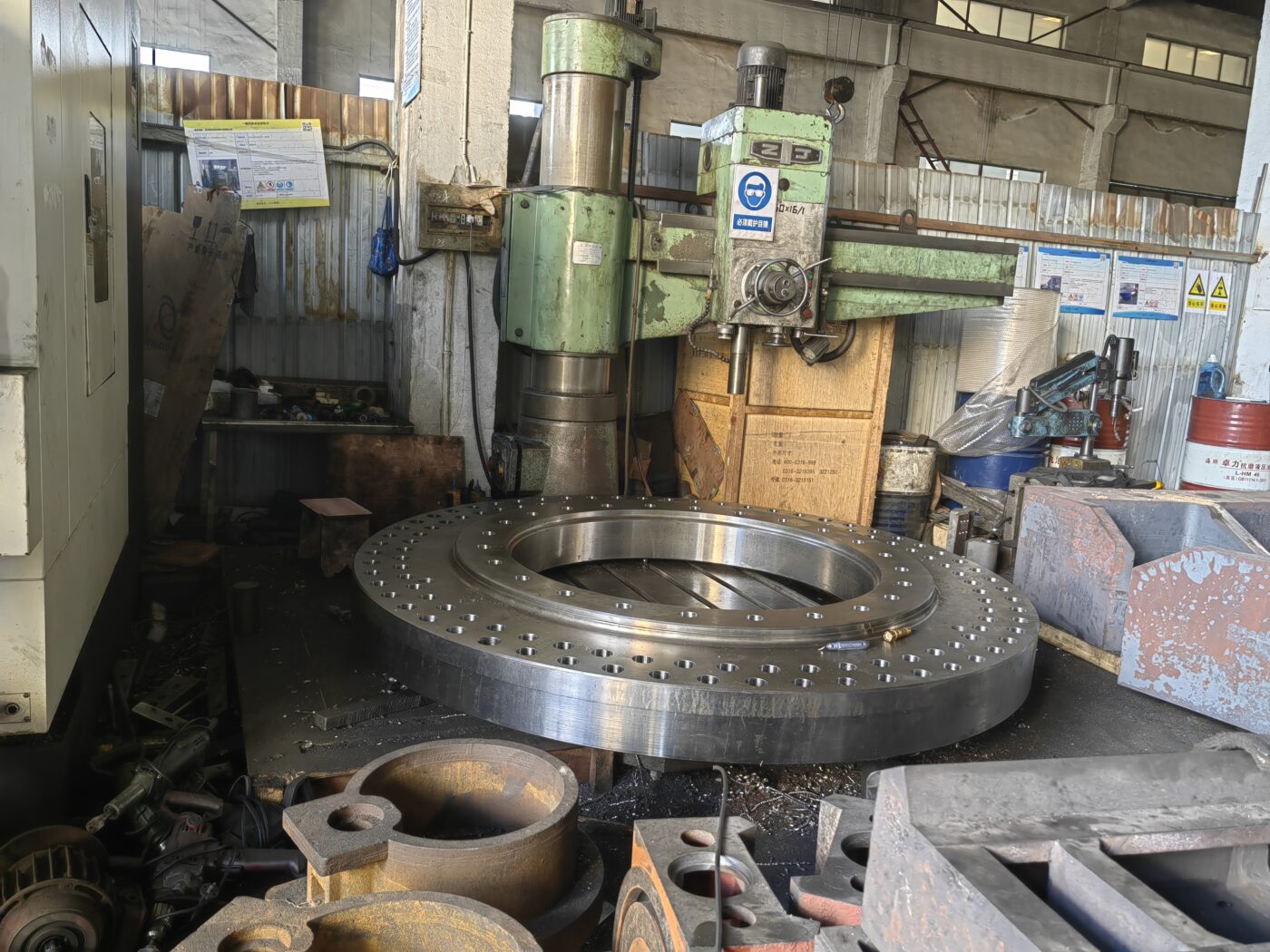
The grade is the same 25Cr-4Mo-7Ni-0.27N super duplex as the pipe, but the forging route changes what matters. Thick sections cool more slowly, and in the 600–1,000 °C range slow cooling precipitates sigma and chi phases that destroy toughness and corrosion resistance. A forging that meets tensile requirements can still fail ASTM A923 Method A, which is why the test exists and why it is written into subsea specifications.
Hot working is carried out between 1,050 °C and 1,150 °C. Below 1,050 °C the alloy cracks; above 1,200 °C the ferrite content climbs and the grain coarsens. After forging, the part is solution annealed at 1,025–1,125 °C and water quenched — not air cooled — to suppress precipitation. Thick sections need the quench rate verified by thermocouple rather than by the furnace chart.
In service, F53 forgings go into valve bodies, subsea hubs and connectors, choke bodies, pump casings and tube sheets. The 32 HRC ceiling in NACE MR0175 sour service is normally met in the annealed condition, but hardness in the centre of a 300 mm section can drift above the surface reading, so we survey hardness across the section and report the maximum.
F53 Forging Standards and Comparable Grades
A182 F53 covers forged or rolled flanges, forged fittings and valve parts. Bar stock for machining is normally ordered to A479 or A276, and billet for open-die forging to A314 or by internal specification. The designation F53 is often written as 2507, S32750, 1.4410 or UNS S32750 on the same enquiry — all four are the same material.
Note the distinction from F55 (S32760, Zeron 100). Both are 25Cr super duplex with PREN above 40, but F55 contains copper and tungsten, and the two are not interchangeable in a qualified welding procedure.
| System | Designation |
| UNS | S32750 |
| W.Nr. / EN | 1.4410 / X2CrNiMoN25-7-4 |
| ASTM A182 | F53 — forged flange, fitting, valve part |
| ASTM A479 / A276 | Bar for machining |
| ASTM A923 | Intermetallic phase detection |
| NORSOK M-630 | MDS D55 / D57 |
Where F53 Forgings Are Used
Subsea valve bodies
Gate, ball and check valve bodies for manifolds and trees, forged to shape and machined, with UT on the finished body.
Wellhead hubs and connectors
Clamp hubs, studded outlets and connector bodies where 2205 lacks the pressure rating at the required wall.
Flanges and pipe spools
A182 F53 weld-neck and blind flanges, ring-rolled to 24 inch and above, matched to A790 pipe for sour and seawater lines.
Choke bodies and flow modules
Erosion-resistant choke bodies for sand-producing wells, where the higher yield strength allows tighter trim clearances.
Pump and compressor casings
Seawater lift pump casings and impeller hubs, resistant to crevice attack under gaskets and deposits.
Tube sheets and channel covers
Tube sheets for seawater and produced water exchangers, drilled and clad-free, avoiding dissimilar welds to the tubes.
Supply Range and Forging Route
Open-die forged blocks and bars from 100 mm to 800 mm section, up to 4,000 kg per piece; ring-rolled flanges from 6 inch to 24 inch nominal bore; near-net forged valve bodies to drawing. Bar stock for machining from 25 mm to 400 mm diameter, peeled or rough turned.
The forging route is specified on the order: upset and draw with a minimum forging ratio of 4:1, solution anneal at 1,025–1,125 °C, water quench, then pickling or machining. We do not supply air-cooled F53, and any repair welding requires a qualified procedure plus a local re-anneal that the buyer should approve in advance.
Inspection includes ultrasonic testing to ASTM A388 or A745 with acceptance criteria agreed at order, ferrite content by metallography (35–55% target), ASTM A923 Method A impact and Method C corrosion, hardness survey across the section, and ASTM G48 Method A pitting test where specified. Dimensional and PMI reports are issued with the EN 10204 3.1 certificate.
Chemical Composition of F53 (wt%)
Chemistry is identical to the pipe grade, so a mill that supplies both can use one heat — which is worth asking for, because it halves the certification work on a project that needs flanges and pipe from the same heat.
The nitrogen range of 0.24–0.32% matters more in a forging than in pipe: nitrogen suppresses ferrite in the thick section and raises the annealed yield strength. A heat at the bottom of the range may not reach 550 MPa in a 300 mm block.
| Element | Min % | Max % |
| Chromium (Cr) | 24.00 | 26.00 |
| Nickel (Ni) | 6.00 | 8.00 |
| Molybdenum (Mo) | 3.00 | 5.00 |
| Nitrogen (N) | 0.24 | 0.32 |
| Carbon (C) | — | 0.030 |
| Manganese (Mn) | — | 1.20 |
| Silicon (Si) | — | 0.80 |
| Copper (Cu) | — | 0.50 |
| Phosphorus (P) | — | 0.035 |
| Sulphur (S) | — | 0.020 |
| Iron (Fe) | balance | balance |
Mechanical Properties of F53 Forgings
Values are the ASTM A182 F53 minima at room temperature for the solution-annealed condition. The grade has no ageing treatment, so the mechanical properties are set by composition and cooling rate alone.
Impact toughness is the property that separates a good forging from a rejected one. A923 Method A requires absorbed energy above the specification threshold at room temperature and is sensitive to sigma phase that tensile testing will not detect.
| Property (room temperature) | ASTM A182 F53 |
| Tensile strength | ≥ 800 MPa |
| Yield strength (0.2%) | ≥ 550 MPa |
| Elongation in 50 mm | ≥ 15% |
| Hardness (NACE limit) | ≤ 32 HRC |
Need F53 forging stock, blocks or rolled flanges?
Send the drawing or section size, quantity, forging ratio, heat-treatment and inspection requirements (A388, A923, G48) — we reply with forge availability, lead time and a priced offer, usually within one working day.