
Project Description
Sanicro 28 (UNS N08028, EN 1.4563, X1NiCrMoCuN31-27-4, GB 00Cr27Ni31Mo3Cu, also traded as Alloy 28, 28 Alloy, Incoloy 28, and Nicrofer 3127 hMo) is a high-alloy multi-purpose super-austenitic stainless steel CRA pipe originally developed in the 1970s by Sandvik (now Alleima) specifically to withstand the aggressive intermediate-concentration phosphoric acid encountered in wet-process H₃PO₄ evaporators — and over the subsequent five decades has evolved into one of the industry’s most versatile corrosion-resistant alloys, equally at home in deep sour gas wells, concentrated sulfuric acid plants, seawater-cooled exchangers, and ASME Section III nuclear heat exchangers. Its defining metallurgical signature is the ternary balance of 31% Ni – 27% Cr – 3.5% Mo – 1% Cu on a sub-0.02% carbon base, a formulation that simultaneously imparts outstanding resistance to reducing acids (via Ni + Cu + Mo synergy), oxidizing acids (via high Cr), chloride stress corrosion cracking (40% CaCl₂ at 100°C immune), pitting (PREN ~40), crevice corrosion, and intergranular attack — while retaining full austenitic stability down to cryogenic temperatures with Charpy values exceeding 60 J at −196°C per EN 10216-5. ASTM B668 governs seamless tube and pipe, with solution-annealed room-temperature minima of Rp0.2 ≥220 MPa (32 ksi), Rm 550–750 MPa (80–109 ksi), A ≥40%, and hardness ≤90 HRB for sections up to 20 mm wall; for thicker sections and bar stock the yield minimum relaxes to ≥200 MPa. For upstream oil and gas, cold-worked high-strength grades Sanicro 28-110 (≥760 MPa / 110 ksi yield) and Sanicro 28-125 (≥860 MPa / 125 ksi yield) are qualified under NACE MR0175 / ISO 15156 for sour H₂S service, making Sanicro 28 one of the few super-austenitic alloys listed in the NACE standard without environmental restriction on chloride or H₂S partial pressure in the solution-annealed, cold-worked, and as-welded conditions. SHUNFU METAL supplies ASTM B668 N08028 seamless CRA pipe in outside diameters 6–260 mm (¹⁄₄″–10″) with wall thickness 0.5–25 mm, solution-annealed at 1100–1160°C and water-quenched, pickled and passivated, delivered with EN 10204 Type 3.1 MTC and full-length PMI + UT (ASTM E213 / ISO 10893-10) + ET (ASTM E426 / ISO 10893-1) + hydrotest per EN 10216-5 for each and every pipe.
Equivalent Grades — Super-Austenitic Fe-Ni-Cr-Mo-Cu Family
| Alloy / Trade Name | UNS | EN / DIN | GB / JIS | Key Alloying | PREN | NACE MR0175 |
|---|---|---|---|---|---|---|
| Sanicro 28 / Alloy 28 | N08028 | 1.4563 X1NiCrMoCuN 31-27-4 |
00Cr27Ni 31Mo3Cu |
27Cr-31Ni -3.5Mo-1Cu |
~40 | Listed — sol-annealed, cold-worked & as-welded |
| Nicrofer 3127 hMo | N08028 | 1.4563 | — | Same chemistry — VDM trade name |
~40 | Same as Sanicro 28 |
| Alloy 31 | N08031 | 1.4562 | — | 27Cr-31Ni -6.5Mo-1.2Cu-N |
~50 | Listed — 2× Mo of 28, premium upgrade |
| Alloy 926 (6Mo) | N08926 | 1.4529 | — | 21Cr-25Ni -6.5Mo-Cu-N |
~46 | Listed — higher PREN, lower Ni than 28 |
| Alloy 825 | N08825 | 2.4858 | NS1402 | 22Cr-42Ni -3Mo-2Cu-Ti |
~31 | Listed — less Cr/Mo than 28, more Ni |
| Alloy 904L | N08904 | 1.4539 | 00Cr20Ni 25Mo4.5Cu |
20Cr-25Ni -4.5Mo-1.5Cu |
~36 | Listed — lower Cr than 28, ~30% cheaper |
Sanicro 28 occupies the strategic middle ground between conventional super-austenitics (904L, Alloy 825) and the premium 6% Mo grades (Alloy 926, 1925hMo, AL-6XN). Its 27% Cr base gives it a decisive oxidizing-acid advantage over the 20–22% Cr competition, while its 3.5% Mo keeps the price well below the 6.5% Mo tier. The 31% Ni content — uniquely high for a 27Cr stainless — is the key to its NACE MR0175 sour-service universality: unlike lower-Ni super-austenitics whose NACE qualification is conditional on strength level or process condition, Sanicro 28 is listed in all three metallurgical conditions.
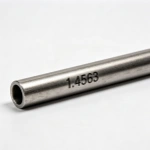
Super-Austenitic CRA Pipe
Oil, Gas & Chemical Process Applications of Sanicro 28 CRA Pipe
Sour Gas Production
Production tubing, casing, and liners in deep H₂S/CO₂ wells. Cold-worked grades 28-110 and 28-125 deliver 110–125 ksi yield with full NACE MR0175 / ISO 15156 qualification in solution-annealed, cold-worked, and as-welded conditions — one of the few super-austenitic alloys with unconditional sour listing.
Phosphoric Acid Evaporators
The worldwide market-leading material for wet-process H₃PO₄ heat-exchanger tubes. Multiple plants with >10-year continuous service records. Resists chloride and free fluoride impurities that destroy graphite and lower-alloy tubes. At 200°C in contaminated 95% super-phosphoric acid: 0.03 mm/year.
Sulfuric Acid Handling
Piping and heat exchangers in 40–70% H₂SO₄ (de-aerated) and >85% concentrations. In 98% concentrated acid the corrosion rate rivals Alloy C-276. Chloride-contaminated sulfuric streams where super-duplex SAF 2507 is inadequate — sections above ~20% H₂SO₄ are a decisive market for Sanicro 28.
Seawater Cooling
Heat exchanger tubes and seawater piping where the alloy serves both seawater and process-side corrosion simultaneously. Proven to eliminate galvanic coupling, coating failure, and bi-metallic tube-sheet complications. Shutdowns <1 month with water <30°C require no draining or freshwater flushing.
Nuclear Heat Exchangers
ASME Section III (Code Case 1325-18, 600°F/316°C max) and Section VIII Div.1 (850°F/455°C max) qualified for nuclear service. Selected for resistance to SCC, pitting, and crevice corrosion in reactor cooling water — a direct consequence of the 31% Ni matrix suppressing chloride-SCC.
Organic Acid Processes
Acetic acid — immune at all concentrations and temperatures, including high-temperature high-pressure environments. Formic acid — far outperforms 316L and 904L. Acetic + formic acid mixtures — superior to both AISI 316 and 317L. Nitric acid — Huey test (ASTM A262 Practice C) corrosion rate <0.15 mm/year.
Flue Gas Desulfurization
FGD absorber outlet ducts, reheaters, and chimney liners handling condensing sulfuric acid mist at the dew-point boundary — the zone where 316L and duplex grades fail by dew-point acid attack within months. Sanicro 28 provides the price-performance sweet spot between 904L and Alloy C-276 in FGD retrofit projects.
Caustic Soda / Alkali
NaOH at moderate temperatures and concentrations where the alloy outperforms AISI 304/316 and can replace pure nickel. In NaOH + NaCl mixed environments Sanicro 28 outperforms both Alloy 800 and Alloy 904L, making it a process engineer’s choice for caustic evaporation units handling brine-contaminated feed.
Downhole Wirelines & Control Lines
High-strength solid wire and capillary tubing for downhole chemical injection, pressure monitoring, and instrument deployment in sour wells. The cold-worked high-strength condition (28-110/125) delivers the mechanical load capacity of duplex without the α′-martensite embrittlement risk.
Supply Range — ASTM B668 Sanicro 28 CRA Pipe
| Standard | ASTM B668, EN 10216-5, SEW 400, NFA 49-217 |
| OD Range | 6–260 mm (¹⁄₄″–10″) |
| Wall Thickness | 0.5–25 mm (0.020″–1.0″) |
| Length | Random (4–7 m) or fixed-length per order |
| End Finish | Plain end, beveled (30°–37.5°), threaded |
| Surface | Solution-annealed + pickled + passivated, or bright-annealed |
| Heat Treatment | 1100–1160°C (2010–2120°F) / water-quench; thin-walled tubes may be accelerated air-cooled |
| Quality Tests | PMI (100%), UT per ASTM E213 / ISO 10893-10, ET per ASTM E426 / ISO 10893-1, hydrostatic per EN 10216-5, visual + dimensional 100% |
| Certification | EN 10204 Type 3.1 MTC; Type 3.2 by 3rd party on request; NACE MR0175 / ISO 15156 compliance statement |
| Cold-Worked | Grade 28-110 (≥760 MPa / 110 ksi) and 28-125 (≥860 MPa / 125 ksi) for OCTG |
solution-annealed & pickled
Physical Properties — Sanicro 28 / N08028
| Density | 8.0 g/cm³ (0.29 lb/in³) |
| Elastic Modulus (20°C) | 195 GPa (28.3 × 10³ ksi) |
| CTE (30–100°C) | 15.0 × 10⁻⁶ / °C |
| CTE (30–400°C) | 16.0 × 10⁻⁶ / °C |
| Thermal Cond. (20°C) | 10 W/(m·°C) [5.5 Btu/(ft·h·°F)] |
| Thermal Cond. (400°C) | 19 W/(m·°C) [11 Btu/(ft·h·°F)] |
| Specific Heat | ~460 J/(kg·K) |
| Electrical Resistivity (20°C) | 0.99 μΩ·m |
| Relative Permeability | ≈1.003 (non-magnetic) |
| Microstructure | Fully austenitic (γ-FCC), stable to cryogenic temperatures |
| Charpy Impact (−196°C) | ≥60 J (44 ft·lb) — EN 10216-5 qual. |
Chemical Composition — Sanicro 28 / N08028 / 1.4563
| Element | Wt% — Nominal | Wt% — ASTM B668 Range | Metallurgical Function |
|---|---|---|---|
| Carbon (C) | — | ≤0.030 | Ultra-low carbon suppresses sensitization and intergranular corrosion in the as-welded condition. C-curve TTC data confirms >30 min dwell time in the 600–700°C sensitization window without grain-boundary carbide precipitation. |
| Silicon (Si) | — | ≤1.0 | Deoxidizer; kept low to avoid sigma-phase stabilization during welding and elevated-temperature service. |
| Manganese (Mn) | — | ≤2.0 | Desulfurization aid and austenite stabilizer; controlled to maintain hot-workability without degrading corrosion resistance. |
| Phosphorus (P) | — | ≤0.030 | Strictly limited per standard; SHUNFU controls to ≤0.020% to maximise weld-pool cleanliness and hot-ductility. |
| Sulfur (S) | — | ≤0.030 | Strictly limited; SHUNFU controls to ≤0.010% via AOD refining to eliminate hot-shortness and ensure Class-A weldability. |
| Chromium (Cr) | 27.0 | 26.0–28.0 | Primary passivating element. 27% Cr is the highest level among commercially significant Fe-Ni-Cr-Mo super-austenitics — the driving force behind the alloy’s oxidizing-acid superiority (HNO₃, H₂SO₄ >85%, phosphoric acid with oxidizing impurities). |
| Nickel (Ni) | 31.0 | 30.0–34.0 | Austenite stabilizer and reducing-acid resistor. At 31% the nickel content is high enough to suppress chloride SCC at all practical service temperatures — 40% CaCl₂ at 100°C (U-bend, 1000 h) shows zero cracking. Also the key to unrestricted NACE MR0175 sour service qualification. |
| Molybdenum (Mo) | 3.5 | 3.0–4.0 | Pitting and crevice corrosion resistance in chloride environments. Contributes ~11.5 points to PREN (3.3 × 3.5). Elevated Mo distinguishes Alloy 28 from the 2–3% Mo grades (Alloy 825, 904L) while remaining below the 6.5% Mo tier on cost. |
| Copper (Cu) | 1.0 | 0.6–1.4 | Reducing-acid passivation — Cu enriches the passive film in non-oxidizing acids (hot H₂SO₄, H₃PO₄) where Cr alone cannot sustain passivity. Synergistic with Mo in sulfuric acid; the Cu + Ni + Mo ternary is the alloy’s defining corrosion signature. |
| Nitrogen (N) | — | — | Residual; not a deliberate micro-alloying element as in the 6% Mo grades. Kept low to preserve weld-ductility and avoid nitride precipitation during solution annealing. |
| Iron (Fe) | Bal. (~36) | Balance | Solvent matrix; the iron base is the primary cost differentiator versus nickel-based alloys (Alloy C-276, Alloy 625) while retaining super-austenitic corrosion performance at roughly 50–60% of the nickel-alloy price point. |
Mechanical Properties — ASTM B668 Solution-Annealed
At 20°C — Section ≤20 mm Wall / Bar ≤100 mm
| Property | Metric | Imperial |
|---|---|---|
| Yield Strength Rp0.2 | ≥220 MPa | ≥32 ksi |
| Yield Strength Rp1.0 | ≥250 MPa | ≥36 ksi |
| Tensile Strength Rm | 550–750 MPa | 80–109 ksi |
| Elongation A | ≥40% | ≥40% |
| Hardness (max) | ≤90 HRB | — |
At 20°C — Section >20 mm Wall / Bar >100 mm
| Property | Metric | Imperial |
|---|---|---|
| Yield Strength Rp0.2 | ≥200 MPa | ≥29 ksi |
| Yield Strength Rp1.0 | ≥230 MPa | ≥33 ksi |
| Tensile Strength Rm | 550–750 MPa | 80–109 ksi |
| Elongation A | ≥40% | ≥40% |
| Hardness (max) | ≤90 HRB | — |
Cold-Worked High-Strength OCTG Grades (NACE MR0175 Qualified)
| Grade | Rp0.2 min | Rm min | Elong. A2″ | Hardness max |
|---|---|---|---|---|
| Sanicro 28-110 | ≥760 MPa (≥110 ksi) |
≥795 MPa (≥115 ksi) |
≥11% | ≤35 HRC |
| Sanicro 28-125 | ≥860 MPa (≥125 ksi) |
≥895 MPa (≥130 ksi) |
≥10% | ≤37 HRC |
Elevated-Temperature Yield Strength Rp0.2 (thin section, min)
| °C | 100 | 200 | 300 | 400 | 500 | 550 |
|---|---|---|---|---|---|---|
| Rp0.2 MPa | 190 | 160 | 150 | 135 | 120 | 115 |
| Rm MPa | 510 | 440 | 390 | 370 | 350 | 340 |
PREN: ~40 (calculated as %Cr + 3.3 × %Mo + 16 × %N = 27 + 11.55 + 1.6).