
L80-1 is the carbon-steel answer to hydrogen sulphide: 552–655 MPa yield, a 23 HRC hardness ceiling, and a chemistry deliberately left wide so the mill controls hardness rather than composition. It is the default sour-service casing in most onshore fields, and the grade most often ordered without the one line that makes it work — the 22 HRC verification on the finished pipe.
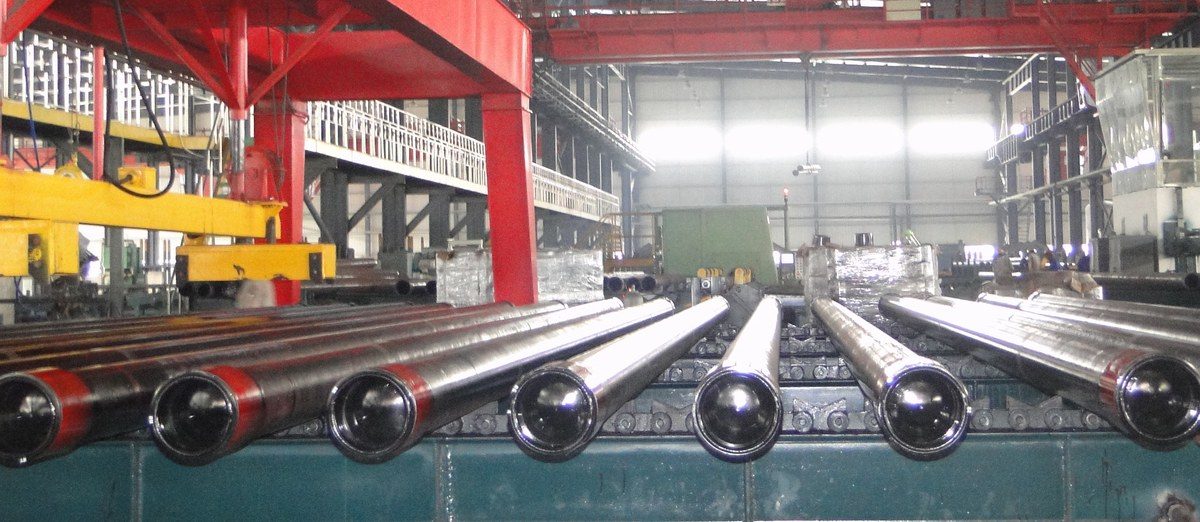
What L80-1 Is and Where It Sits
API 5CT defines L80 in three types, and they are three different steels sharing one designation. Type 1 is a carbon-manganese steel and is what the market means by “L80” in most conversations. Type 9Cr and Type 13Cr are chrome-bearing versions for CO2 service. Confusing the three is the most common specification error in sour-service casing.
| Type | Chemistry | Where it is used |
|---|---|---|
| L80-1 (Type 1) | Carbon-manganese, hardness controlled | H2S service with low CO2 |
| L80 Type 9Cr | 9 % chromium | CO2 service, higher temperature |
| L80 Type 13Cr | 13 % chromium, martensitic | Sweet CO2 wells, the entry CRA grade |
Type 1 sits between N80 and C90 in the grade hierarchy and is the only one of the three that is bought for cracking resistance rather than corrosion resistance. If the well has CO2 but no H2S, the correct choice is 13Cr, not L80-1. If it has H2S but little CO2, L80-1 is the cheapest grade that will survive.
The Hardness Ceiling
Sulphide stress cracking is a hardness phenomenon. Hard regions of the steel can absorb enough hydrogen to crack under load, and the way to prevent it is to keep the whole wall below a hardness threshold. API 5CT caps L80 at 23 HRC (241 HBW) for that reason; ISO 15156 / NACE MR0175 caps carbon steel at 22 HRC for sour service.
Those two numbers are one point apart, and that point is where most L80-1 orders go wrong. A pipe at 22.8 HRC passes API 5CT and fails the NACE limit. If the purchase order says only “L80-1 to API 5CT”, the mill is entitled to ship it. The order has to read “hardness 22 HRC maximum, verified on the finished pipe” — and be tested after the final temper, not on the billet.
Verification means a survey, not a spot check. Hardness is measured at four points around the circumference on both ends of every joint, or per an agreed sampling plan, and recorded against the heat number. Anything above the limit is either re-tempered or rejected; it cannot be argued down with a tensile test.
Chemical Composition of L80-1 (wt%)
L80-1 is the rare API grade where chemistry is a ceiling rather than a recipe. The standard does not tell the mill which steel to melt; it tells the mill what the finished pipe must do. Carbon, manganese and the residuals are capped so that the required hardness is achievable with a normal quench and temper, and the mill is free to work inside those limits.
| Element | Maximum % |
|---|---|
| Carbon (C) | 0.43 |
| Manganese (Mn) | 1.90 |
| Silicon (Si) | 0.45 |
| Phosphorus (P) | 0.030 |
| Sulphur (S) | 0.030 |
In practice most L80-1 heats run near 0.25–0.35 % carbon and 0.8–1.2 % manganese, which is enough to reach the yield window without pushing hardness past the cap. A heat at the 0.43 % carbon ceiling can still meet the mechanical requirements and will struggle to stay under 22 HRC — which is why the hardness test, not the chemistry, decides acceptance.
Mechanical Properties of L80-1
The yield window is narrow by design: 552 to 655 MPa. That is a band of just over 100 MPa, in which the steel must be strong enough to hold the string and soft enough to resist cracking. It is the tightest window of any standard API 5CT grade below C90.
| Property | Requirement |
|---|---|
| Yield strength | 552–655 MPa (80,000–95,000 psi) |
| Tensile strength | ≥ 655 MPa (95,000 psi) |
| Elongation | Per formula, from test area and tensile |
| Hardness, API 5CT | ≤ 23 HRC (241 HBW) |
| Hardness, NACE MR0175 | ≤ 22 HRC (250 HV) |
A heat that lands at 650 MPa yield with 21 HRC hardness is the ideal outcome: maximum strength inside the window with margin under the NACE cap. A heat at 660 MPa is out of grade even though it is stronger, and a heat at 21 HRC but 540 MPa yield is out of grade in the other direction. The two requirements pull against each other, and the mill balances them in the temper.
Sizes, Weights and Connections
L80-1 is produced as casing from 4-1/2 in to 13-3/8 in and as tubing from 1.05 in to 4-1/2 in. The common casing combinations are the same as any other grade in the size, so the grade choice does not change the dimensional options — it changes the wall available at a given weight and the connection that can be cut on it.
| Outside diameter | Common nominal weights (lb/ft) | Typical duty |
|---|---|---|
| 4-1/2 in (114.3 mm) | 11.6 / 13.5 / 15.1 | Sour tubing and liner |
| 5-1/2 in (139.7 mm) | 17.0 / 20.0 / 23.0 | Sour production casing |
| 7 in (177.8 mm) | 23.0 / 26.0 / 29.0 / 32.0 | Main sour production string |
| 9-5/8 in (244.5 mm) | 40.0 / 43.5 / 47.0 | Sour intermediate casing |
| 13-3/8 in (339.7 mm) | 54.5 / 61.0 / 68.0 | Surface string in sour fields |
Connections follow the same rule as any casing: STC and LTC for low-tension strings, BTC where the string carries compression as well as tension, and a premium metal-to-metal connection for gas wells. Sour gas wells almost always justify premium connections, because an API round thread relies on thread compound for the seal and a leak path in H2S service is not a maintenance item.
Where L80-1 Stops
L80-1 solves cracking. It does not solve corrosion, and conflating the two is how a sour string ends up with a corrosion allowance it cannot afford. Wet CO2 attacks carbon steel at a rate set by partial pressure and temperature; above roughly 0.5 bar CO2 partial pressure the required wall becomes uneconomic and a 13Cr grade takes over. L80-1 has no answer to that, because it is designed to resist hydrogen cracking, not to resist CO2.
The second limit is the service condition itself. ISO 15156 does not certify a grade; it evaluates a combination of H2S partial pressure, in-situ pH, temperature and chloride level. The same L80-1 string can be acceptable in one well and outside the standard in the next, and the evaluation has to be done on the well data rather than on the mill certificate. This is why sour-service enquiries should carry the gas composition and water analysis, not just the word “sour”.
Chlorides are the third confusion. Chloride stress corrosion cracking is a stainless-steel failure mode; carbon steel is not susceptible to it in the same way. For L80-1 the governing variables are H2S, pH and hardness — chloride content matters far less than it does when the same well is being considered for 13Cr or duplex.
What a Quotation Needs
Two L80-1 enquiries with the same size and weight can be different products. The difference is in the last three lines of the specification, not the first three. Send:
- Outside diameter and nominal weight
- L80-1, stated as Type 1 — not just “L80”
- Hardness requirement: 22 HRC maximum for NACE MR0175 service, with the test method
- Connection: STC, LTC, BTC or named premium
- Length range R1, R2 or R3
- Quantity in joints, metres or tonnes
- H2S partial pressure, pH and temperature for the ISO 15156 evaluation
- Inspection: MTC level, hardness survey scope, third-party witness
ShunFu Metal supplies L80-1 casing and tubing from API Q1 certified mills, with hardness surveys recorded against heat number and mill certificates to EN 10204 3.1. Request a quotation.
Frequently Asked Questions
What is the difference between L80-1 and L80-13Cr?
Chemistry and purpose. L80-1 is a carbon-manganese steel bought for resistance to sulphide stress cracking in low-CO2 wells. L80-13Cr is a 13 % chromium martensitic steel bought for resistance to CO2 corrosion in sweet wells. They share a designation and a yield window, and they are not interchangeable.
What hardness should be specified for sour service?
22 HRC maximum, verified on the finished pipe, when the string is to be used under NACE MR0175 / ISO 15156. API 5CT alone permits 23 HRC, so an order that cites only the API grade does not guarantee the sour-service limit.
Can L80-1 be used in CO2 service?
Only where the CO2 partial pressure is low enough that a corrosion allowance is practical. Carbon steel corrodes in wet CO2 regardless of grade, and L80-1 offers no protection against it. Above roughly 0.5 bar CO2 partial pressure, 13Cr is normally the cheaper answer over the life of the well.
Why is the L80-1 yield range so narrow?
Because the grade is balanced between two opposing requirements: enough strength to carry the string, and low enough hardness to resist sulphide stress cracking. The 552–655 MPa window is where both can be met at the same time.
Is L80-1 available with premium connections?
Yes. The pipe is supplied plain-end or API threaded, and premium connections are cut at a licensed facility with the connection manufacturer’s qualification testing and torque-turn records. Name the connection designation rather than writing “premium”.
Need L80-1 casing with 22 HRC verification?
Send the size and weight, connection, quantity and the well conditions. We reply with hardness survey scope, mill availability and a priced offer, usually within one working day.