
317L (UNS S31703, 1.4438) is the grade that fills the gap between 316L and 904L. One extra percent of molybdenum — 3.0–4.0% against 2.0–3.0% — lifts PREN from about 26 to 30 and buys meaningful margin in sulphur-bearing and mildly chlorinated streams, at roughly a third of the price of a super-austenitic.
The carbon cap of 0.03% makes it weldable without post-weld annealing, exactly like 316L, and the nickel range of 11–15% stabilises the austenite enough to tolerate the higher molybdenum. It is a direct substitution grade: same fabrication practice, same welding consumables family, slightly better corrosion resistance.
It is the standard material for sulphur recovery unit piping, sour water stripper overheads, and dilute sulphuric acid service where 316L corrodes at an unacceptable rate but 904L is not justified. It also appears in pulp and paper bleach plants and in flue gas desulphurisation slurry lines.
317L is not a substitute for duplex in chloride stress corrosion cracking. Its austenitic structure still cracks in hot chlorides, and NACE MR0175 permits it only within a narrow sour service window. Where SCC is the threat, 2205 or 2507 is the answer.
Standards and Equivalent Grades
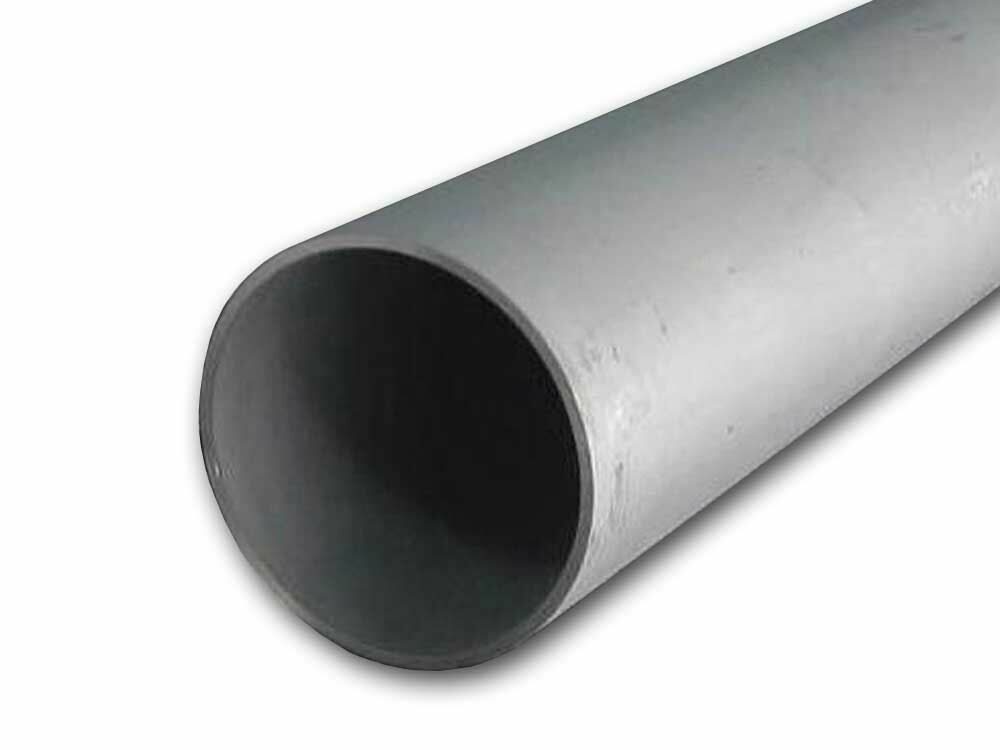
Pipe to A312, tube to A213, bar to A479 and A276, fittings to A403, and forged flanges to A182 F317L. The European designation is 1.4438 (X2CrNiMo18-15-4) and the Chinese equivalent is 022Cr19Ni13Mo3.
| System | Designation |
| UNS | S31703 |
| W.Nr. / EN | 1.4438 / X2CrNiMo18-15-4 |
| ASTM A312 / A213 | Pipe / seamless tube |
| ASTM A479 / A276 | Bar for machining |
| ASTM A182 F317L | Forged flange |
| GB | 022Cr19Ni13Mo3 |
Where 317L Is Used
Sulphur recovery units
Claus unit piping, condensers and reheater tube bundles handling wet sulphur-bearing gas.
Sour water stripper overheads
Overhead lines where ammonia, H2S and chlorides appear together at 80–120 °C.
Dilute sulphuric acid
Acid coolers and transfer lines below 60 °C where 316L corrodes too quickly.
Flue gas desulphurisation
Slurry piping and absorber internals with chlorides up to 20,000 ppm.
Pulp and paper bleach plants
Chlorine dioxide and hypochlorite stages where 316L pits under deposits.
Heat exchanger tubing
Bundles for mildly aggressive process streams where higher alloys are not justified.
Supply Range and Condition
Seamless pipe from 6 mm to 610 mm outside diameter; seamless tube from 6 mm to 50 mm; round bar from 16 mm to 300 mm, peeled or ground. Standard condition is solution annealed at 1,030–1,100 °C and water quenched, pickled and passivated.
Testing includes hydrostatic or eddy current test, intergranular corrosion test to ASTM A262 Practice E where specified, and PMI on the finished part. EN 10204 3.1 certificates with heat traceability.
Chemical Composition of 317L (wt%)
Molybdenum at 3.00–4.00% is the defining range and the element to verify on the certificate; a heat at 3.05% and a heat at 3.95% both comply but behave differently in chloride service. Nickel at 11.00–15.00% is higher than 316L to keep the alloy fully austenitic at that molybdenum level.
| Element | Min % | Max % |
| Chromium (Cr) | 18.00 | 20.00 |
| Nickel (Ni) | 11.00 | 15.00 |
| Molybdenum (Mo) | 3.00 | 4.00 |
| Carbon (C) | — | 0.030 |
| Manganese (Mn) | — | 2.00 |
| Silicon (Si) | — | 0.75 |
| Phosphorus (P) | — | 0.045 |
| Sulphur (S) | — | 0.030 |
| Iron (Fe) | balance | balance |
Mechanical Properties
Values are the ASTM A312 minima at room temperature for solution-annealed product. The grade is used annealed and is not hardenable by heat treatment.
| Property (room temperature) | ASTM minimum |
| Tensile strength | ≥ 485 MPa |
| Yield strength (0.2%) | ≥ 205 MPa |
| Elongation in 50 mm | ≥ 35% |
Need 317L bar, pipe or tube?
Send the size, quantity, form and the operating chemistry (chlorides, H2S, temperature) — we reply with mill availability, lead time and a priced offer, usually within one working day.