
316L (UNS S31603, 1.4404) is the grade every project falls back on when 304 is not quite enough and a duplex or nickel alloy is more than the duty justifies. The 2–3% molybdenum is what buys the extra pitting resistance; the 0.03% carbon cap is what makes it weldable without a post-weld anneal, which is why almost every instrument and utility line on a platform is 316L.
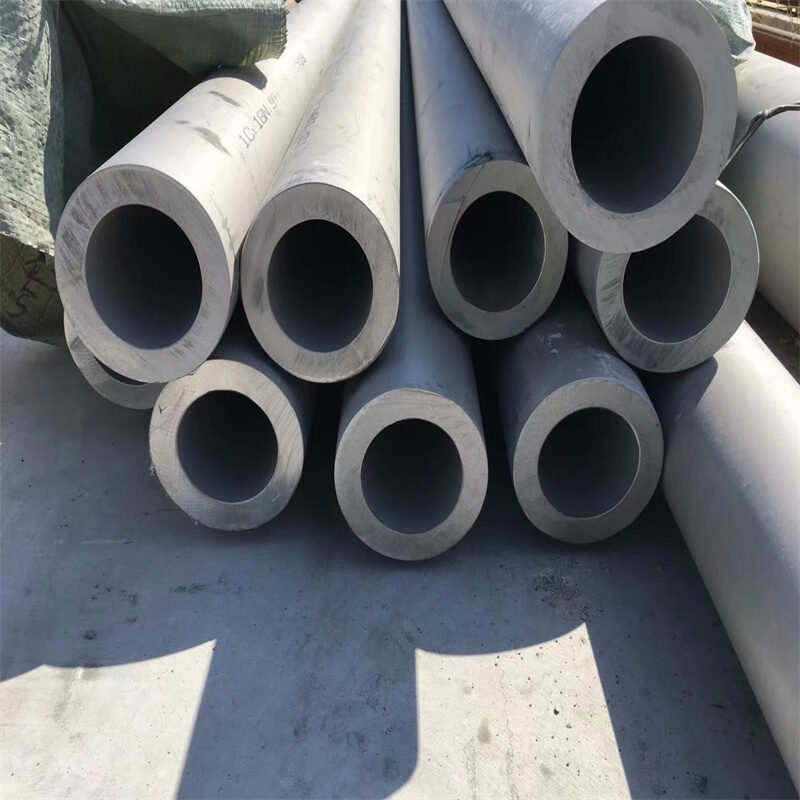
Compared with 316, the only difference is carbon — 0.03% maximum instead of 0.08%. That is enough to prevent chromium carbide precipitation in the weld heat-affected zone, so welded pipe does not need solution annealing after fabrication. For field-welded utility lines this is the deciding property.
The grade is not a sour service answer on its own. NACE MR0175 permits 316L only within a narrow window of H2S partial pressure, pH and temperature, and it is prone to chloride stress corrosion cracking above about 60 °C. Where those limits are exceeded the choice moves to duplex 2205 or a nickel alloy.
Supply is normally specified to A312 for pipe and A213 for tube, with A403 wrought fittings and A182 F316L forgings for flanges. Matching the fitting specification to the pipe is where documentation errors usually appear.
Standards and Equivalent Grades
A312 covers seamless and welded pipe; A213 covers seamless tube; A269 covers general-service tube; A403 covers wrought fittings. The European designation is 1.4404, and the Chinese equivalent is 022Cr17Ni12Mo2.
| System | Designation |
| UNS | S31603 |
| W.Nr. / EN | 1.4404 / X2CrNiMo17-12-2 |
| ASTM A312 / A213 | Pipe / seamless tube |
| ASTM A403 | Wrought fittings |
| ASTM A182 F316L | Forged flanges |
| GB | 022Cr17Ni12Mo2 |
Where 316L Pipe Is Used
Instrument and impulse tubing
Gauge, transmitter and analyser lines, where bendability and weldability matter more than strength.
Water injection and utility lines
Low-pressure injection and wash water lines where chlorides stay below the SCC threshold.
Low-pressure sour service
Produced water and slop lines inside the NACE MR0175 envelope for austenitic stainless.
Chemical dosing and sampling
Methanol, glycol and corrosion inhibitor injection skids.
Heat exchanger tubing
Shell-and-tube bundles for clean, low-chloride process streams.
Hygienic and high-purity service
Food, pharmaceutical and high-purity water lines where 304 would pit.
Supply Range and Condition
Seamless pipe from 6 mm to 610 mm outside diameter, wall 1.0 mm to 30 mm; welded pipe to 1,200 mm; seamless tube for instrumentation from 6 mm to 25 mm with bright annealed finish. Standard condition is solution annealed and pickled; bright annealed material is available for instrument tubing.
Testing includes hydrostatic or eddy current test, flattening and flare tests, intergranular corrosion test to ASTM A262 Practice E on request, and PMI on the finished length. EN 10204 3.1 certificates with heat traceability.
Chemical Composition of 316L (wt%)
Molybdenum at 2.00–3.00% is the only meaningful difference from 304L, and it is the element that decides whether the pipe survives a chloride-bearing stream. Carbon is capped at 0.03% for weldability.
| Element | Min % | Max % |
| Chromium (Cr) | 16.00 | 18.00 |
| Nickel (Ni) | 10.00 | 14.00 |
| Molybdenum (Mo) | 2.00 | 3.00 |
| Carbon (C) | — | 0.030 |
| Manganese (Mn) | — | 2.00 |
| Silicon (Si) | — | 0.75 |
| Phosphorus (P) | — | 0.045 |
| Sulphur (S) | — | 0.030 |
| Iron (Fe) | balance | balance |
Mechanical Properties
Values are the ASTM A312 minima at room temperature for solution-annealed pipe. The grade is not strengthened by heat treatment and is used annealed throughout.
| Property (room temperature) | ASTM A312 minimum |
| Tensile strength | ≥ 485 MPa |
| Yield strength (0.2%) | ≥ 170 MPa |
| Elongation in 50 mm | ≥ 35% |
Need 316L pipe, tube or matching fittings?
Send the size, schedule, quantity, seamless or welded route and any NACE or intergranular test requirement — we reply with mill availability, lead time and a priced offer, usually within one working day.