
Project Description
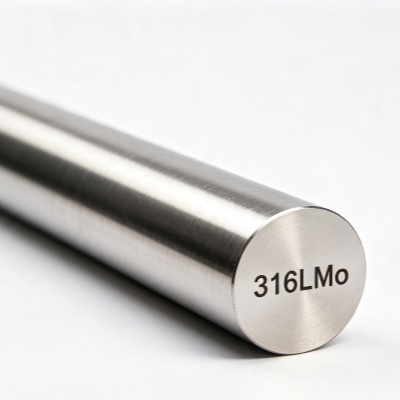
316LMo (UNS S31603), formally designated as 1.4435, X2CrNiMo18-14-3, and 03Х17Н14М3, is the premium nickel-enriched variant of standard 316L austenitic stainless steel. While it shares the same UNS number as conventional 316L, the 1.4435 composition imposes tighter and higher minimum alloy limits — nickel 12.50–15.00% (vs 10.00–14.00%), molybdenum minimum 2.50% (vs 2.00%), and chromium minimum 17.00% (vs 16.00%) — yielding measurably improved resistance to pitting corrosion and chloride stress corrosion cracking at a marginal cost increment above standard 316L. SHUNFU METAL, certified to ISO 9001:2015 and API Q1, produces 316LMo bars to the enriched 1.4435 chemistry through controlled electric arc furnace (EAF) melting with AOD refining, verifying nickel and molybdenum content by in-house OES on every heat to ensure compliance with the tighter EN 10088-3 tolerances that define this grade.
316LMo / 1.4435 Stainless Steel Bar — Overview
316LMo (1.4435) is the upgraded chemistry variant of 316L specified when standard 316L is close to its corrosion performance limit and the cost of upgrading to 904L, 254SMO, or duplex stainless steels is difficult to justify. The approximately 25% higher minimum nickel content (12.5% vs 10.0%) and guaranteed molybdenum floor of 2.5% provide a discernible margin of safety against localized corrosion initiation in mildly aggressive chloride-containing oilfield environments, including produced water with moderate salinity, seawater-cooled heat exchangers operating below the crevice corrosion threshold, instrument tubing in mildly sour gas streams, and chemical injection fittings handling dilute acid or oxidizing media. The fully austenitic microstructure, low carbon content (0.030% max), and molybdenum addition collectively provide good weldability without post-weld heat treatment, though the richer nickel content offers an additional benefit of reduced ferrite formation in weld deposits compared to standard 316L. SHUNFU METAL supplies 316LMo bars in the solution-annealed condition (1040–1100°C, water quenched), with full MTC documentation per EN 10204 Type 3.1 confirming compliance with the enriched 1.4435 chemistry.
316LMo / 1.4435 Equivalent Grades — International Standards
| Standard | Designation |
|---|---|
| ASTM A479 / A276 / A240 / A182 | UNS S31603 / Grade 316L (F316L forging) |
| EN 10088-3 / DIN | 1.4435 / X2CrNiMo18-14-3 |
| GOST 5632 | 03Х17Н14М3 (03Kh17N14M3) |
Note that UNS S31603 is shared between standard 316L and the enriched 1.4435 chemistry; the EN grade designation (1.4435) and GOST designation (03Х17Н14М3) are the definitive identifiers of the enriched nickel-molybdenum variant. SHUNFU METAL supplies bars certified to ASTM A479 UNS S31603 with EN 10088-3 Grade 1.4435 chemistry, with full heat traceability and API Q1 documentation as standard.
SHUNFU METAL
316LMo / 1.4435 Applications — Oil & Gas Industry
316LMo (1.4435) is specified where standard 316L is technically capable but operating close to its corrosion margin — the richer nickel and molybdenum chemistry provides a qualifying buffer against localized corrosion without the step-change cost of 904L or 254SMO. SHUNFU METAL supplies 316LMo bars to the following oil and gas applications, with every production lot verified against ASTM A479 UNS S31603 and EN 10088-3 Grade 1.4435 chemistry limits:
Supply Range — 316LMo / 1.4435 Bar Dimensions
SHUNFU METAL maintains comprehensive production capability for 316LMo bars across hot-rolled, cold-finished, and forged product forms, processed through ISO 9001:2015 controlled workflows. Standard solution annealing at 1040–1100°C followed by rapid water quenching ensures a fully austenitic microstructure free of deleterious sigma and chi intermetallic phases. The following dimensional ranges are offered as standard, with custom sizes accommodated through in-house facilities:
| Product Form | Diameter / Thickness Range | Width Range | Length (Standard) | Surface Finish |
|---|---|---|---|---|
| Hot Rolled Round | 10 mm – 300 mm | — | 3000 – 6000 mm | Black / Pickled |
| Cold Finished / Peeled Round | 3 mm – 100 mm | — | 2000 – 6000 mm | Peeled / Polished |
| Hot Rolled Flat | 10 mm – 120 mm | 50 mm – 400 mm | 2000 – 6000 mm | Pickled |
| Forged Round | 100 mm – 800 mm | — | 1000 – 6000 mm | Rough Machined / Black |
| Forged Flat / Block | 50 mm – 350 mm | 100 mm – 800 mm | 1000 – 5000 mm | Rough Machined / Black |
All bars are supplied with EN 10204 Type 3.1 Mill Test Certificates documenting heat number, full chemical analysis (confirming Ni ≥ 12.50% and Mo ≥ 2.50%), mechanical test results, solution annealing verification, and dimensional compliance. Intergranular corrosion testing per ASTM A262 Practice E (Streicher test) is available for welded fabrication qualification.
316LMo / 1.4435 Chemical Composition
The 1.4435 composition differentiates itself from standard 316L through three enriched alloy minima: nickel at 12.50% (vs 10.00%), molybdenum at 2.50% (vs 2.00%), and chromium at 17.00% (vs 16.00%). These tighter specifications — while still within the broader UNS S31603 envelope — ensure that every 1.4435 heat contains measurably more of the alloying elements responsible for pitting resistance (Cr + Mo) and stress corrosion cracking resistance (Ni). At SHUNFU METAL, every heat is verified by in-house optical emission spectrometry (OES) against both ASTM A479 UNS S31603 and the tighter EN 10088-3 Grade 1.4435 limits:
| Element | C | Mn | Si | P | S | Cr | Ni | Mo |
|---|---|---|---|---|---|---|---|---|
| 1.4435 (EN 10088-3) | 0.030 max | 2.00 max | 1.00 max | 0.045 max | 0.015 max | 17.00–19.00 | 12.50–15.00 | 2.50–3.00 |
| 316L (ASTM A479) | 0.030 max | 2.00 max | 1.00 max | 0.045 max | 0.030 max | 16.00–18.00 | 10.00–14.00 | 2.00–3.00 |
The pitting resistance equivalent number (PREN) calculated as %Cr + 3.3(%Mo) = 17.5 + 3.3(2.75) ≈ 26.6 for a typical 1.4435 heat, compared to 16.5 + 3.3(2.5) ≈ 24.8 for standard 316L at its minimum composition. While this PREN differential of approximately 2 points represents a modest improvement, the real-world corrosion advantage of 1.4435 is amplified by the higher nickel content (12.5% minimum) which raises the alloy’s resistance to chloride stress corrosion cracking — the failure mode that most frequently limits 316L service life in oilfield environments. SHUNFU METAL’s API Q1 certified traceability links every finished bar to its original heat analysis, with Ni ≥ 12.50% and Mo ≥ 2.50% confirmed on every MTC.
316LMo / 1.4435 Mechanical Properties — Solution Annealed
The mechanical properties of 316LMo (1.4435) are essentially identical to those of standard 316L — the enriched nickel and molybdenum chemistry is specified for corrosion resistance improvement, not strength enhancement. SHUNFU METAL performs in-house tensile testing (ASTM E8) and hardness testing (ASTM E18) on every production lot, with full results documented on the MTC:
| Property | Minimum | Typical | Test Method |
|---|---|---|---|
| Tensile Strength (MPa / ksi) | 485 / 70 | 580 / 84 | ASTM E8 |
| Yield Strength 0.2% (MPa / ksi) | 170 / 25 | 280 / 41 | ASTM E8 |
| Elongation in 4D (%) | 30 | 45 | ASTM E8 |
| Reduction of Area (%) | 40 | 65 | ASTM E8 |
| Hardness (HB / HRB) | HB 217 max / HRB 95 max | HRB 80 | ASTM E10 / E18 |
Values per ASTM A479 for bar products in the solution-annealed condition (1040–1100°C, water quenched). The mechanical properties of 1.4435 are indistinguishable from standard 316L by tensile or hardness testing — the specification is exclusively a chemistry upgrade for corrosion resistance.
Selection guidance — when to upgrade from 316L to 316LMo (1.4435): The enriched 1.4435 chemistry should be specified when operating experience with standard 316L shows evidence of localized pitting initiation or chloride stress corrosion cracking at chloride concentrations, temperatures, or pH conditions that are borderline for the standard grade. The incremental material cost of 1.4435 over standard 316L is typically a single-digit percentage, making it a cost-effective insurance upgrade when replacement of failed components involves production deferral, vessel entry, or offshore intervention costs that far exceed the modest material premium.
Service temperature limits: 316LMo (1.4435) shares the same temperature capability as standard 316L: suitable for continuous service from cryogenic temperatures up to approximately 450°C in oxidizing atmospheres and 870°C in reducing or dry environments. Prolonged exposure between 450°C and 870°C should be avoided unless the component is solution annealed after fabrication. SHUNFU METAL’s ISO 9001:2015 accredited laboratory validates all mechanical properties on representative test specimens from each heat treatment batch, with API Q1 ensuring full material traceability from melt to end user.