
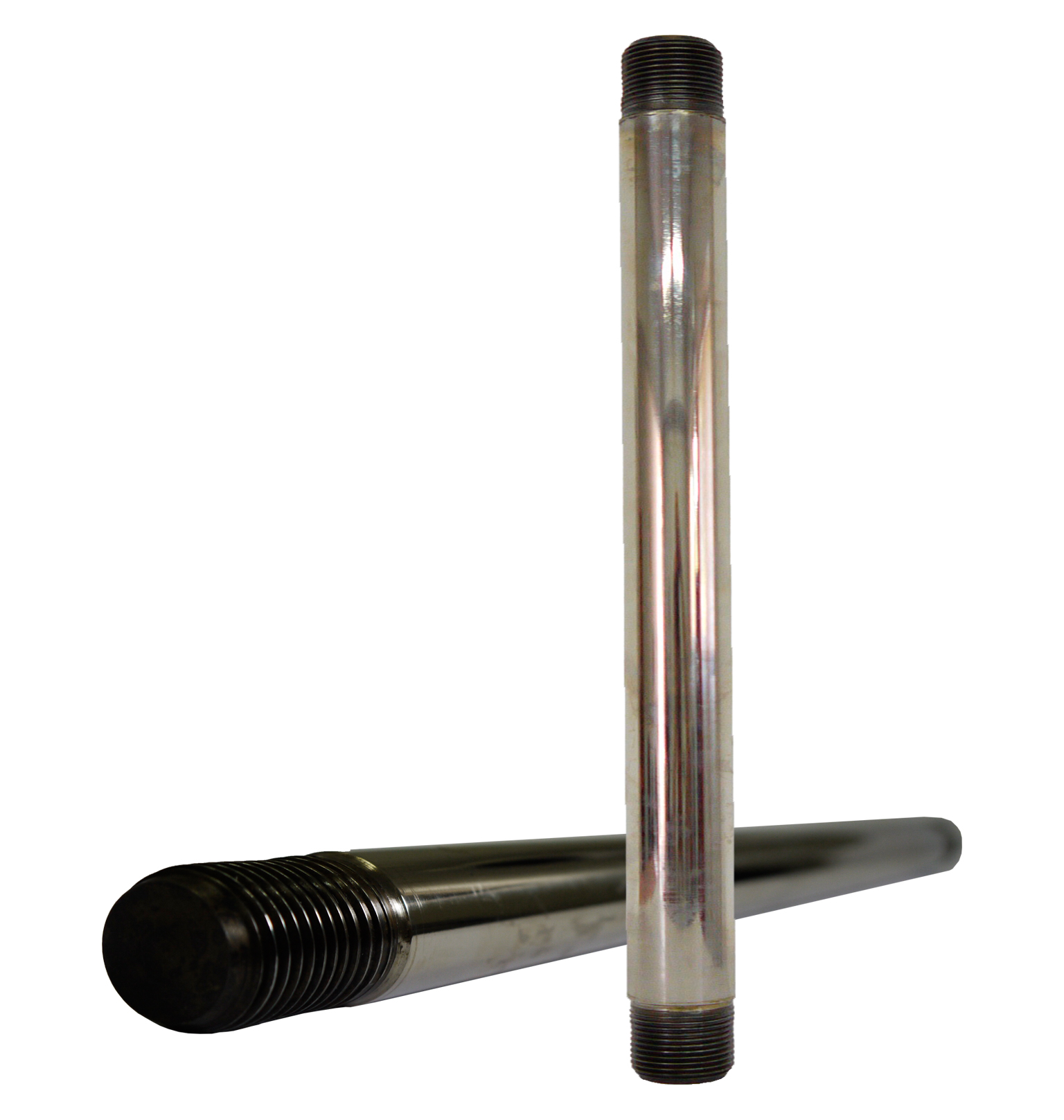
Polished rod is the top section of a sucker rod string and the only part that passes through the stuffing box on every stroke. Its surface finish, straightness and thread quality decide how long the packing lasts and how often the well has to be shut in. Supplied to API Spec 11B in 1045 carbon, 4140 alloy, 8620 norloy and 431 stainless, with cold-rolled threads and matched couplings. Standard polished rods connect to a polished rod coupling; end-upsetting rods connect to a sucker rod coupling.
Standard and Function
A polished rod is not a length of sucker rod with a smooth finish. It is a separate component covered by its own section of API Spec 11B, and it carries three requirements the rest of the string does not: a ground and polished OD that seals against the stuffing box packing, a straightness tolerance tight enough that the packing is not worked sideways on each stroke, and a rolled thread at the upper end sized to the carrier bar rather than to the rod string.
The grade choice is normally made by the operator rather than the mill, and it follows the well rather than the load. A non-corrosive waterflood well runs 1045 carbon; a mildly corrosive CO2 well runs 4140 alloy; a CO2 or mildly sour well with chlorides moves to 431 stainless; and a genuinely sour well needs the N50 grade qualified to NACE MR0175. Getting this wrong does not show up as a broken rod on day one — it shows up as pitting under the packing, which then cuts the sealing surface.
Sizes and Thread Data
Common polished rod (API Spec 11B):
| Size (inch) | Diameter of rod body OD(mm) | Thread nominal diameter (in) | Width of sucker rod (in) | Polished rod thread vanish cone BP4 | Standard length L ±50(mm) |
|---|---|---|---|---|---|
| 1-1/8 | 28.58 (+0.13,-0.25) | 15/16 or 1 1/16 | 5/8 or 3/4 | 9° | 2400/3400/4900/6700/7900/9100/11000/12200 |
| 1-1/4 | 31.75 (+0.13,-0.25) | 1 3/16 | 7/8 | 9° | 2400/3400/4900/6700/7900/9100/11000/12200 |
| 1-1/2 | 38.10 (+0.13,-0.25) | 1 3/8 | 1 | 9° | 2400/3400/4900/6700/7900/9100/11000/12200 |
End-upsetting polished rod (SY/T 5029-2006):
| Size (inch) | Diameter of rod body OD(mm) | Upsetting end thread nominal diameter (in) | Not upsetting end thread nominal diameter (in) | Width of sucker rod (in) | Length of polished rods LK ±50(mm) |
|---|---|---|---|---|---|
| 1 | 25.40 (+0.13,-0.25) | 1 3/16 | 15/16 | 1 3/16 | 4500/6000/8000/10000/11000/12000 |
| 1-1/8 | 28.58 (+0.13,-0.25) | 1 3/8 | 1 1/16 | 1 3/8 | 4500/6000/8000/10000/11000/12000 |
| 1-1/4 | 31.75 (+0.13,-0.25) | 1 9/16 | 1 3/16 | 1 9/16 | 4500/6000/8000/10000/11000/12000 |
Two dimensions in these tables are worth checking before an order is placed. The thread nominal diameter is not the rod body diameter — a 1-1/4 in rod carries a 1-3/16 in thread on the common pattern and a 1-9/16 in upset thread on the end-upsetting pattern, and the coupling follows the thread, not the body. The second is the vanish cone: all standard sizes use a 9° cone, and a non-standard cone angle means the thread cannot be gauged with the same ring.
Grades and Material Selection
| Type | Material | Min tensile | Where it belongs |
|---|---|---|---|
| Piston steel | 1045 medium carbon | 620 MPa 100,000 psi |
Non-corrosive well fluids, light to heavy loads. The lowest-cost option and the benchmark for the others. |
| Alloy steel | 4140 Cr-Mo | 860 MPa 125,000 psi |
Mild to medium corrosive fluids that are effectively inhibited. Higher hardenability and better abrasion resistance than 1045. |
| Norloy steel | 8620 Ni-Cr-Mo | 689 MPa 100,000 psi class |
Carburising grade; case hardness with a tough core where abrasion rather than corrosion drives the wear. |
| Stainless steel | 431 martensitic | 792 MPa 115,000 psi |
Corrosive service including salt water, and progressing cavity pump wells where torque strength matters. The general-purpose corrosion answer. |
| N50 high-power | Stainless, NACE qualified | On request | Sour wells. Conforms to NACE MR0175 for high-strength unannealed bar — the only grade here intended for H2S service. |
| Hard-faced | 1045 with welded OD overlay | On request | Abrasive plus corrosive conditions at moderate to heavy load. The overlay is what resists wear; the base grade is not upgraded. |
Chemical composition (wt%):
| Type | C | Mn | Si | P | S | Cr | Ni | Mo |
|---|---|---|---|---|---|---|---|---|
| 1045 Piston Steel | 0.43-0.50 | 0.60-0.90 | 0.25 max | 0.040 max | 0.050 max | / | / | / |
| 4140 Alloy Steel | 0.38-0.43 | 0.75-1.00 | 0.20-0.35 max | 0.035 max | 0.040 max | 0.80-1.10 | / | 0.15-0.25 |
| 8620 Norloy Steel | 0.18-0.23 | 0.70-0.90 | 0.15-0.35 max | 0.035 max | 0.040 max | 0.40-0.70 | 0.40-0.70 | 0.15-0.25 |
| 431 Stainless Steel | 0.20 max | 1.0 max | 1.0 max | 0.040 max | 0.030 max | 15.0-17.0 | 1.25-2.50 | / |
Minimum tensile strength:
| Type | Tensile Strength (Mpa) |
|---|---|
| 1045 Piston Steel | 620 min |
| 4140 Alloy Steel | 860 min |
| 8620 Norloy Steel | 689 min |
| 431 Stainless Steel | 792 min |
The composition table covers the four grades that are melted to a fixed chemistry. The N50 and hard-faced variants are supplied against their own procurement specification, so chemistry is confirmed on the mill certificate rather than quoted as a range here.
Rolled Threads and Couplings
This technique ensures a perfect thread on each and every pin. The burnished thread surface that results from rolled threads improves resistance to corrosion and reduces abrasion within the thread. The work hardened flank provides increased surface tensile, yield and shear strength. Due to pressure deformation, a residual compressive stress system builds up at the thread root, which counteracts tensile loading. When compared to cut threads, the load capacity of rolled thread is increased by 6 – 12%.
Couplings are supplied matched to the rod: a polished rod coupling for the common pattern, a sucker rod coupling for the end-upsetting pattern. Both are cold-formed and rolled to the same practice as the pin, because a cut coupling thread against a rolled pin thread gives up most of the fatigue gain the rolling was meant to buy.
Applications
Beam-pumped oil wells
The standard duty. Polished rod through the stuffing box on every stroke, sized from the rod string and the polished rod load rather than from the pump bore.
Progressing cavity pump wells
431 stainless is the usual choice: the higher torque strength and toughness suit PCP drive strings, and the corrosion resistance covers the produced fluids.
CO2 and mildly sour wells
4140 where inhibition is reliable, 431 where chlorides are present. Both fail by pitting under the packing if the grade is chosen on load alone.
Sour service
N50 to NACE MR0175. The grade is specified for the H2S partial pressure of the well, not selected from a catalogue.
Sandy and abrasive wells
Hard-faced 1045 with a welded OD overlay. Used where solids in the fluid wear the packing surface faster than corrosion attacks it.
Thermal and steam injection
Thermal service changes the modulus and the packing behaviour; the rod is specified with the temperature at the stuffing box in mind, and couplings are matched for the same cycle.
Inspection and Certification
Polished rods fail at three places — the thread root, the undercut at the change of section, and the packing surface. The inspection plan is built around those three.
| Check | Method | What it catches |
|---|---|---|
| Chemistry | Heat analysis, verified by OES on request | Grade mix-up between 1045, 4140 and 8620, which all look identical after grinding |
| Tensile and yield | One test per heat treatment lot | Under-tempered or under-annealed stock |
| Thread gauging | API 11B ring and plug gauges, 100% of pins | Pitch diameter and cone angle errors that only show as a leak or a jump-out at the wellsite |
| Surface and straightness | Visual and dial indication on the polished section | Grinding marks and bend that destroy the packing seal |
| Hardness | HRC on the body, and on the overlay for hard-faced rod | Overlay thickness and bond quality on hard-faced stock |
| NACE verification | Hardness and tensile per MR0175 for N50 | Sour service grade supplied outside its qualified strength window |
Certification is EN 10204 Type 3.1 traceable to heat number, with the grade, tensile result and thread gauge record on the certificate. For N50 the NACE MR0175 statement is issued against the supplied strength level, because the qualification does not transfer to a higher strength condition.
Need Polished rods to the specification above?
Send the size, condition, quantity and any NACE or PMI requirements — we reply with mill availability, lead time and a priced offer, usually within one working day.