What the patent actually protects — and why it should change how you specify offshore valve-body steel
When an international EPC or OCTG buyer evaluates Chinese valve-body steel, the first question is always the same: which standard does it map to, and can the metallurgy be trusted? The invention that just earned China’s 26th National Patent Award — A high-strength, high-toughness steel for petroleum drilling-platform valve bodies and its production process (patent No. ZL201510356334.7) — answers both directly.
At its core this is a low-alloy chromium-molybdenum (Cr-Mo) steel in the same family as AISI 4130 and AISI 4140. In North American wellhead practice the equivalent is API 6A material class 60K/75K, most often supplied as quenched-and-tempered AISI 4130 forgings, or — where low-temperature qualification is required — as ASTM A350 LF2. In Europe the same steel is 25CrMo4 (1.7218) or 42CrMo4 (1.7225), produced as forgings to EN 10222-2 or as castings to EN 10213. The full mapping is summarized below.
| Attribute | Detail |
|---|---|
| Award | 26th China National Patent Award — Excellence Prize |
| Patent No. | ZL201510356334.7 |
| Title | High-strength, high-toughness steel for petroleum drilling-platform valve bodies and its production process |
| Lead inventor | Shi Kewei, Deputy Chief Engineer, HuaiGang |
| Industrialized | End of 2015 |
| Grade series | 65K to 95K (full range) |
| System | Equivalent grade | Note |
|---|---|---|
| China (patent route) | 65K–95K series | Spans and exceeds API 6A 75K ceiling |
| API 6A | 60K (414 MPa) / 75K (517 MPa) | Standard wellhead body designations |
| USA (AISI/UNS) | AISI 4130 (G41300) / 4140 (G41400) | Cr-Mo low-alloy |
| USA (forgings) | ASTM A182 / ASTM A350 LF2 | A350 LF2 qualified at −46 °C |
| Europe (EN) | 25CrMo4 (1.7218) / 42CrMo4 (1.7225) | EN 10222-2 forged / EN 10213 cast |
The root problem with legacy ingot-forged valve-body steel
The reason high-strength valve-body steel for deep-sea and polar service stayed imported for so long is not chemistry — it is the starting stock. The traditional route casts an ingot and then forges it. Ingots segregate. They carry macro-shrinkage, central porosity, and a coarse, heterogeneous structure that forging alone cannot fully erase. The patent record is blunt about the consequences: low yield, long production cycle, low steel purity, and mechanical properties that simply cannot meet deep-sea high-pressure and ultra-low-temperature requirements.
That is the gap this patent targets. It is not a new alloy so much as a new pedigree for the same service-critical part. And pedigree is exactly what offshore buyers should be auditing, because the failure modes of a poorly fed ingot — brittle fracture at the lowest design temperature, inclusion-initiated cracking under sustained pressure — are the failure modes that kill valves on a platform.
The breakthrough — a continuously cast large round bloom as forging feedstock
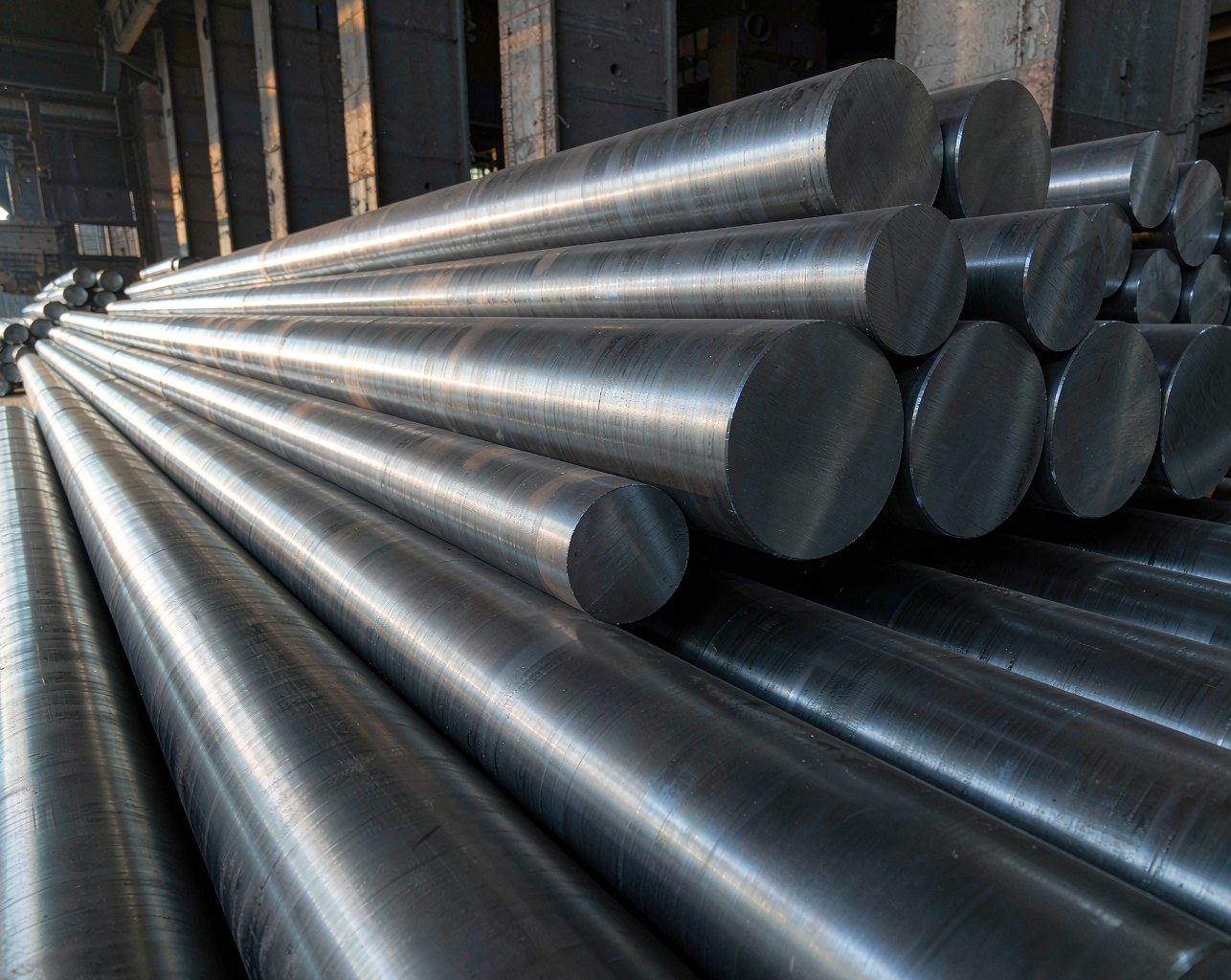
The inventive step is to discard the ingot entirely. The patented route casts a large-diameter continuous-cast round bloom, then applies continuous rolling and finally forging to shape the body. Feeding the forging press with a homogenized, continuously cast bloom instead of a segregated ingot changes the metallurgical starting point: tighter chemistry control, fewer central defects, and a structure the subsequent rolling and forging can refine rather than fight.
Four process levers do the heavy lifting: an optimized alloy composition, full-process protective casting to keep the melt clean, three-stage electromagnetic stirring to suppress centerline segregation, and precise dephosphorization and inclusion control. Together they lift steel purity, density, and chemical uniformity to a level the legacy route cannot reach.
| Dimension | Traditional ingot + forge | Patented CC-bloom + roll + forge |
|---|---|---|
| Starting stock | Ingot (segregation, shrinkage) | Continuous-cast large round bloom |
| Yield (成材率) | Low | Significantly improved |
| Production cycle | Long | Shortened (continuous flow) |
| Purity / cleanliness | Low | High (protective cast + EMS + de-P) |
| Property ceiling | Cannot meet extreme service | Meets −60 °C + high pressure |
Why it wins at −60 °C and under extreme pressure
The headline property is stable toughness at −60 °C, paired with high strength and high pressure-bearing capacity — the combination demanded by deep-sea high-pressure and polar operating envelopes. The patent states the mechanical properties substantially exceed those of the traditional process. The mechanism is straightforward: cleanliness and homogeneity are what let a Cr-Mo forging retain ductile behavior at very low temperatures. An ingot-derived part carries the seeds of its own brittle fracture — centerline segregation and residual inclusions become crack origins exactly when the steel is coldest and most stressed.
Our view is that this is the point most buyers miss. They compare a Chinese 75K body to a Western 75K body on the certificate line and stop there. The certificate does not tell you whether the starting stock was a clean continuous-cast bloom or a segregated ingot. For Arctic and deep-water valves, that distinction is the difference between a part that survives its design temperature and one that does not.
| Requirement | Patented steel |
|---|---|
| Low-temperature toughness | Stable at −60 °C |
| Strength | High (65K–95K range) |
| Pressure-bearing | Meets deep-sea high-pressure service |
| Versus traditional process | Mechanical properties far exceed legacy route |
Industrialization — 500,000 tonnes and a 65K–95K series
A patent is only a promise until it ships. This one has. Since the end of 2015, the technology has produced more than 500,000 tonnes of high-end petroleum valve-body steel with cumulative sales above 2 billion yuan. The product covers the full 65K to 95K grade series and is supplied to CNPC, Sinopec, CNOOC and FMC — replacing the traditional ingot process and becoming the mainstream production technology in its segment. That is the real proof point: a domestic route that has displaced an imported-dependency process at scale is no longer a pilot, it is the incumbent.
| Metric | Result |
|---|---|
| Cumulative output | > 500,000 tonnes |
| Cumulative sales | > 2 billion yuan |
| Grade coverage | 65K–95K full series |
| Reference customers | CNPC, Sinopec, CNOOC, FMC |
| Market position | Mainstream technology, import substitution |
Greener and cheaper, not just stronger
The route also lands on the right side of the cost and carbon conversation. Against the traditional process it lifts production efficiency by more than 30%, cuts comprehensive energy consumption by 25%, and reduces carbon emissions by 20% — while cutting industrial solid waste at the source. For a buyer under Scope-3 pressure, that is a defensible procurement story, not just a performance one. The technology also extends into nuclear power, thermal power, high-end equipment and new energy, which signals the process is generic, not a one-off chemistry trick.
| Indicator | Change |
|---|---|
| Production efficiency | +30% or more |
| Comprehensive energy use | −25% |
| Carbon emissions | −20% |
| Industrial solid waste | Reduced at source |
| Extensible to | Nuclear, thermal, high-end equipment, new energy |
What this means when you specify offshore valve-body steel
Our take for specifiers is simple. Stop treating “made in China” valve-body steel as a price-only line item and start auditing the metallurgical pedigree — because the supplier that casts a clean continuous-cast bloom, rolls it, and forges it has a structurally better part than one that starts from a segregated ingot, even at the same certificate strength. The HuaiGang patent is the clearest public evidence that the domestic continuous-cast-bloom-plus-forging route now delivers −60 °C toughness, a 65K–95K range, and a half-million-tonne, multi-major-customer track record.
At SHUNFU METAL we read this as validation of how we qualify offshore and pressure-part material: we look at the process route, not just the grade line. When you need valve-body or pressure-containing forgings for deep-sea or polar service, ask your supplier one question — ingot or continuous-cast bloom? The answer tells you more about low-temperature reliability than any single impact value on the MTC.
Written by Harris, technical staff at SHUNFU METAL. Data sourced from the 26th China National Patent Award public record for patent ZL201510356334.7.