
440C (UNS S44004 / 1.4125 / X105CrMo17 / SUS440C / 105Х17М / 9Cr18Mo) is the highest-carbon grade in the martensitic stainless steel family, engineered to deliver maximum attainable hardness among all stainless steels — up to 60–62 HRC in the as-quenched condition. With 0.95–1.20% carbon and 16–18% chromium, 440C combines the highest wear resistance of any stainless grade with moderate corrosion protection, making it the definitive material for hardened valve internals, precision bearings, and pump wear components in the petroleum industry.
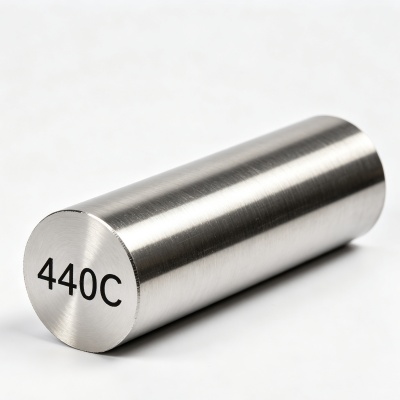
The molybdenum addition (0.40–0.80%) enhances pitting resistance and tempered-hardness stability. SHUNFU METAL manufactures and exports 440C stainless steel bar as a flagship product for global oil and gas equipment supply chains, operating under ISO 9001 and API Q1 certified quality systems with complete lot traceability from melt to dispatch, including ESR remelting for critical bearing and valve applications demanding maximum micro-cleanliness.
440C Stainless Steel — The Hardest Stainless Grade Available
440C belongs to the high-carbon martensitic stainless steel family — alloys whose service properties are developed through austenitizing at 1,010–1,065°C, quenching in oil or forced air to form a hard martensitic structure, and tempering at 150–370°C to balance hardness with toughness. Its defining 0.95–1.20% carbon — the highest in any standard stainless steel — produces a dense distribution of primary and secondary chromium carbides that confer extraordinary wear resistance: 440C outperforms 440A by 4–8 HRC points and 440B by 2–3 HRC points in peak attainable hardness, while matching or exceeding tool steels in abrasive-wear and adhesive-wear (galling) resistance.
The 16–18% chromium provides oxidation protection and mild-environment corrosion resistance superior to carbon and low-alloy tool steels at equivalent hardness. SHUNFU METAL refines every 440C heat through AOD processing with LF and VD finishing steps to achieve tight chemistry control, low sulfur for transverse ductility, and minimal gas content. For bearing-grade and high-integrity valve applications, ESR remelting eliminates centerline segregation and achieves superior micro-cleanliness with ASTM E45 Method A inclusion ratings.
The ISO 9001 framework governs the entire production sequence: incoming raw material verification, spectrometric chemistry checks on every cast, heat treatment chart recording, mechanical test sampling per ASTM A370, ultrasonic inspection per ASTM E2375 / EN 10228-3, and final dimensional verification. API Q1 supplementary requirements — independent third-party witness testing, retained reference samples for five years, and full characteristic documentation — are applied as standard for all API-governed orders.
Compared to 440A and 440B, 440C delivers substantially higher maximum hardness and the best wear resistance of the 440 family, making it the definitive choice for applications where surface durability and edge retention are paramount. Its higher carbide volume, however, reduces solid-solution chromium, giving 440C slightly lower corrosion resistance than 440B in chloride-bearing environments — an acceptable trade-off in petroleum service where the primary degradation mechanisms are abrasive wear, galling, and contact fatigue rather than pitting corrosion.
SHUNFU METAL supplies 440C in the annealed condition for customer machining and subsequent in-house hardening, or fully heat-treated to target hardness (52–60 HRC) per customer specification, supported by complete heat treatment records, EN 10204 3.1 certificates, and optional deep-cryogenic treatment to minimize retained austenite for improved dimensional stability.
Equivalent Grades of 440C Across International Standards
The 440C chemistry is recognized under numerous national and international standards. SHUNFU METAL maintains dual-certified inventory traceable to ASTM, AMS, EN, DIN, JIS, GOST, GB, and ISO norms simultaneously. The ISO 9001 / API Q1 document package ensures seamless acceptance across all end-user, engineering-procurement-construction contractor, and third-party inspection regimes.
| Standard / Specification | Designation |
|---|---|
| ASTM A276 / A276M | Type 440C (UNS S44004) |
| ASTM A580 / A959 | 440C (S44004) Wire / Grade Reference |
| ASTM A473 | Type 440C (S44004) Forgings |
| AMS 5618 / AMS 5630 / AMS 5880 | 440C (S44004) Aerospace / Premium Grade |
| EN 10088-3 | X105CrMo17 (1.4125) |
| DIN EN 10088-3 | X105CrMo17 (1.4125) |
| JIS G4303 | SUS 440C |
| GOST 5632 | 105Х17М (105X17M) |
| GB/T 1220 / GB/T 3280 | 9Cr18Mo / 102Cr17Mo |
| ISO 683-17 | X108CrMo17 |
| SAE J405 | 51440C |
Oil & Gas Industry Applications
440C stainless steel bars serve across the full petroleum value chain — upstream drilling and production, midstream gathering and compression, and downstream refining — wherever maximum surface hardness, galling resistance, and contact-fatigue endurance converge. As the hardest stainless steel commercially available, 440C is the default material for hardened valve internals subjected to high-cycle sliding and impact contact, precision bearing elements in downhole rotating assemblies, and wear-critical pump components handling abrasive produced fluids and drilling muds. SHUNFU METAL supplies 440C bars to API 6A/6D valve manufacturers, pump OEM shops, bearing houses, and precision machining workshops supporting the global petroleum industry, with ISO 9001 and API Q1 certification ensuring full compliance with end-user quality, lot-traceability, and independent verification requirements.
Valve Balls & Seats
Through-hardened to 58–60 HRC floating and trunnion ball-valve balls, solid seats, and seat insert rings for API 6D pipeline and API 6A wellhead gate, ball, plug, and choke valves.
Valve Stems & High-Pressure Trim
Hardened stems, cages, discs, back-seat bushings, and internal trim components for control valves, chokes, and safety-relief valves in high-pressure hydrocarbon and gas-lift service.
Precision Ball & Roller Bearings
Hardened races, rings, rolling elements, and thrust washers for downhole drilling motors, mud-pump power ends, top-drive thrust bearings, and high-speed rotating control devices.
Pump Plungers & Wear Components
Through-hardened reciprocating pump plungers, case and impeller wear rings, shaft sleeves, and throat bushings for API 610 centrifugal pumps and API 674/675 positive-displacement units in produced-water and multiphase service.
Downhole Tools & Drilling Components
Hardened sleeves, bushings, wear pads, and sealing surfaces for drilling jars, stabilizers, reamers, MWD/LWD housings, and rotary-steerable-system components operating in abrasive formations.
Compressor Valve Plates & Springs
Hardened compressor valve plates, rings, springs, and seat plates for reciprocating gas-gathering compressors, gas-lift compression units, and vapor-recovery compressor packages.
Metering Pumps & Injection Quills
Hardened check-valve balls, seats, plungers, and needle-valve metering stems for chemical-injection quills, methanol-injection pumps, sampling systems, and instrument isolation valves.
Choke & Flow-Control Elements
Hardened flow beans, throttle bushings, orifice plates, and cage trim for adjustable and positive chokes in pressure letdown stations, wellhead choke manifolds, and subsea flow-control modules.
Instrument & Gauge Components
Hardened pivots, anvils, bearing points, and sliding contacts for pressure gauges, dead-weight testers, densitometers, and mechanical metering equipment on well-test and process-monitoring skids.
Supply Range of 440C Stainless Steel Bar
SHUNFU METAL manufactures and stocks 440C stainless steel in hot-rolled, forged, and cold-finished bar forms covering the complete dimensional spectrum required by valve, bearing, pump, and downhole-tool manufacturers worldwide. Hot-rolled bars are produced from continuous-cast bloom through our bar mill with controlled reduction ratios ensuring sound center condition; forged bars utilize open-die press forging with upset reduction ratios ≥ 4:1 to achieve full structural consolidation, microstructural refinement, and uniform grain flow in heavy sections up to 1,200 mm diameter.
Cold-finished bars are centerless-ground or peeled to IT 7–8 tolerances with surface roughness Ra ≤ 1.6 μm. Every heat undergoes ultrasonic inspection per ASTM E2375 / EN 10228-3 Class B, dimensional verification against order tolerances, and hardness testing (HRC or HB depending on condition). The ISO 9001 and API Q1 quality system guarantees full traceability: each bar is hard-stamped with heat number and re-identified after cutting, with EN 10204 3.1 certificates linking every delivered piece to melt chemistry, heat treatment chart records, and mechanical test results.
ESR-remelted 440C is stocked for bearing-grade and high-integrity valve applications demanding ASTM E45 Method A inclusion ratings of A/B/C/D thin series and zero centerline segregation.
| Product Form | Diameter / Section Range | Length | Surface / Condition |
|---|---|---|---|
| Hot-Rolled Round Bar | ⌀8 mm – ⌀200 mm | 3,000 – 6,000 mm | Annealed & Peeled / Black |
| Forged Round Bar | ⌀100 mm – ⌀1,200 mm | 2,000 – 8,000 mm | Annealed / Rough Machined |
| Hot-Rolled Flat Bar | 5–100 mm thick × 50–500 mm wide | 3,000 – 6,000 mm | Black / Ground / Machined |
| Forged Flat / Block | 100–500 mm thick × 200–1,200 mm wide | 1,000 – 5,000 mm | Annealed / Rough Machined |
| Forged Rings (Seamless) | OD 200–2,000 mm, WT 50–400 mm | 100–800 mm face height | Rough Machined / Annealed |
| Cold-Finished / Ground Bar | ⌀5 mm – ⌀100 mm | 1,000 – 4,000 mm | Centerless Ground / Polished |
Bars supplied in the annealed condition (max 96 HRB / ~269 HB) for customer machining and in-house hardening, or fully heat-treated to target hardness per specification (52–60 HRC range). Deep-cryogenic treatment (−75 to −100°C) available to reduce retained austenite below 5% for maximum dimensional stability in precision bearing and metering applications. Non-standard diameters, stepped shafts, hollow bars, and cut-to-length pieces on inquiry. Electrolytic cutting for hard-tempered stock avoids thermal alteration at end zones. PKO/PE anti-rust coating, VCI wrapping, and sea-worthy timber crate packing standard for export. Custom packaging and batch-level third-party inspection by SGS, TÜV, or Bureau Veritas on request.
Chemical Composition of 440C (EN 10088-3 / ASTM A276)
The chemical composition of 440C is defined under both European and North American standards with near-identical alloy ranges: EN 10088-3 specifies X105CrMo17 (1.4125) with mandatory molybdenum at 0.40–0.80%, while ASTM A276 defines 440C (UNS S44004) with molybdenum at ≤ 0.75%. The hallmark of 440C is its 0.95–1.20% carbon content — the highest in the standard stainless steel portfolio — which, combined with 16–18% chromium, generates approximately 3–5 vol% more primary carbide than 440B, translating directly to superior abrasive-wear and adhesive-wear resistance.
The molybdenum addition enhances pitting resistance in mildly acidic produced-water environments and retards over-tempering during elevated-temperature service. SHUNFU METAL controls each heat to the tighter overlap range of both specifications through AOD + LF + VD refining, with ESR remelting available for bearing-grade and critical service applications. Spectrometric verification is performed on every cast, and product analysis accompanies each certificate. The API Q1 system mandates retained reference samples for five years and independent third-party rechecks for all critical oil and gas orders. GB/T 1220 9Cr18Mo (C 0.90–1.00, Cr 17.0–19.0, Mo ≤ 0.75) and GOST 5632 105X17M (C 0.95–1.15, Cr 16.0–18.0, Mo ≤ 0.80) are available dual-certified upon request.
| Element | EN 10088-3 X10⁵CrMo17 (1.4125) | ASTM A276 Type 440C (S44004) |
|---|---|---|
| Carbon (C) | 0.95 – 1.20 | 0.95 – 1.20 |
| Silicon (Si) | ≤ 1.00 | ≤ 1.00 |
| Manganese (Mn) | ≤ 1.00 | ≤ 1.00 |
| Phosphorus (P) | ≤ 0.040 | ≤ 0.040 |
| Sulfur (S) | ≤ 0.030 | ≤ 0.030 |
| Chromium (Cr) | 16.0 – 18.0 | 16.0 – 18.0 |
| Molybdenum (Mo) | 0.40 – 0.80 | ≤ 0.75 |
All values in weight percent (wt%). Cast analysis per respective standard. Neither specification mandates a minimum nickel content. SHUNFU METAL’s AOD practice typically achieves P ≤ 0.025% and S ≤ 0.008% for standard-grade, and P ≤ 0.020% / S ≤ 0.005% for ESR-grade, well inside both specification maxima. The GB/T 1220 9Cr18Mo chemistry (C 0.90–1.00, Cr 17.0–19.0, Mo ≤ 0.75, Si ≤ 0.80, Mn ≤ 0.80) and GOST 105X17M chemistry (C 0.95–1.15, Cr 16.0–18.0, Mo ≤ 0.80) are available dual-certified upon request alongside the primary EN/ASTM certificates.
Mechanical Properties — Annealed & Hardened Conditions
440C achieves its full mechanical potential through austenitizing at 1,010–1,065°C, oil quenching (or forced-air for thin sections) to transform the structure to hard martensite, and tempering at 150–370°C to adjust the hardness/toughness balance. Peak hardness of 60–62 HRC is achieved in the as-quenched condition and maintained at 58–60 HRC after the standard low-temperature temper (150–200°C); this is the highest hardness commercially available from any stainless steel.
Deep-cryogenic treatment at −75 to −100°C transforms retained austenite (typically 5–20% after quenching) to fresh martensite, increasing hardness by 1–2 HRC points and improving long-term dimensional stability — a critical requirement for precision bearing components and metering elements. Tempering between 370–540°C must be avoided to prevent chromium carbide sensitization with associated loss of corrosion resistance and impact toughness. Annealed bars (heated to 845–900°C and slowly cooled to ≤ 96 HRB / 269 HB) provide maximum machinability in the annealed condition for customer roughing before finish heat treatment. SHUNFU METAL executes all heat treatment in calibrated furnaces under ISO 9001 and API Q1 protocols with chart-recorder validation, ensuring repeatable through-section properties. For oil-quenched sections exceeding 75 mm diameter, immediate tempering after quench-cooling to 50–60°C is mandatory to prevent delayed cracking; double tempering is recommended for sections above 100 mm to ensure uniform hardness and complete stress relief.
| Condition | Tensile Rm (MPa) | Yield Rp0.2 (MPa) | Elong. A5 (%) | RA Z (%) | Hardness |
|---|---|---|---|---|---|
| +A Annealed (845–900°C, FC) | 760 – 860 | 415 – 450 | 15 – 20 | 30 – 40 | ≤ 96 HRB (≤ 269 HB) |
| +QT315 Hardened & Temp. 315°C (ASTM A276) | ≥ 1,930 | ≥ 1,860 | ≥ 3 | ≥ 15 | ≥ 55 HRC |
| +QT200 Hardened & Temp. 150–200°C (Max Hardness) | 1,800 – 2,070 | 1,600 – 1,900 | 2 – 5 | 10 – 15 | 58 – 60 HRC |
| +QT300 Hardened & Temp. 200–370°C (Balanced Toughness) | 1,550 – 1,950 | 1,350 – 1,750 | 3 – 8 | 12 – 20 | 52 – 57 HRC |
| As-Quenched (1,010–1,065°C, OQ/AC) | — | — | — | — | 60 – 62 HRC |
| +A Cold-Finished Wire, Annealed (ASTM A580) | ≤ 965 | — | — | — | ≤ 96 HRB |
Data per ASTM A276/A276M, EN 10088-3, AMS 5630, and manufacturer typical values. Mechanical properties measured on longitudinal specimens at room temperature per ASTM A370 / EN ISO 6892-1. +QT conditions: austenitize 1,010–1,065°C, oil or forced-air quench, temper as indicated, air cool. Deep-cryogenic treatment (−75 to −100°C, 1–2 h) between quenching and tempering recommended for maximum hardness and dimensional stability. Isothermal annealing at 690°C / 4 h available for improved machinability in automated production.
Physical properties: density 7.70 g/cm³, elastic modulus 200–215 GPa, thermal conductivity 15–24 W/m·K (20–500°C), thermal expansion coefficient 10.4 μm/m·°C (20–100°C). Forging range: 900–1,150°C with slow post-forge cooling and full re-annealing. Magnetic in all conditions. SHUNFU METAL’s technical team provides application-specific heat treatment optimization, hardness/toughness trade-off curves, and mechanical test certification beyond standard minimums upon request.
Need 440C / S44004 to the specification above?
Send the size, condition, quantity and any NACE or PMI requirements — we reply with mill availability, lead time and a priced offer, usually within one working day.