
Project Description
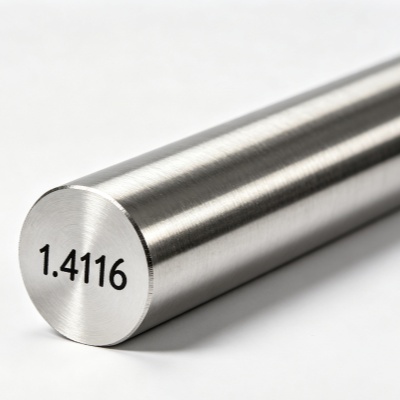
1.4116 / X50CrMoV15 (5Cr15MoV / 50Х14МФ / Z50CD15 / AISI 420MoV) is a premium martensitic stainless steel with 0.48–0.55% carbon, 14–15% chromium, and deliberate molybdenum (0.5–0.8%) and vanadium (0.10–0.20%) additions — the signature blade steel of German knife manufacturers and an increasingly important engineering material for high-hardness, wear-resistant components in the petroleum, valve, pump, and instrumentation sectors. Through-hardening to 55–58 HRC with excellent edge retention, superior pitting resistance (Mo-enhanced), and good machinability in the annealed condition, 1.4116 bridges the gap between basic Cr13 grades (1.4034) and the 440 series. SHUNFU METAL supplies 1.4116 / X50CrMoV15 stainless steel bar under ISO 9001 and API Q1 certified quality systems, with AOD refining and controlled-sulfur processing (S ≤ 0.015%) for valve-internal and precision-bearing applications requiring mirror-quality surface finish.
X50CrMoV15 (1.4116) — The Mo-V-Alloyed Martensitic Blade and Wear Grade
X50CrMoV15 distinguishes itself from the basic Cr13 martensitic grades through deliberate molybdenum (0.5–0.8%) and vanadium (0.10–0.20%) additions that create a refined vanadium-carbide dispersion within the martensitic matrix. The Mo content elevates pitting resistance significantly above 1.4034 / X46Cr13 — a critical advantage in chloride-bearing process streams, washdown environments, and mildly acidic petroleum auxiliary services — while V refines the as-quenched grain size and tempering carbide distribution, delivering consistent 55–58 HRC through-hardness with markedly better edge stability than the 440 series. Austenitizing at 980–1,030°C followed by oil quenching and tempering at 100–200°C produces the signature high-hardness condition; the standard annealed state (750–850°C slow-cool, HB ≤ 280) provides excellent machinability — considerably easier to drill, turn, and thread than 440C in the soft condition — while subsequent hardening to 55–57 HRC fully develops the grade’s wear resistance. SHUNFU METAL refines each 1.4116 heat through AOD processing with controlled-sulfur targets of 0.008–0.015%: the lower S content yields superior polishability (Ra ≤ 0.05 μm achievable) for bearing and sealing surfaces; the mid-S band (0.015–0.030%) provides better machinability for production-oriented machine shops. The ISO 9001 framework governs raw-material verification, cast-level spectrometric chemistry checks, heat-treatment chart recording, mechanical test sampling per ASTM A370 / EN ISO 6892-1, and ultrasonic inspection — with API Q1 supplementaries (independent witness testing, lot traceability, and five-year retained reference samples) applied as standard for all oil and gas industry shipments.
Compared to its closest relatives, 1.4116 delivers approximately 2–4 HRC points higher peak hardness than 1.4034 / X46Cr13 (55–57 vs 49–55 HRC) with 3–5× better pitting resistance in chloride media thanks to Mo; versus 440C, it offers significantly easier machinability (HB ≤ 280 vs ≤ 269, but with far lower carbide volume) with only 3–5 HRC less peak hardness (55–57 vs 58–62 HRC) and superior toughness at equivalent hardness, making it the balanced choice for dynamic wear components that need corrosion resistance, hardness, and machinability in equal measure. Also known as Krupp 4116 in the cutlery and surgical-instrument industries, and as the Chinese equivalent 5Cr15MoV — widely specified for high-end kitchen knives, medical scissors, industrial shear blades, and pump/valve wear components requiring premium surface finish and consistent hardening response.
Equivalent Grades of 1.4116 Across International Standards
| Standard / Specification | Designation |
|---|---|
| EN 10088-2 / 10088-3 | X50CrMoV15 (1.4116) |
| DIN 17440 / EN 10088-3 | X45CrMoV15 |
| GB/T 20878 / GB/T 1220 | 5Cr15MoV |
| GOST 5632-72 | 50Х14МФ (50Kh14MF) / 50Х15МФ (50Kh15MF) |
| NF A35-574 | Z50CD15 / Z50CD15CI |
| UNE 36016 | F3422 |
| STAS 3583-87 | T40NiCr130 |
| EN 10088-3 (close relative) | X55CrMo14 (1.4110) |
| Commercial / Trade Name | AISI 420MoV, Krupp 4116, Acidur 4116, Nirosta 4116 |
Note: No direct AISI/UNS number exists for 1.4116. “AISI 420MoV” is a commercial designation, not an official AISI grade. The nearest standard AISI grade is Type 420 (S42000), which covers the Cr13 family with no Mo/V requirement. GB 5Cr15MoV is the most widely used equivalent in Asian markets and shares the same Mo-V alloying concept; GOST 50Х14МФ specifies slightly wider ranges (C 0.42–0.56, Cr 12.0–15.0, Mo 0.45–0.80, V 0.10–0.15). EN 1.4110 X55CrMo14 is a close European cousin with similar C and Cr but lower V (max 0.15) and no required V minimum. SHUNFU METAL certifies to EN 1.4116 as the primary standard; GB 5Cr15MoV and GOST 50Х14МФ dual certification is available upon request.
Oil & Gas Industry Applications
1.4116 / X50CrMoV15 stainless steel bars serve in petroleum-industry applications demanding the combination of high hardness (55–58 HRC), enhanced pitting resistance (Mo-bearing), and mirror-quality surface finish — filling the application space between 1.4034 (lower hardness but better toughness) and 440C (higher hardness but poorer machinability and higher cost). Its vanadium-refined grain structure and Mo-enhanced passivation layer make it especially suitable for valve internals exposed to mildly aggressive produced-water and process-fluid environments, high-hardness pump wear components, precision metering and instrumentation elements, and industrial cutting blades in petrochemical maintenance and fabrication. SHUNFU METAL supplies 1.4116 bars to API 6D valve-trim manufacturers, pump OEM wear-component shops, compressor rebuild facilities, precision-instrument workshops, and industrial blade and die manufacturers, all under ISO 9001 and API Q1 certification with full EN 10204 3.1 documentation.
Valve Balls & Seats
Hardened & high-polished ball-valve balls and seats for API 6D trunnion and floating ball valves in moderate-pressure oil and gas service, where Mo-enhanced pitting resistance and 55–57 HRC hardness deliver reliable long-cycle sealing.
Valve Stems & Spindles
Quenched-and-tempered rising-spindle gate, globe, and plug valve stems; blowout-proof stem assemblies and polished actuator spindles requiring combined corrosion resistance, surface hardness, and torsional strength.
Pump Wear Rings & Sleeves
Hardened casing wear rings, shaft sleeves, and impeller wear rings for API 610 centrifugal and gear pumps handling mildly corrosive hydrocarbons and produced water with abrasive particulate loading.
Bearing Races & Rolling Elements
Through-hardened precision bearing races, balls, and roller elements for moderate-load rotary equipment in corrosive environments — pump thrust bearings, swivel bearings, and rotary-table roller assemblies.
Compressor Valve Plates & Springs
Hardened & tempered valve plates, reed valves, and coil springs for reciprocating gas compressors and vapor-recovery units — components demanding high fatigue strength, wear resistance, and corrosion tolerance.
Instrumentation & Metering Components
High-polish gauge spindles, metering needles and seats, dead-weight tester pistons, and precision flow-control elements requiring mirror surface finish (Ra ≤ 0.05 μm) and dimensional stability.
Industrial Cutting Blades
Hardened slitting cutters, guillotine blades, and rotary shear knives for gasket and seal cutting, pipe-end preparation, and oilfield maintenance-shop fabrication equipment.
Spring-Loaded Check Valve Internals
Hardened poppets, seats, and guide bushes for spring-loaded check and relief valves in process-fluid, steam-condensate, and instrument-air service requiring consistent seating and corrosion tolerance.
Precision Fasteners & Pins
Quenched-and-tempered studs, dowel pins, locating pins, and high-hardness fasteners for valve-bonnet and pressure-retaining assemblies in mildly corrosive hydrocarbon and petrochemical service.
Supply Range of 1.4116 / X50CrMoV15 Stainless Steel Bar
SHUNFU METAL supplies 1.4116 / X50CrMoV15 in hot-rolled, forged, and cold-finished bar forms for valve-trim manufacturers, pump wear-component shops, bearing OEMs, and precision-instrument workshops. Hot-rolled round bars are produced from continuous-cast billet with controlled reduction ratios ≥ 4:1 for center soundness; forged bars use open-die press forging with upset ratios ≥ 3:1 for full structural consolidation in heavy sections. For bearing-grade and polishing-grade applications, controlled-sulfur processing (S ≤ 0.015% for Ra ≤ 0.05 μm polishability; S 0.015–0.030% for improved machinability) is selected according to end use. Every production lot undergoes 100% ultrasonic inspection per ASTM E2375 / EN 10228-3 Class B, dimensional verification, and hardness testing. Under ISO 9001 and API Q1, each bar carries hard-stamped heat number and full traceability with EN 10204 3.1 certification.
| Product Form | Diameter / Section Range | Length | Surface / Condition |
|---|---|---|---|
| Hot-Rolled Round Bar | ⌀8 mm – ⌀200 mm | 3,000 – 6,000 mm | Annealed & Peeled / Black |
| Forged Round Bar | ⌀100 mm – ⌀600 mm | 2,000 – 8,000 mm | Annealed / Rough Machined |
| Hot-Rolled Flat Bar | 3–60 mm thick × 30–350 mm wide | 2,000 – 6,000 mm | Black / Ground / Machined |
| Forged Flat / Block | 30–250 mm thick × 150–600 mm wide | 1,000 – 5,000 mm | Annealed / Rough Machined |
| Cold-Finished / Ground Bar | ⌀5 mm – ⌀100 mm | 1,000 – 4,000 mm | Centerless Ground / Polished |
Bars supplied in the annealed condition (HB ≤ 280, Rm ≤ 900 MPa per EN 10088-3) for customer machining with in-house hardening, or fully quenched and tempered to 55–57 HRC. Controlled-sulfur options: S ≤ 0.015% for premium polishing-grade stock (ball-valve balls, bearing races, metering components); S 0.015–0.030% for production-machining-grade stock. Forging-ring products (OD 200–1,200 mm) available from billet to customer geometry. Cold-finished bars supplied centerless-ground or peeled to IT 7–8 tolerances with surface roughness Ra ≤ 1.6 μm (ground) / Ra ≤ 0.2 μm (polished). Non-standard diameters, stepped shafts, and cut-to-length pieces on inquiry. PKO/PE anti-rust coating, VCI wrapping, and sea-worthy timber crate packing standard for export. Third-party inspection by SGS, TÜV, or Bureau Veritas on request.
Chemical Composition of 1.4116 X50CrMoV15 (EN 10088-3 / GB 5Cr15MoV)
The chemical composition of 1.4116 is defined under EN 10088-3 with tight ranges on the key alloying elements — carbon (0.45–0.55%), chromium (14.0–15.0%), molybdenum (0.50–0.80%), and vanadium (0.10–0.20%). The Chinese equivalent GB 5Cr15MoV specifies near-identical chemistry, making dual certification straightforward. What separates 1.4116 from basic Cr13 grades is the deliberate Mo+V alloying: Mo elevates pitting resistance and secondary hardening response; V pins grain size during austenitizing and forms fine vanadium carbides during tempering that boost wear resistance without the coarse primary carbide loading characteristic of the 440 series. SHUNFU METAL’s AOD practice achieves P ≤ 0.025% and controlled S levels per application — S ≤ 0.008% for polishable/bearing grade, S 0.008–0.015% for standard grade, or S 0.015–0.030% for production-machining grade — all with spectrometric cast-level verification and product analysis on every shipment lot.
| Element | EN 10088-3 X50CrMoV15 (1.4116) | GB/T 20878 5Cr15MoV |
|---|---|---|
| Carbon (C) | 0.45 – 0.55 | 0.45 – 0.55 |
| Silicon (Si) | ≤ 1.00 | ≤ 1.00 |
| Manganese (Mn) | ≤ 1.00 | ≤ 1.00 |
| Phosphorus (P) | ≤ 0.040 | ≤ 0.040 |
| Sulfur (S) | ≤ 0.030 (rec. ≤ 0.015) | ≤ 0.030 |
| Chromium (Cr) | 14.0 – 15.0 | 14.0 – 15.5 |
| Molybdenum (Mo) | 0.50 – 0.80 | 0.50 – 0.80 |
| Vanadium (V) | 0.10 – 0.20 | 0.10 – 0.20 |
All values in weight percent (wt%). Cast analysis per respective standard. EN 10088-3 recommends tighter S control: S 0.015–0.030% for improved machinability; S ≤ 0.015% for polishability (mirror-finish applications); S 0.008–0.030% for weldability. No Ni, Cu, Nb, N, Al, or Ti minimums are mandated in either standard; residual Ni is typically < 0.60%. SHUNFU METAL’s AOD practice achieves P ≤ 0.025% and user-selectable S: ≤ 0.008% (polishable / bearing grade), 0.008–0.015% (standard), or 0.015–0.030% (production-machining grade). GOST 50Х14МФ (C 0.42–0.56, Cr 12.0–15.0, Mo 0.45–0.80, V 0.10–0.15) and GOST 50Х15МФ (C 0.42–0.56, Cr 14.0–16.0, Mo 0.45–0.80, V 0.10–0.15) dual certification is available upon request with the primary EN certificate.
Mechanical Properties — Annealed & Hardened / Tempered Conditions
1.4116 / X50CrMoV15 develops its mechanical properties through vacuum or salt-bath austenitizing at 980–1,030°C followed by oil quenching and low-temperature tempering (100–200°C). Unlike the Cr13 family, the deliberate Mo+V alloying enables the steel to retain high hardness (55–58 HRC) even through the standard 100–200°C temper range while maintaining 10–12% retained elongation in the tempered condition — a key advantage over 440C for dynamic components. The grade is NOT recommended for service temperatures above 200°C (tempering is performed at or below this temperature, and over-tempering in the 370–540°C range causes chromium carbide precipitation with loss of corrosion resistance and embrittlement). Annealed bars (750–850°C, furnace cool, HB ≤ 280, Rm ≤ 900 MPa) provide the most machinable condition, approximately 20–30% more machinable than 440C and equivalent to or better than 1.4034. SHUNFU METAL executes all heat treatment in calibrated multi-zone furnaces with chart-recorder validation under ISO 9001 and API Q1 protocols, allowing batch-level properties certification per EN 10204 3.1 for every shipment.
| Condition / Heat Treatment | Tensile Rm (MPa) | Yield Rp0.2 (MPa) | Elong. A (%) | Hardness |
|---|---|---|---|---|
| +A Annealed (750–850°C, FC), all sections | ≤ 900 (max.) | — | ≥ 12 | ≤ 280 HB (≤ 100 HV) |
| +QT Standard Quenched (980–1,030°C, OQ) + Tempered 100–200°C, ≤ 100 mm | 1,600 – 1,950 | 1,400 – 1,800 | 3 – 8 | 55 – 57 HRC |
| +QT Peak Hardness Quenched (1,030°C max., OQ) + Tempered 100–150°C, ≤ 30 mm | 1,900 – 2,100 | 1,750 – 1,950 | 1 – 5 | 56 – 58 HRC |
| +QT Tempered 200–350°C Tempered in mid-range, ≤ 100 mm | 1,500 – 1,800 | 1,300 – 1,650 | 4 – 9 | 52 – 56 HRC |
| +QT Tempered 350–540°C (NOT recommended) | Avoid — chromium carbide precipitation zone — loss of corrosion resistance & impact embrittlement | |||
Mechanical properties per EN 10088-3 for annealed condition; hardened/tempered data from manufacturer typical values measured on longitudinal specimens per EN ISO 6892-1 / ASTM A370 at room temperature. Quenching medium: oil (preferred) or forced inert gas — section thickness and geometry determine quench severity. Low-temperature tempering (100–200°C) following quenching is standard; higher tempering temperatures progressively reduce hardness but improve ductility. The 370–540°C range must be avoided in all cases due to sensitization. Physical properties (20°C): density 7.70 g/cm³; elastic modulus 215 GPa (20°C), 200 GPa (300°C), 190 GPa (400°C); thermal conductivity 30 W/m·K (20°C); thermal expansion coefficient 10.5 μm/m·K (20–100°C), 11.0 μm/m·K (20–300°C), 11.5 μm/m·K (20–400°C); specific heat capacity 460 J/kg·K (20°C); electrical resistivity 0.65 Ω·cm. Forging range: 1,100–800°C with slow post-forge cooling (vermiculite or furnace) and full re-annealing — do NOT air-cool after forging as air-hardening tendency may cause cracking. Magnetic in all conditions. SHUNFU METAL’s technical team provides application-specific heat treatment consultation, sulfur-level recommendation for target surface finish, and EN 10204 3.2 / third-party witness testing upon request.