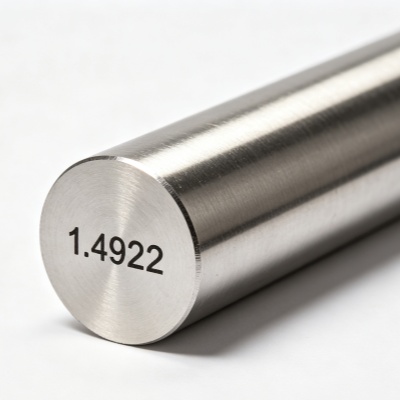
422 / UNS S42200 (EN 1.4922, X20CrMoWV12-1) is a 12%Cr martensitic creep-resisting stainless steel bar engineered for high-temperature service in oil & gas, power generation, and petrochemical industries. Strengthened by a balanced addition of molybdenum, tungsten, and vanadium, this grade delivers superior creep rupture strength and oxidation resistance at sustained operating temperatures up to 649 degC. SHUNFU METAL produces 422 stainless steel bars through EAF + LF + VD melting, with optional ESR or VAR refining for critical applications demanding ultra-low inclusion content. Every heat is fully traceable and backed by our ISO 9001 and API Q1 certified quality management system.
Equivalent Grades of 422 / S42200
Standard
Designation
ASTM A565
Grade 616 / UNS S42200
AMS 5655
S42200
EN 10088-1 / EN 10302
1.4922 X20CrMoWV12-1
DIN
1.4935 X20CrMoWV12-1
GOST
20X12HMoV
GB/T 1221
2Cr12NiMo1W1V / S47220
JIS G4311
SUH616
ISO
X23CrMoWMnNiV12-1-1
422 Stainless Steel Bar
SHUNFU METAL
Oil & Gas and Industrial Applications
High-Temperature Bolting
Turbine casing studs, flange bolts, and high-pressure steam joint fasteners in refinery and petrochemical plants.
Valve Stems and Trim
Gate valve stems, globe valve discs, and control valve internals for high-temperature hydrocarbon processing.
Pump Shafts
Multistage centrifugal pump shafts and boiler feed pump rotors operating in elevated-temperature service environments.
Compressor Components
Reciprocating compressor valve plates, piston rods, and crosshead pins in hydrogen and synthesis gas compression.
Reactor Internals
Hydrocracker reactor support grids, catalyst bed fasteners, and thermowell protection tubes in refining units.
Industrial Furnace Hardware
Tube supports, hangers, and anchor bolts for fired heaters and thermal cracking furnaces.
Supply Range
Hot Rolled Round Bar
Diameter
20 mm – 400 mm
Length
3,000 – 6,000 mm
Hot Rolled Flat Bar
Thickness x Width
10 mm – 300 mm x 50 mm – 800 mm
Length
2,000 – 6,000 mm
Forged Round Bar
Diameter
80 mm – 1,200 mm
Length
2,000 – 10,000 mm
Forged Flat / Block
Thickness x Width
40 mm – 600 mm x 100 mm – 1,500 mm
Length
1,500 – 8,000 mm
Delivery condition: annealed, quenched & tempered (+QT), or rough machined as specified. SHUNFU METAL leverages a 6,000-ton forging press and radial forging machine to ensure consistent grain flow and centerline soundness across all dimensions. ISO 9001 and API Q1 certified mill test reports accompany every shipment.
Chemical Composition
Element
EN 10088-1 1.4922
ASTM A565 S42200
SHUNFU METAL Internal
C
0.18 – 0.24
0.20 – 0.25
0.20 – 0.24
Cr
11.0 – 12.5
11.0 – 12.5
11.5 – 12.5
Mo
0.80 – 1.20
0.75 – 1.25
0.90 – 1.10
W
0.40 – 0.60
0.75 – 1.25
0.85 – 1.15
V
0.25 – 0.35
0.20 – 0.40
0.22 – 0.30
Ni
0.30 – 0.80
0.50 – 1.00
0.60 – 0.90
Si
0.10 – 0.50
leq 0.50
leq 0.40
Mn
0.30 – 0.80
leq 1.00
0.40 – 0.80
P
leq 0.030
leq 0.030
leq 0.020
S
leq 0.015
leq 0.025
leq 0.010
SHUNFU METAL enforces a tighter P leq 0.020% and S leq 0.010% internal specification to ensure superior toughness and reduced temper embrittlement susceptibility. All heats undergo OES and LECO combustion analysis with full traceability per ISO 9001 and API Q1 requirements.
Mechanical Properties
Property
Quenched & Tempered (+QT)
Tensile Strength, Rm
geq 930 MPa
Yield Strength, Rp0.2
geq 760 MPa
Elongation, A5
geq 12%
Reduction of Area, Z
geq 35%
Hardness
269 – 331 HBW
Impact Toughness, KV2 (RT)
geq 20 J
Elevated-Temperature Creep Rupture Strength (MPa)
500 degC / 10,000 h
~340
550 degC / 100,000 h
~155
600 degC / 100,000 h
~82
620 degC / 100,000 h
~58
649 degC / 100,000 h
~40
Heat treatment per EN 10302 / ASTM A565: anneal at 850 – 900 degC (furnace cool), austenitize at 1,020 – 1,070 degC (oil or air quench), double temper at 650 – 750 degC (air cool). SHUNFU METAL performs 100% ultrasonic testing to EN 10228-3 / ASTM A388 and verifies mechanical properties on every heat per ISO 9001 and API Q1 protocols. Double tempering is mandatory to ensure optimal carbide precipitation and long-term microstructural stability under creep conditions.