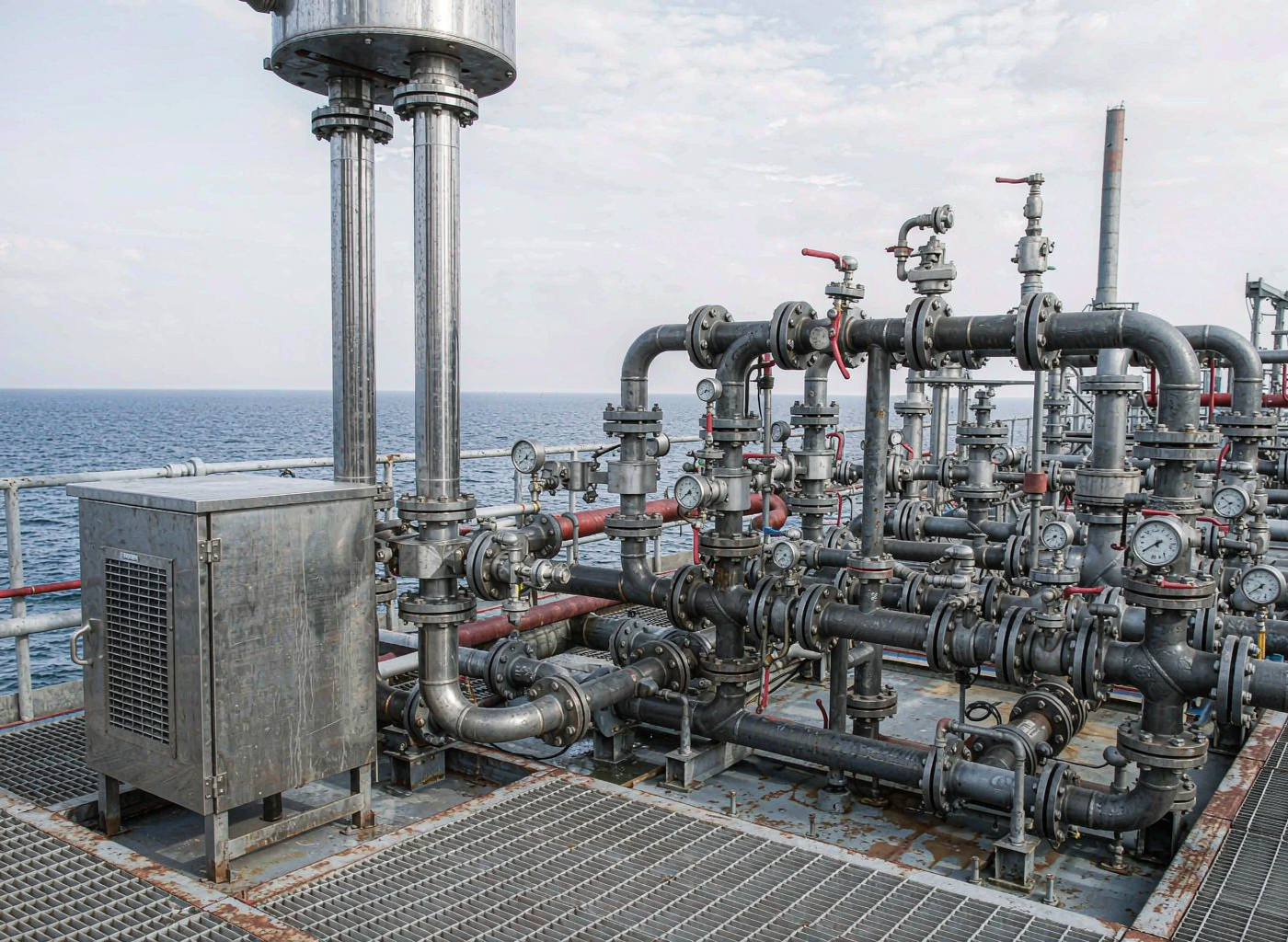
To realize a hydrogen society, fuel cell vehicles (FCVs) that run on hydrogen and the hydrogen refueling stations that supply them are being developed and rolled out worldwide. Today, hydrogen is commonly transported and stored as high-pressure gas. The equipment involved — piping, valves, onboard vehicle tanks, and the storage accumulators installed at refueling stations — is built largely from metallic materials, stainless steels in particular.
When metallic materials are exposed to high-pressure hydrogen gas, their mechanical properties, including ductility and strength, can deteriorate. This phenomenon is known as hydrogen environment embrittlement or hydrogen gas embrittlement — one form of hydrogen embrittlement. Equipment exposed to high-pressure hydrogen in FCVs and refueling stations must therefore be durable against hydrogen embrittlement. In Japan, under projects run by the New Energy and Industrial Technology Development Organization (NEDO), research institutions have installed mechanical testing systems for high-pressure hydrogen gas and conducted extensive durability evaluations of a wide range of materials.
This article outlines mechanical testing methods for high-pressure hydrogen gas environments and the properties of various stainless steels used in high-pressure hydrogen service.
Tensile Properties in High-Pressure Hydrogen
Among mechanical tests in high-pressure hydrogen, the tensile test is simple to perform and highly effective for rapidly evaluating the embrittlement behavior of materials. Because hydrogen embrittlement involves the diffusion and accumulation of hydrogen at embrittled locations over time, the effect becomes more pronounced at lower strain rates. Therefore, compared with conventional tensile testing, the slow strain rate test (SSRT) performed at extremely low strain rates is especially effective for evaluating hydrogen embrittlement. Figure 1 shows the equipment configuration. Hydrogen gas is compressed and sealed inside an autoclave at a preset pressure; after the temperature is adjusted with external equipment, the specimen is pulled at a predetermined speed. Both rod-type and strip-type tensile specimens can be used. The mechanical properties measured in hydrogen (tensile strength, fracture elongation, reduction of area, and so on) are compared with those measured in air or inert gas to evaluate the effect of hydrogen. The influence of hydrogen becomes evident at strain rates of 10-4 s-1 and below.
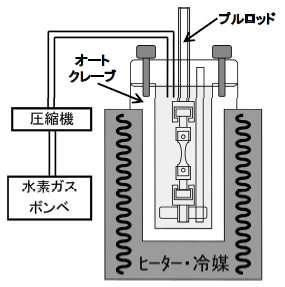
Figure 2 shows fracture surfaces of stainless steel after SSRT in high-pressure hydrogen gas — strip-type tensile specimens tested at room temperature in 45 MPa hydrogen. In SUS304L (Figures 2a and 2b), the specimen shows almost no necking, and the fracture surface is flat and brittle due to the influence of hydrogen. SUS316L (Figures 2c and 2d), by contrast, exhibits a ductile fracture surface with pronounced irregularities, essentially the same as a fracture surface obtained in air.
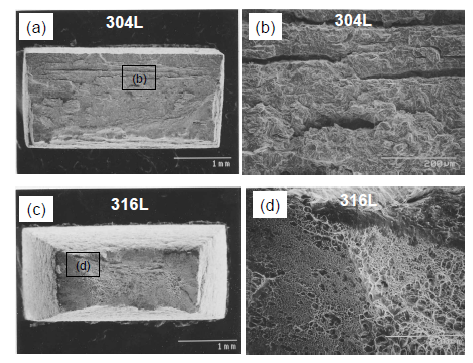
Figure 3 shows the hydrogen gas embrittlement sensitivity of various Fe-Ni system materials. The vertical axis is the relative reduction of area — the reduction of area measured in hydrogen gas at room temperature (45–90 MPa) divided by that measured in air. The closer this value is to 100%, the smaller the influence of hydrogen, meaning the material is less prone to hydrogen gas embrittlement. The horizontal axis is the Ni equivalent, a compositional parameter combining the mass fractions of alloying elements such as Ni, Cr and Mo; a higher value means the face-centered cubic (fcc) austenite phase is more stable. In Figure 3, low-alloy steel (SCM435) and martensitic stainless steels (SUS420 and SUS630) — which have body-centered cubic (bcc) crystal structures — are susceptible to hydrogen gas embrittlement and show low relative reduction of area. Among austenitic stainless steels with an fcc structure, grades low in Ni and Mo such as SUS304L undergo martensitic transformation during deformation and also show relatively low values. However, reports suggest this is not caused by the strain-induced martensite phase itself but by the low stacking fault energy, which promotes hydrogen embrittlement. Grades rich in Ni and Mo such as SUS316L have a stable austenite phase and show good properties in high-pressure hydrogen at room temperature, with only small losses in fracture elongation and reduction of area. For SUS316–316L series materials, the published standard of the High-Pressure Gas Safety Association recommends selecting a material whose Ni equivalent is above the specified value for the temperature range of the application. On the other hand, materials with excessive Ni content (Ni-based alloys), despite their stable austenite phase, are still prone to hydrogen gas embrittlement, and the effect becomes more pronounced through aging treatment. High-Mn stainless steels (Type 205, etc.) have also been reported to be susceptible to hydrogen gas embrittlement even with a stable austenite phase.
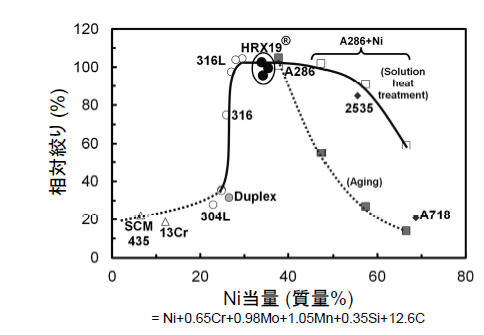
In recent years, stainless steels specifically for high-pressure hydrogen service have been developed. Nippon Steel Corporation has commercialized HRX19®, a high-strength stainless steel with a tensile strength (TS) of 800 MPa or more achieved by increasing the N content within an appropriate Ni equivalent range; it shows excellent properties, as indicated in Figure 3. As stainless steels with reduced use of rare elements such as Ni and Mo, Nippon Steel Stainless Steel Corporation has reported the development of STH1 and STH2, and Aichi Steel Corporation reported AUS305-H2.
Hydrogen gas embrittlement also occurs below room temperature, and austenitic stainless steels are most susceptible around −100°C because martensite forms more readily during deformation at lower temperatures. Below −150°C, however, no material suffers hydrogen gas embrittlement, since hydrogen can no longer diffuse at such ultra-low temperatures. SUS310S, which has extremely stable austenite, and the high-N stainless steels mentioned above show good resistance to hydrogen gas embrittlement across the entire temperature range.
Fatigue Properties in High-Pressure Hydrogen
Equipment used in FCVs and hydrogen stations is subjected to fluctuating loads during hydrogen filling, so fatigue properties in hydrogen are equally important. Using the same equipment as for the tensile tests described above, fatigue life and crack growth rates can be measured by applying cyclic loads from outside. For evaluating the fatigue life of cylindrical components such as accumulators, piping and onboard tanks in actual hydrogen stations, a method using tubular specimens has been proposed; the test principle is shown in Figure 4. Two approaches are available: varying the internal hydrogen gas pressure (internal pressure test) and keeping the internal hydrogen pressure constant while varying the external water pressure (external pressure test). The former better approximates the actual service conditions of piping and vessels, while the latter benefits from easy pressure cycling and enables testing in a shorter time. Once an initial notch forms on the inner surface of the specimen, a fatigue crack propagates from the notch toward the outer surface; when it reaches the outer surface, hydrogen gas leaks out. That moment is defined as the fatigue life.
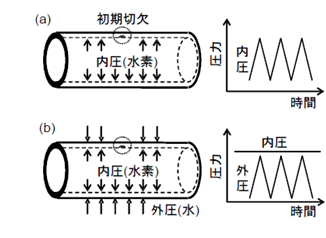
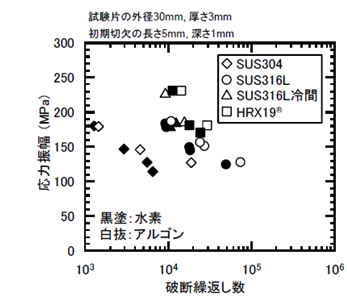
Figure 5 shows the results of external pressure fatigue tests for various stainless steels. The vertical axis is stress amplitude — the calculated range of circumferential stress at the inner surface of the tube — and the horizontal axis is the number of cycles to failure (fatigue life). The hydrogen pressure is 50–70 MPa. SUS304 shows a reduced life in hydrogen, especially in the long-life range. As with SSRT, plastic deformation generates a bcc martensite phase in SUS304, and embrittlement of this phase accelerates fatigue crack growth. Also consistent with the strain rate effect in SSRT, the longer the fatigue test cycle period, the more the fatigue life of SUS304 in hydrogen decreases. Solution-treated SUS316L (TS ≈ 500 MPa), cold-worked SUS316L (TS ≈ 700 MPa) and HRX19 (TS ≥ 800 MPa) show fatigue properties unaffected by hydrogen, as in the SSRT results, and the high-strength HRX19® delivers the longest fatigue life. HRX19® has also been reported to offer high resistance to fatigue crack growth in high-pressure hydrogen.
Other Properties: Welding and IHE
For hydrogen equipment, welded construction is preferred because mechanical joints are prone to hydrogen leakage. SSRT properties of welded joints in austenitic stainless steels in high-pressure hydrogen have been confirmed to match those of the base metal — again ensured by increasing the stability of the austenite phase. To prevent hot cracking during welding, weld metal typically contains about 10% ferrite (δ) phase (bcc structure), and a ferrite content of 20% or less is not affected by hydrogen gas embrittlement. Cold-worked materials and age-hardening stainless steels (Alloy 286) cannot be welded because the heat-affected zone softens. HRX19®, by contrast, obtains its strength through solution treatment, so it does not soften in the heat-affected zone and can be welded and used as-is. Suitable welding consumables and conditions have been studied to ensure the strength and hydrogen embrittlement resistance of welded joints, with good results.
The embrittlement discussed in the previous sections is evaluated by tensile and fatigue tests in high-pressure hydrogen near room temperature. To assess the influence of hydrogen absorbed during long-term service, a different approach is used: specimens are pre-exposed to high-temperature, high-pressure hydrogen to absorb hydrogen, and then tested mechanically in air. This evaluates internal reversible hydrogen embrittlement (IHE), in which hydrogen inside the material plays the decisive role — a different mechanism from hydrogen gas embrittlement. SUS304–316L series materials and HRX19® show the same trends as in Figure 3, whereas the age-hardening stainless steel Alloy 286 becomes more sensitive under IHE evaluation, raising concerns about IHE in high-temperature, long-term service. It has also been reported that adding larger amounts of hydrogen than in actual environments by electrolysis in aqueous solution can be used to evaluate hydrogen embrittlement. Even under such severe conditions, HRX19® has demonstrated the highest resistance to hydrogen embrittlement.
Conclusion
Reducing CO2 emissions and securing a stable energy supply have made the realization of a hydrogen society an important priority for countries around the world. The correct selection and use of existing materials, together with the development of new ones, will remain central to these research and development efforts, and further progress is expected in the years ahead.
Reprinted from Stainless (《不锈》), Issue 2, 2025.