
Inconel 725 (UNS N07725) takes the 625 chemistry — nickel, chromium, molybdenum, niobium — adds titanium and aluminium, and age hardens it to 827 MPa yield. The point of the alloy is that it delivers roughly 718 strength with roughly 625 corrosion resistance, which is what HPHT wells with chlorides actually need.
718 is stronger and cheaper, but its 3% molybdenum gives a PREN near 24 — not enough for chlorides above a few thousand ppm. 625 has the molybdenum (9%) but only reaches about 400 MPa yield in the annealed condition. 725 splits the difference at roughly 8% molybdenum and 827 MPa, and it is weldable with matching filler.
The alloy is used for HPHT tubing and liners, wellhead outlets, subsea hardware and completion tools where the produced fluid combines high pressure, temperature, CO₂, H₂S and chlorides. It is listed in NACE MR0175 and in API 6CRA for oilfield equipment.
Two conditions are supplied: annealed for machining, and annealed plus aged for service. Ageing is 720 °C for 8 hours, furnace cooled to 620 °C, held 8 hours, then air cooled — the part must be aged after the final forming step, so the purchase order has to say which condition is wanted.
725 Standards and Equivalent Grades
Bar and wire are covered by ASTM B805; the alloy also appears in ASME Code Case 2217 for bar and forging stock, in API 6CRA for oilfield equipment, and in JIS as NCF 725. Seamless tube is normally ordered to a purchaser specification referencing B805 chemistry with API 6CRA mechanical requirements.
| System | Designation |
| UNS | N07725 |
| ASTM B805 | Bar and wire |
| ASME Code Case | 2217 |
| API 6CRA | Oilfield equipment |
| JIS | NCF 725 |
| NACE MR0175 | Listed for sour service |
Where 725 Pipe and Tube Are Used
HPHT tubing and liners
Wells combining 140 MPa and 200 °C with chlorides, where 13Cr is out of its envelope and 718 lacks pitting resistance.
Wellhead outlet lines
Short runs from the tree to the choke, exposed to the full produced fluid chemistry.
Subsea jumpers and connectors
Small-bore pipe and tube in manifolds and termination units.
Completion tool bodies
Mandrels and housings that must be aged after machining.
Chemical injection lines
Lines carrying inhibitors and methanol into sour wells.
Heat exchanger tubing
Bundles for produced water cooling where duplex grades are not permitted by the specification.
Supply Range and Condition
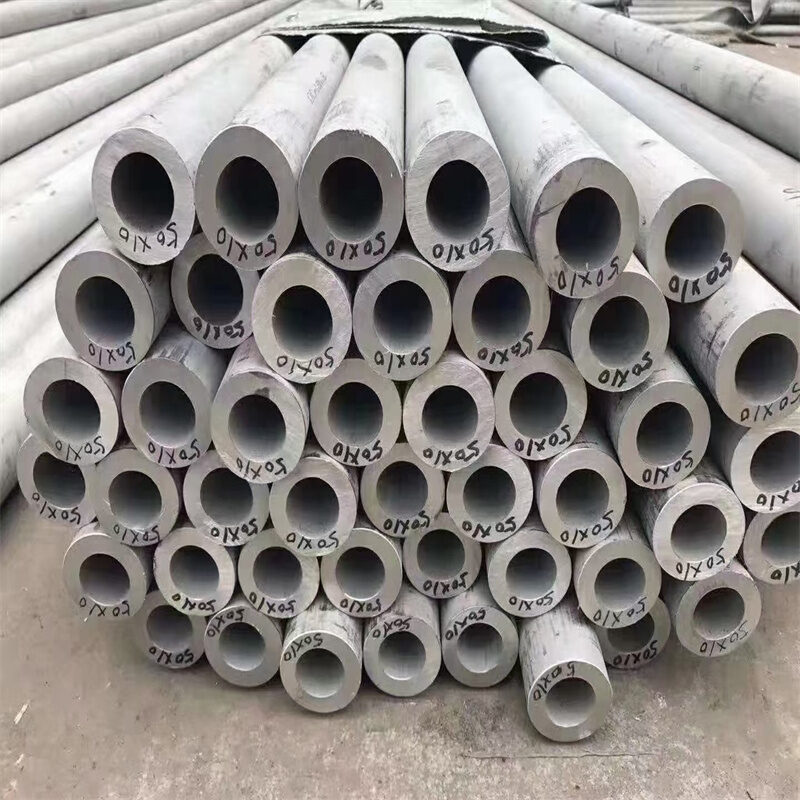
Seamless tube from 25 mm to 165 mm outside diameter, wall 3 mm to 25 mm; pipe to 219 mm. Supplied annealed for machining, or annealed and aged to 827 MPa yield minimum. Bar stock is also available for machined components.
Testing includes chemistry, tensile and yield in the ordered condition, hardness, and intergranular corrosion testing to ASTM G28 Method A where specified. EN 10204 3.1 certificates with heat traceability.
Chemical Composition of 725 (wt%)
Molybdenum at 7.0–9.5% is the difference between 725 and 718 in corrosion terms. Titanium (1.0–1.7%) and aluminium (0.35% maximum) drive the gamma-double-prime and gamma-prime precipitation that produces the aged strength.
| Element | Min % | Max % |
| Ni | 55.00 | 59.00 |
| Cr | 19.00 | 22.50 |
| Mo | 7.00 | 9.50 |
| Nb+Ta | 2.75 | 4.00 |
| Ti | 1.00 | 1.70 |
| Al | — | 0.35 |
| C | — | 0.030 |
| Fe | balance | balance |
Mechanical Properties
Values are typical for the aged condition. The alloy is normally used aged; annealed stock is supplied only for machining or forming before the final heat treatment.
| Condition | Tensile strength | Yield (0.2%) |
| Annealed | ≈ 830 MPa | ≈ 380 MPa |
| Annealed + aged | ≈ 1,240 MPa | ≥ 827 MPa |
Need 725 pipe or tube in the aged condition?
Send the size, quantity and whether ageing is done before or after machining — we reply with mill availability, lead time and a priced offer, usually within one working day.