
Inconel 718 (UNS N07718, W.Nr. 2.4668, GB GH4169) is a precipitation-hardenable nickel-chromium alloy that reaches a 1,035 MPa yield strength in the aged condition and holds it to 650 °C — far past the ~315 °C ceiling of martensitic PH grades such as 17-4PH. In oil and gas it is the working alloy for HPHT wellhead bodies, tree valve bodies and completion tools, where API 6A HH or API 17D ask for strength, toughness and chloride SCC resistance in the same heavy section.
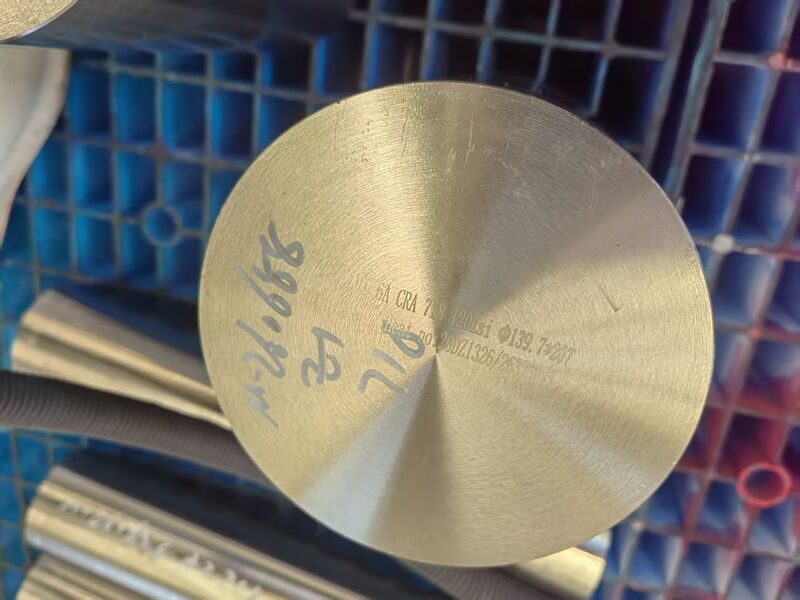
718 was developed for jet engine discs and migrated into oil and gas for one reason: it is the only precipitation-hardened alloy that combines 1,000 MPa-class strength with enough chromium and molybdenum to survive produced fluids containing H2S and CO2. Martensitic PH grades (17-4PH, 15-5PH, Custom 465) reach similar strength but lose toughness above 300 °C and are hardness-limited in sour service. Solid-solution nickel alloys (625, C-276) resist corrosion but top out near 400 MPa yield. 718 occupies the gap between them.
The alloy is hardened by the gamma-double-prime phase (Ni3Nb), formed during a two-step age at 720 °C and 620 °C. That is why 718 is supplied and machined in the solution-annealed condition (≤ 277 HB) and only reaches full strength after the buyer’s final heat treatment — or after ours, if the part is finish-machined before delivery. For wellhead bodies this is normally done at the forge shop, with hardness verified on a coupon from the same heat.
In sour service, NACE MR0175 / ISO 15156 permits 718 subject to a hardness ceiling, and most operators write 40 HRC maximum into the purchase specification. Standard AMS 5662 ageing lands at 363–444 HB, so a hardness-controlled heat treatment and a per-heat hardness survey are needed rather than a generic certificate. We supply both the standard AMS condition and a NACE-restricted condition with hardness mapped across the section.
718 is often compared with Inconel 725 and Incoloy 925. 725 carries roughly 8% molybdenum instead of 3% and is the choice when PREN matters more than strength; 925 is a lower-cost Ni-Fe-Cr alternative that machines more freely but yields about 25% less. 718 remains the strength leader and the one with the widest mill availability in bar and forging stock.
Inconel 718 Equivalent Grades and Specifications
718 is registered under every major system, which matters at the purchasing desk: a European enquiry may quote 2.4668, a Chinese mill certificate may say GH4169, and an aerospace-derived oil and gas spec will cite AMS 5662. All three describe the same chemistry with the same age-hardening response. We certify to the designation named in the purchase order and issue EN 10204 3.1 mill test reports as standard.
Note the difference between the AMS conditions. 5662 covers bar, forging and ring in the solution-treated plus aged condition using vacuum induction melting followed by vacuum arc remelting; 5663 is the consumable-electrode remelted variant for rotating parts; 5664 covers seamless tube. For wellhead and tree bodies, 5662 with AMS 2630 Class A ultrasonic inspection is the usual combination.
| System | Designation |
| UNS | N07718 |
| W.Nr. / DIN | 2.4668 / NiCr19Fe19Nb5Mo3 |
| AFNOR | NC19FeNb |
| GB / GB/T | GH4169 |
| AMS 5662 | Bar, forging, ring — solution treated and aged |
| AMS 5663 | Bar, forging, ring — consumable electrode remelted |
| AMS 5664 | Seamless tube |
| ASTM B637 | Bar, forging stock, billet |
| API 6A / API 17D | Wellhead and subsea body material |
Where Inconel 718 Is Used in Oil and Gas
HPHT wellhead bodies and bonnets
Body and bonnet forgings for 10K and 15K wellheads, specified to API 6A HH / DD. 718 holds pressure capability at 232 °C where 4130 and F22 forgings start losing allowable stress.
Xmas tree valve bodies and trim
Gate and globe valve bodies, seat pockets and stems. The alloy’s galling resistance after surface treatment allows metal-to-metal sealing at 15K without tungsten carbide overlays.
Tubing hangers and mandrels
Hanger bodies and load shoulders carrying the full string weight plus thermal expansion. High yield strength keeps wall thickness — and therefore bore — within the drift requirement.
Packer and completion tools
Mandrels, slips, setting sleeves and shear subs. 718 machines cleanly in the annealed state and can be aged after machining, so tight tolerances are held without distortion.
Downhole gauge and sensor carriers
Housings for permanent gauges and MWD electronics exposed to 200 °C and 140 MPa. Wall sections stay thin, leaving room for the instrument.
Subsea connectors and stab plates
API 17D / 17H components for horizontal and vertical trees. The alloy is qualified for seawater exposure with cathodic protection and does not need a corrosion-resistant overlay.
High-pressure fittings and autoclave bodies
Crosses, tees and vessel closures for 100 MPa test loops and laboratory autoclaves, where 316L would need triple the wall thickness.
Bolting for 15K flanges
Studs and nuts to ASTM A1014 / NACE MR0175 where B7M runs out of allowable stress at temperature and A286 loses corrosion resistance.
Supply Range and Delivery Condition
Round bar from 12 mm to 300 mm diameter, supplied peeled, turned or ground; forged blanks and blocks up to 3,000 kg for wellhead and tree bodies; seamless tube from 6 mm to 114 mm outside diameter in the annealed or aged condition. Bar is normally cut to length with sawn ends and chamfered edges for machining centres.
Standard delivery condition is solution annealed at 954–1,010 °C followed by water or polymer quench, hardness ≤ 277 HB, which is the machinable state specified by AMS 5662. Aged material (720 °C / 8 h, furnace cool at 50 °C/h to 620 °C, hold 8 h, air cool) is supplied when the buyer machines before delivery or when the part is finish-formed at our works.
Every heat is tested for chemistry by optical emission and combustion analysis, tensile properties at room temperature, hardness across the section, and grain size to ASTM E112 (six or finer for API 6A bodies). Ultrasonic inspection follows AMS 2630 or ASTM A388 Class A unless a tighter acceptance level is written into the order. Positive material identification is performed on the finished part and reported by heat number.
Chemical Composition of Inconel 718 (wt%)
The composition is balanced for two things: enough niobium (4.75–5.50%) to form the gamma-double-prime strengthening phase, and enough iron (balance, typically 17–20%) to keep the alloy forgeable and affordable compared with C-276 or 725. Chromium at 17–21% provides the passive film; molybdenum at 2.80–3.30% gives modest pitting resistance (PREN ≈ 24) rather than true seawater immunity.
Carbon is held at 0.08% maximum and sulphur at 0.015% maximum because both segregate to grain boundaries and degrade stress-rupture life. Boron at 0.006% maximum is a deliberate trace addition that improves creep resistance; it is also the element most often missed by mills quoting a generic nickel alloy chemistry, so we check it on every incoming heat.
Aluminium and titanium are kept in a narrow window (0.20–0.80% Al, 0.65–1.15% Ti) because they form the gamma-prime and gamma-double-prime phases together. Too little and the alloy will not reach 1,035 MPa after ageing; too much and it becomes notch-sensitive and difficult to forge without cracking.
| Element | Min % | Max % |
| Nickel (Ni) | 50.00 | 55.00 |
| Chromium (Cr) | 17.00 | 21.00 |
| Iron (Fe) | balance | balance |
| Niobium + Tantalum (Nb+Ta) | 4.75 | 5.50 |
| Molybdenum (Mo) | 2.80 | 3.30 |
| Titanium (Ti) | 0.65 | 1.15 |
| Aluminium (Al) | 0.20 | 0.80 |
| Cobalt (Co) | — | 1.00 |
| Carbon (C) | — | 0.08 |
| Manganese (Mn) | — | 0.35 |
| Silicon (Si) | — | 0.35 |
| Phosphorus (P) | — | 0.015 |
| Sulphur (S) | — | 0.015 |
| Boron (B) | — | 0.006 |
| Copper (Cu) | — | 0.30 |
Mechanical Properties of Inconel 718 Bar and Forging
The table below reflects AMS 5662 minimum values for bar and forging at room temperature. In the solution-annealed condition the alloy is deliberately soft so it can be machined; the aged condition is what the design calculation must use, and it is roughly 2.4 times stronger in yield.
At 650 °C the aged alloy still delivers about 860 MPa yield and 1,000 MPa tensile, which is why 718 is used for steam and process valves well above the range of Cr-Mo steels. Above 650 °C the strengthening phases coarsen quickly and the alloy is normally replaced by Waspaloy or 617.
| Property (room temperature) | Solution treated | Aged, AMS 5662 |
| Tensile strength | ≥ 965 MPa | ≥ 1,240 MPa |
| Yield strength (0.2%) | ≥ 550 MPa | ≥ 1,035 MPa |
| Elongation in 4D | ≥ 20% | ≥ 12% |
| Reduction of area | — | ≥ 15% |
| Hardness | ≤ 277 HB | 363–444 HB |
| Property (aged, typical) | 538 °C | 650 °C |
| Tensile strength | 1,140 MPa | 1,000 MPa |
| Yield strength (0.2%) | 965 MPa | 860 MPa |
| Elongation in 4D | 18% | 15% |
Need Inconel 718 bar or forging to AMS 5662 or a NACE-restricted hardness?
Send the size, quantity, delivery condition and any API 6A material class or hardness ceiling — we reply with mill availability, heat-treatment route, lead time and a priced offer, usually within one working day.