
Hastelloy C-22 (UNS N06022, W.Nr. 2.4602) is a nickel-chromium-molybdenum alloy with 3% tungsten that separates itself from C-276 in one specific way: it resists both oxidising and reducing media in the same heat of material. C-276 needs a carefully controlled oxidising/reducing balance in the process stream; C-22 tolerates excursions. In oil and gas that difference is what allows a single pipe specification to cover a well that starts sweet and turns sour.
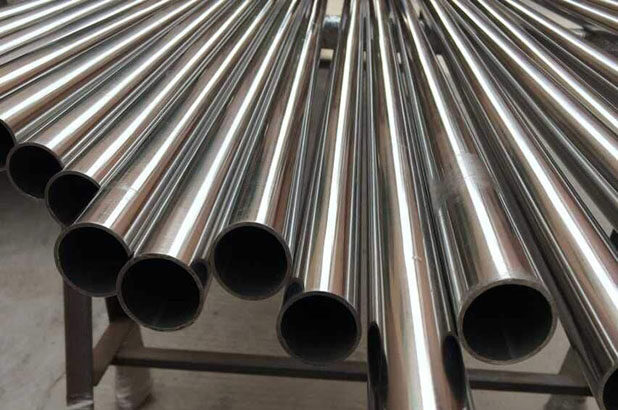
The alloy is a high-molybdenum austenitic nickel alloy — 13% Mo, 22% Cr, 3% W — with a very low carbon content (0.015% maximum) and no deliberate stabilising additions. That combination gives roughly 70 PREN, placing it among the most pitting-resistant alloys in general industrial use, and it keeps the passive film intact in chloride concentrations where 254SMO and AL-6XN break down.
C-22 was designed as a weldable upgrade to C-276: the lower carbon and the tungsten addition suppress the precipitation of intermetallic phases in the heat-affected zone, so welded pipe retains corrosion resistance without a post-weld solution anneal. For sour service this matters because field welds and repair welds are often unavoidable.
In oil and gas, C-22 pipe is specified for sour gas well tubing and liners, wellhead flow lines, acid gas scrubbing circuits and refinery effluent lines where chlorides and H2S appear together. It is also the standard material for flue gas desulphurisation absorber internals, where chlorides concentrate and pH swings between 2 and 6.
NACE MR0175 / ISO 15156 lists C-22 for sour service without a hardness restriction in the annealed condition, which is one reason it is preferred over precipitation-hardened nickel alloys when the well chemistry is not fully characterised at the design stage.
Hastelloy C-22 Equivalent Grades and Pipe Standards
C-22 is covered by separate ASTM specifications for each product form, and buyers frequently mix them. Seamless pipe is B622, welded pipe is B619, welded tube is B626, plate is B575 and bar is B574. Quoting the wrong one is the most common documentation error on this grade, so we confirm the form first and then certify to the matching specification.
European enquiries normally cite 2.4602 and DIN 17744 for the wrought chemical composition. The alloy is also listed in NORSOK M-630 for North Sea piping and in ASME BPVC Section VIII for pressure vessels.
| System | Designation |
| UNS | N06022 |
| W.Nr. / DIN | 2.4602 / NiCr21Mo14W |
| ASTM B622 | Seamless pipe and tube |
| ASTM B619 | Welded pipe |
| ASTM B626 | Welded tube |
| ASTM B575 / B574 | Plate, sheet / rod and bar |
| NORSOK M-630 | MDS D59 |
Where C-22 Pipe Is Specified
Sour gas well tubing and liners
Wells with H2S partial pressure above 0.1 MPa combined with chlorides and CO2. C-22 is used where 825 and 625 have insufficient pitting resistance or where the water chemistry is variable.
Wellhead flow lines and manifolds
Short runs between the tree and the first separator, where pressure let-down creates a cold Joule-Thomson zone and chlorides deposit.
Acid gas scrubbing and amine units
Rich amine lines, reclaimers and lean/rich exchangers. The alloy resists both the amine solution and the acid gas that flashes out during pressure swings.
Refinery effluent and pickling lines
Sour water stripper overheads and stainless pickling baths containing nitric-hydrofluoric mixtures, where 316L and 904L fail by uniform corrosion.
FGD absorber internals
Spray headers, oxidation air lances and mist eliminator supports in limestone-gypsum absorbers, where chloride levels reach 60,000 ppm and pH cycles daily.
Seawater and brine heat exchangers
Tube bundles for produced water coolers and desalination duty, resistant to crevice attack under deposits.
Supply Range and Delivery Condition
Seamless pipe from 6 mm to 219 mm outside diameter, wall thickness 1.0 mm to 20 mm; welded pipe to 1,200 mm diameter; welded and drawn tube from 6 mm to 50 mm. Standard delivery condition is solution annealed at 1,120–1,175 °C with rapid water quench, pickled and passivated, in random lengths of 4–6 m or cut to order.
Pipe is supplied to ASTM B622 with either a 1.25% or 2.5% minimum wall tolerance, so the ordered wall thickness must state which. For sour service we normally recommend the 2.5% option, since the pressure design is sensitive to wall loss in a material this expensive.
Testing includes hydrostatic or non-destructive electric test per specification, eddy current or ultrasonic wall inspection on request, intergranular corrosion testing to ASTM G28 Method A, and positive material identification on every length. Mill test reports are issued to EN 10204 3.1 with the heat number traceable to the pipe stencil.
Chemical Composition of Hastelloy C-22 (wt%)
The molybdenum content (12.5–14.5%) is the single most important variable for pitting resistance, and it is also the element most likely to sit at the bottom of the range in low-cost material. We verify Mo by X-ray fluorescence on every heat rather than relying on the mill certificate alone.
Carbon is held at 0.015% maximum to prevent grain-boundary carbide precipitation during welding. Silicon at 0.08% maximum is unusually tight for a wrought alloy and exists to avoid the formation of topologically close-packed phases that would consume molybdenum from solid solution.
Tungsten at 2.5–3.5% is what distinguishes C-22 from C-4 and C-276. It improves resistance to crevice corrosion in oxidising chloride environments but raises the alloy’s cost, so the element is always specified rather than left to mill discretion.
| Element | Min % | Max % |
| Nickel (Ni) | balance | balance |
| Chromium (Cr) | 20.00 | 22.50 |
| Molybdenum (Mo) | 12.50 | 14.50 |
| Tungsten (W) | 2.50 | 3.50 |
| Iron (Fe) | 2.00 | 6.00 |
| Cobalt (Co) | — | 2.50 |
| Carbon (C) | — | 0.015 |
| Silicon (Si) | — | 0.08 |
| Manganese (Mn) | — | 0.50 |
| Vanadium (V) | — | 0.35 |
| Phosphorus (P) | — | 0.020 |
| Sulphur (S) | — | 0.020 |
Mechanical Properties of C-22 Pipe and Tube
The alloy is used exclusively in the annealed condition; there is no strengthening heat treatment. Values below are the ASTM B622 minima for seamless pipe at room temperature.
Design allowables in ASME BPVC Section VIII Division 1 are governed by the 100,000-hour rupture strength above 540 °C, not by the room-temperature tensile. For refinery piping above 600 °C, C-22 is normally replaced by a higher-strength nickel alloy.
| Property (room temperature) | Minimum |
| Tensile strength | ≥ 690 MPa |
| Yield strength (0.2%) | ≥ 283 MPa |
| Elongation in 50 mm | ≥ 45% |
| Hardness | ≤ 100 HRB |
| Density | 8.69 g/cm³ |
Need C-22 pipe or tube to ASTM B622 with a specific wall tolerance?
Send the outside diameter, wall thickness, quantity, delivery condition and any NACE or G28 test requirement — we reply with mill availability, lead time and a priced offer, usually within one working day.