
Project Description
Hastelloy C-22 (UNS N06022 / W.Nr. 2.4602) is a nickel-chromium-molybdenum-tungsten alloy that combines outstanding resistance to both oxidising and non-oxidising media with superior protection against chloride-induced pitting, crevice attack, and stress-corrosion cracking. Its 22 % chromium content gives it a decisive advantage over C-276 in oxidising environments, while the synergy of 13 % molybdenum and 3 % tungsten retains excellent performance in reducing acids. SHUNFU METAL supplies Hastelloy C-22 bar and rod in solution-annealed condition, produced by VIM + VAR double-vacuum melt practice for maximum chemical homogeneity, with EN 10204 3.1 / 3.2 material test reports on request.
1. Hastelloy C-22 (N06022) — Introduction & Key Features
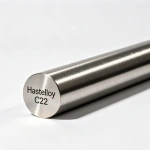
Developed by Haynes International, Hastelloy C-22® (UNS N06022) belongs to the Ni-Cr-Mo-W family of corrosion-resistant alloys, and is widely regarded as a step-up from C-276 wherever both oxidising and reducing environments are encountered in the same process stream. The critical crevice corrosion temperature in 6 % FeCl₃ reaches 80 °C — the highest among all benchmark alloys including 625 and C-276 — making it the material of choice for equipment exposed to chloride-rich sour fluids in O&G, subsea, and chemical-process applications.
- Pitting Resistance Equivalent Number (PREN): ≈ 72 — among the highest of any commercial nickel alloy
- Resistant to all mineral acids at moderate concentrations: HCl, H₂SO₄, HNO₃, H₃PO₄, HBr
- Excellent resistance to mixed “Green Death” and “Yellow Death” corrosion test solutions
- No crevice corrosion in both static and flowing seawater after 180 days (29 °C)
- No stress-corrosion cracking in boiling 45 % MgCl₂ for 1 008 hours (ASTM G36)
- Density: 8.69 g/cm³ | Melting range: 1 357–1 399 °C (2 475–2 550 °F)
- Approved under NACE MR0175 / ISO 15156 for sour-service equipment
2. Hastelloy C-22 Equivalent Grades
| Standard | Designation | Notes |
|---|---|---|
| UNS (ASTM/ASME) | N06022 | Primary designation |
| DIN / EN (W.Nr.) | 2.4602 | NiCr21Mo14W — EN 10095 / VdTÜV Wb. 499 |
| ISO | NiCr21Mo14W | ISO 9723 / ISO 6208 (bars) |
| Trade name | Hastelloy C-22® | Registered trademark of Haynes International, Inc. |
| VDM / Nicrofer | Nicrofer 5621 hMoW | VDM Metals trade variant |
| NACE / ISO | NACE MR0175 / ISO 15156-3 | Listed for sour service (H₂S environment) |
| Corrosion class | Ni-Cr-Mo-W Group | Upgraded from C-276 for mixed-media environments |
3. Hastelloy C-22 (N06022) Chemical Composition
| Element | Ni | Cr | Mo | W | Fe | Co | Mn | Si | V | C |
|---|---|---|---|---|---|---|---|---|---|---|
| wt % | Balance | 20.0–22.5 | 12.5–14.5 | 2.5–3.5 | 2.0–6.0 | ≤ 2.5 | ≤ 0.50 | ≤ 0.08 | ≤ 0.35 | ≤ 0.010 |
Per ASTM B574 / SB 574. P ≤ 0.02 %, S ≤ 0.02 % (not shown). Nominal: Ni 56 %, Cr 22 %, Mo 13 %, W 3 %, Fe 3 %.
4. Hastelloy C-22 (N06022) Mechanical Properties
All values in solution-annealed condition (1 121 °C / 2 050 °F + water quench), per ASTM B574 / Haynes International data sheets.
| Property | Room Temp. | 204 °C | 427 °C | 649 °C | 760 °C |
|---|---|---|---|---|---|
| UTS (MPa) | 765 | 662 | 614 | 552 | 496 |
| 0.2 % YS (MPa) | 359 | 262 | 214 | 193 | 200 |
| Elongation (%) | 70 | 74 | 79 | 80 | 77 |
| Hardness (HRBW) | ≈ 84 (bar, solution-annealed) | ||||
Bar diameter φ 12.7–50.8 mm. Charpy V-notch impact: 568 J at room temperature; 469 J at −196 °C.
5. Oil & Gas Applications of Hastelloy C-22 Bar / Rod
Hastelloy C-22 is specified across the full upstream-to-downstream value chain wherever a single material must resist both oxidising and reducing corrosion in the presence of chlorides, H₂S, CO₂, and aggressive drilling or completion fluids:
- Wireline and downhole tool bodies in HPHT sour wells
- Subsurface safety valve (SSSV) components
- Wellhead valve stems, seats, and bonnets
- Chemical injection nozzles and quills
- Production tubing couplings in H₂S / CO₂ service
- Subsea tree and manifold fasteners
- Umbilical end connectors and terminations
- ROV-operated valve spindles in seawater service
- Subsea chemical injection pump shafts
- Hypochlorite dosing system components (seawater chlorination)
- Sour gas scrubber internals (absorber trays, nozzles)
- Amine treater heat-exchanger tube sheets and baffles
- Acid gas injection valve trim and shafts
- Wet H₂S reactor effluent cooler internals
- FGD (flue gas desulphurisation) spray headers and agitator shafts
- Pressure sensor housings for mixed-acid service
- Thermowell bars in chloride-bearing process streams
- Control valve shafts and plugs for sour service
- Sample conditioning system fittings and adapters
6. Supply Specifications — Hastelloy C-22 Bar & Rod
| Parameter | Details |
|---|---|
| Product Forms | Round bar, square bar, flat bar, hexagonal bar, forged billet |
| Diameter / Size Range | φ 4 mm – φ 500 mm (round); custom cross-sections available on request |
| Length | 50 mm – 6 000 mm; cut-to-length service available |
| Manufacturing Route | VIM + VAR double-vacuum melt → hot forging / hot rolling → solution anneal + water quench → straightening |
| Delivery Condition | Solution-annealed (SA); cold-drawn (CD); centreless-ground / precision-polished available |
| Surface Finish | Black / hot-rolled, turned, ground, polished, pickled, bright |
| Applicable Standards | ASTM B574 / ASME SB574 (bar); ASTM B472 (billet/bar for flanges); ASTM B564 / SB564 (forgings) |
| Sour Service Approval | NACE MR0175 / ISO 15156-3 listed; compliant for H₂S partial pressures per relevant limits |
| Heat Treatment | Solution anneal 1 121 °C (2 050 °F) + rapid water quench; re-anneal required after hot-work or cold-work ≥ 7 % |
| Quality Documentation | EN 10204 3.1 MTR standard; EN 10204 3.2 (third-party witness) on request; PMI (XRF / OES) per bar |
| NDE Options | Ultrasonic testing (UT) per ASTM E2375; dye-penetrant (PT); hardness survey (HRB) per piece |
| Packaging | Individual tag with heat number; bundled / wooden crate; VCI paper + desiccant for sea freight |
7. SHUNFU METAL Quality Assurance for Hastelloy C-22
SHUNFU METAL applies a multi-tier quality framework aligned with API, ASME, and ISO requirements for critical pressure-containing and wetted parts:
- Melt traceability: Every heat is produced via VIM + VAR to ensure ultra-low carbon (≤ 0.010 %), sulphur (≤ 0.02 %), and phosphorus (≤ 0.02 %), minimising grain-boundary sensitisation and inter-granular corrosion risk.
- Corrosion performance verification: Optional inter-granular corrosion test per ASTM G28 Method A (ferric sulphate/sulphuric acid) available on request to confirm sensitisation-free condition.
- Dimensional inspection: 100 % straightness check; OD / length measurements per ASTM E18 / E10; roundness within h9–h11 tolerance unless tighter tolerance agreed.
- PMI: Positive Material Identification by XRF on every bar; OES available for full spectral analysis as optional upgrade.
- MTR: EN 10204 3.1 certificates issued as standard; 3.2 witness inspection by Lloyd’s, Bureau Veritas, SGS, or TÜV available with advance notice.
- Hardness: Rockwell B hardness test per piece; typical 84 HRBW for bar in annealed condition; Brinell available for heavy forgings.
- Packaging: Individual heat-number stencil on each bar; VCI wrapping + wooden crate for export; desiccant packs included for containers destined for humid climates.