
Project Description
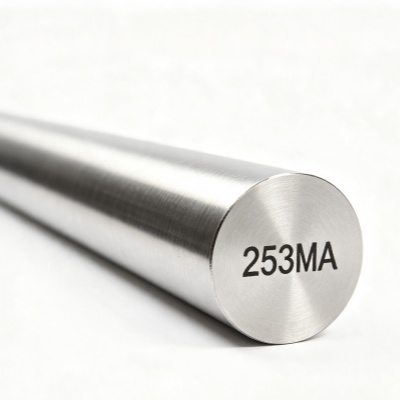
253MA (UNS S30815), also designated as 1.4835, X9CrNiSiNCe21-11-2, and 1Cr21Ni11Si2NCe, is a rare-earth micro-alloyed heat-resistant austenitic stainless steel engineered for superior oxidation resistance and creep strength at service temperatures from 850°C to 1100°C. The alloy’s defining metallurgical innovation — a controlled cerium addition (0.03–0.08%) combined with elevated silicon (1.40–2.00%) and nitrogen (0.14–0.20%) — produces an exceptionally adherent and self-healing chromium oxide scale that resists spallation during repeated thermal cycling, substantially outperforming standard grades such as 310S and 309S in cyclic oxidation service. SHUNFU METAL, certified to ISO 9001:2015 and API Q1, produces 253MA bars through controlled electric arc furnace (EAF) melting with AOD refining, precisely controlling the cerium, silicon, and nitrogen additions that distinguish this grade from conventional heat-resistant stainless steels.
253MA Stainless Steel Bar — Overview
Originally developed by Outokumpu (Avesta) under the designation 253 MA (Micro-Alloyed), this grade bridges the performance gap between standard austenitic heat-resistant grades such as 309S and 310S and significantly more expensive nickel-based alloys. The cerium micro-alloying is the critical differentiator: rare-earth oxide particles formed at the metal-scale interface act as mechanical anchoring sites that dramatically improve oxide scale adhesion, preventing the spallation-driven metal loss that limits the cyclic oxidation life of conventional heat-resistant stainless steels. In oil and gas operations, 253MA has become the preferred material for ethylene cracking furnace components, refinery fired heater tube hangers and supports, flare tips, burner nozzles, heat treatment furnace fixtures, and high-temperature conveyor systems in processing plants where operating temperatures regularly exceed 900°C. The elevated nitrogen content (0.14–0.20%) also provides solid solution strengthening, delivering a yield strength of 310 MPa minimum — approximately 50% higher than standard 310S — which allows thinner-section component designs with attendant material cost savings. SHUNFU METAL supplies 253MA bars in the solution-annealed condition (1050–1150°C, rapid air or water cooling), with every production lot verified by in-house OES and full MTC documentation per EN 10204 Type 3.1.
253MA Equivalent Grades — International Standards
| Standard | Designation |
|---|---|
| ASTM A479 / A276 / A240 / A182 | UNS S30815 / Grade F45 (forging) |
| ASME SA-479 / SA-182 | SA-479 S30815 / SA-182 F45 |
| EN 10095 / DIN | 1.4835 / X9CrNiSiNCe21-11-2 |
| GB/T 1220 | 1Cr21Ni11Si2NCe |
No direct JIS or GOST equivalents exist for 253MA. The GB designation is 1Cr21Ni11Si2NCe. SHUNFU METAL supplies bars certified to ASTM A479 UNS S30815, ASME SA-479, EN 10095 Grade 1.4835, and GB/T 1220, with full heat traceability and API Q1 documentation as standard.
SHUNFU METAL
253MA Applications — Oil & Gas Industry
253MA is specified wherever sustained or cyclic exposure above 850°C causes conventional heat-resistant grades such as 310S to fail by oxide scale spallation — the primary life-limiting mechanism in refinery fired heaters, ethylene crackers, and combustion equipment. SHUNFU METAL supplies 253MA bars to manufacturers serving the following high-temperature petroleum and petrochemical applications, with every production lot verified against ASTM A479 and ASME SA-479 requirements:
Supply Range — 253MA Bar Dimensions
SHUNFU METAL maintains dedicated production capability for 253MA bars across hot-rolled, cold-finished, and forged product forms, processed through ISO 9001:2015 controlled workflows. The cerium micro-alloying requires precise control of deoxidation practice during steelmaking to ensure uniform rare-earth oxide dispersion without clustering, and final solution annealing at 1050–1150°C is critical to dissolve chromium carbides formed during cooling from hot working. SHUNFU METAL’s metallurgical team verifies each heat treatment batch by grain size determination and oxidation resistance evaluation:
| Product Form | Diameter / Thickness Range | Width Range | Length (Standard) | Surface Finish |
|---|---|---|---|---|
| Hot Rolled Round | 10 mm – 300 mm | — | 3000 – 6000 mm | Black / Pickled |
| Cold Finished / Peeled Round | 3 mm – 100 mm | — | 2000 – 6000 mm | Peeled / Polished |
| Hot Rolled Flat | 10 mm – 120 mm | 50 mm – 400 mm | 2000 – 6000 mm | Pickled |
| Forged Round | 100 mm – 800 mm | — | 1000 – 6000 mm | Rough Machined / Black |
| Forged Flat / Block | 50 mm – 350 mm | 100 mm – 800 mm | 1000 – 5000 mm | Rough Machined / Black |
All bars are supplied with EN 10204 Type 3.1 Mill Test Certificates documenting heat number, full chemical analysis (including cerium, silicon, and nitrogen), mechanical test results, solution annealing verification, grain size per ASTM E112, and dimensional compliance. Cyclic oxidation testing per manufacturer procedures is available for critical high-temperature component qualification.
253MA Chemical Composition per ASTM A479
The 253MA chemistry is defined by the synergistic combination of elevated silicon (1.40–2.00%), controlled nitrogen (0.14–0.20%), and the critical cerium micro-alloy addition (0.03–0.08%). Silicon enhances the formation and self-healing characteristics of the protective chromium oxide scale; nitrogen provides solid solution strengthening for elevated yield strength at both ambient and elevated temperatures; and cerium — the defining micro-alloying element — forms finely dispersed rare-earth oxide particles that mechanically anchor the oxide scale to the metal surface, dramatically reducing oxide spallation during thermal cycling. At SHUNFU METAL, every heat is verified by in-house optical emission spectrometry (OES) against ASTM A479 UNS S30815 limits:
| Element | C | Si | Mn | P | S | Cr | Ni | N | Ce |
|---|---|---|---|---|---|---|---|---|---|
| Wt % | 0.05–0.10 | 1.40–2.00 | 0.80 max | 0.040 max | 0.030 max | 20.00–22.00 | 10.00–12.00 | 0.14–0.20 | 0.03–0.08 |
Composition conforms to ASTM A479 UNS S30815 and EN 10095 Grade 1.4835. The cerium content (0.03–0.08%) is the hallmark of 253MA and the element most closely monitored during steelmaking — even 0.01% deviation outside specification compromises the oxide scale adhesion that defines the alloy’s cyclic oxidation performance. The elevated silicon (1.40–2.00%) and nitrogen (0.14–0.20%) are intentionally specified at levels that would risk sigma phase embrittlement in conventional grades, but the unique cerium-silicon-nitrogen synergy of 253MA maintains microstructural stability at temperatures well above the sigma formation range. SHUNFU METAL’s API Q1 certified traceability links every finished bar to its original heat analysis, with cerium and silicon content verified on every MTC.
253MA Mechanical Properties — Solution Annealed Condition
The elevated nitrogen and silicon content of 253MA delivers yield strength approximately 50% higher than standard 310S (310 MPa vs 205 MPa minimum) while maintaining the excellent ductility required for thermal expansion accommodation in high-temperature components. SHUNFU METAL performs in-house tensile testing (ASTM E8) and hardness testing (ASTM E18) on every production lot, with full results documented on the MTC. The following values represent minimum guaranteed properties per ASTM A479 for bar products:
| Property (Ambient Temperature) | 253MA (S30815) | 310S (S31008) | 309S (S30908) | Test Method |
|---|---|---|---|---|
| Tensile Strength (MPa / ksi) | 600 min / 87 | 515 min / 75 | 515 min / 75 | ASTM E8 |
| Yield Strength 0.2% (MPa / ksi) | 310 min / 45 | 205 min / 30 | 205 min / 30 | ASTM E8 |
| Elongation in 4D (%) | 30 min | 30 min | 30 min | ASTM E8 |
| Reduction of Area (%) | 40 min | — | — | ASTM E8 |
| Hardness (HB) | HB 217 max | HB 217 max | HB 217 max | ASTM E10 |
Values per ASTM A479 for bar products in the solution-annealed condition (1050–1150°C, rapid air or water cooling). The 310 MPa minimum yield strength of 253MA — a 50% advantage over both 310S and 309S — permits thinner-wall component designs with significant weight and material cost savings in high-temperature structural applications such as furnace tube supports and conveyor systems.
Elevated-temperature performance: The primary design advantage of 253MA is not ambient strength but cyclic oxidation resistance at 850–1100°C. Laboratory testing demonstrates that 253MA loses approximately 60–80% less metal thickness by oxide spallation than 310S after equivalent thermal cycling exposure — a direct result of the cerium-anchored oxide scale. For continuous service, 253MA is rated for operation up to approximately 1100°C in oxidizing atmospheres, with the nitrogen-silicon synergy also providing enhanced creep rupture strength compared to 310S in the 800–950°C range.
Service temperature limits: 253MA is suitable for continuous service up to approximately 1100°C in oxidizing atmospheres. The alloy is not recommended for prolonged exposure between 600°C and 900°C under conditions that promote sigma phase formation, though its nitrogen content partially suppresses sigma precipitation kinetics compared to standard 310S. SHUNFU METAL’s ISO 9001:2015 accredited laboratory validates all mechanical properties on representative test specimens from each heat treatment batch, with API Q1 ensuring full material traceability from melt to end user.