
Nitronic 50, also known as Fermonic 50, is a high-strength austenitic stainless steel designated as ASTM XM-19, UNS S20910, and EN 1.3964. Developed originally by Armco Steel, it offers approximately twice the yield strength of 316 stainless steel while maintaining comparable corrosion resistance. The alloy is widely used in the oil & gas, marine engineering, chemical processing, aerospace, and medical device industries where high strength combined with excellent pitting resistance in chloride environments is required. Its nitrogen-strengthened austenitic matrix provides superior resistance to stress corrosion cracking and remains non-magnetic even after severe cold working, making it ideal for critical service in sour gas applications per NACE MR0175 / ISO 15156.
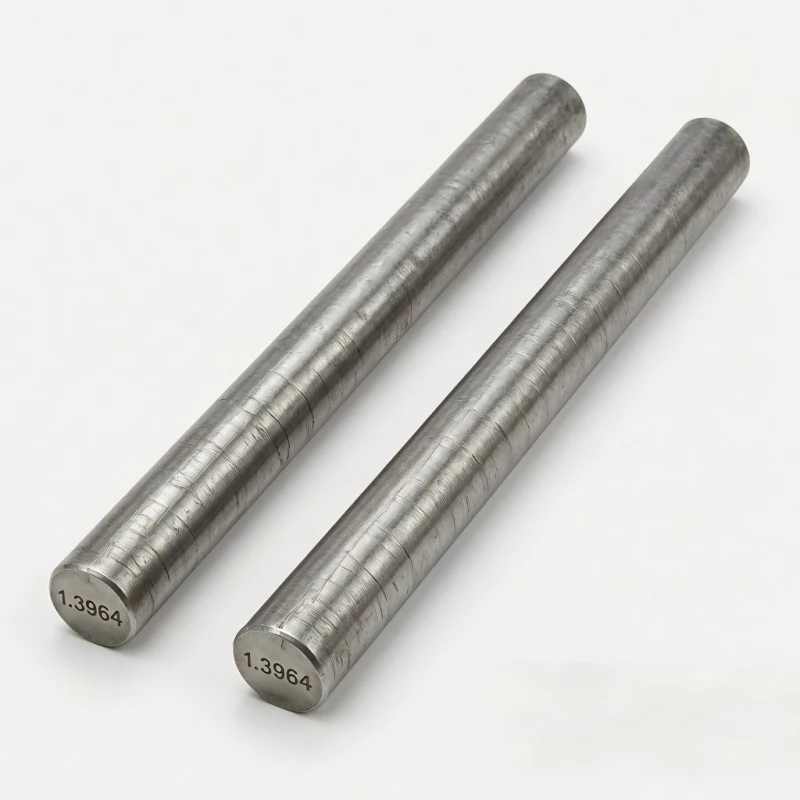
Equivalent Grades & Standards
| Standard / System | Grade / Designation |
|---|---|
| ASTM | XM-19 per ASTM A276, A479, A240, A182, A193, A194 |
| AMS | AMS 5764 (bar, wire, forgings), AMS 5842, AMS 5843 |
| EN / DIN | 1.3964 / X2CrNiMnMoNbN 21-15-3-1 per EN 10088-3, EN 10272 |
| UNS | S20910 |
| Trademarks | Nitronic 50 (Cleveland-Cliffs), Fermonic 50 |
| NACE | MR0175 / ISO 15156 for sour service |
| JIS | No direct equivalent; closest SUS 316 or duplex 2205 |
| GOST | No direct equivalent; closest 08Kh21N6M2T |
Typical Applications
Oil & Gas:
Marine:
Chemical Processing:
Aerospace:
Medical:
Power Generation:
Its combination of high strength, non-magnetic properties, and chloride pitting resistance makes it a preferred choice where standard 316 falls short mechanically.
Supply Range
| Form | Dimensions |
|---|---|
| Round Bar | Dia. 6 mm – 500 mm (0.25″ – 20″) |
| Flat Bar | Thk. 3–80 mm × W 10–350 mm |
| Plate / Sheet | Thk. 0.5–100 mm × W up to 2500 mm |
| Seamless Tube | OD 6–300 mm × WT 0.8–30 mm |
| Wire | Dia. 0.1–12 mm (0.004″–0.47″) |
| Forgings | OD up to 2000 mm; weight up to 5000 kg |
Chemical Composition
Per ASTM A276 / A479 (weight %):
| C | Mn | Si | P | S | Cr | Ni | Mo | Nb | N | Fe |
|---|---|---|---|---|---|---|---|---|---|---|
| ≤0.06 | 4.0–6.0 | ≤1.00 | ≤0.040 | ≤0.030 | 20.5–23.5 | 11.5–13.5 | 1.5–3.0 | 0.1–0.3 | 0.2–0.4 | Bal. |
High nitrogen and molybdenum contents provide the alloy’s distinctive pitting resistance and elevated strength in the annealed condition.
Mechanical Properties
| Condition | Tensile Strength (MPa) | Yield Strength 0.2% (MPa) | Elongation (%) | Hardness (HRB) |
|---|---|---|---|---|
| Annealed (ASTM A276) | ≥690 (100 ksi) | ≥380 (55 ksi) | ≥35 | ≤96 |
| Cold Worked (typical) | 860–1000 | 620–860 | 15–25 | 25–38 HRC |
| AMS 5764 (solution annealed) | ≥690 | ≥380 | ≥35 | ≤96 |
Annealing is performed at 1065–1120°C followed by water quenching. The alloy remains austenitic and non-magnetic (relative permeability ≤1.02) in all conditions. Impact toughness at cryogenic temperatures is excellent, with Charpy V-notch values typically exceeding 100 J at -196°C.
Need Nitronic 50 / S20910 to the specification above?
Send the size, condition, quantity and any NACE or PMI requirements — we reply with mill availability, lead time and a priced offer, usually within one working day.