
Project Description
Hastelloy C-4 (UNS N06455 / W. Nr. 2.4610 / NiMo16Cr16Ti, Chinese GB: NS335) is the most microstructurally stable member of the widely used nickel-chromium-molybdenum (Ni-Cr-Mo) C-series family. Developed as a deliberate refinement of the original Hastelloy C (N10002), its defining advancement is the complete elimination of tungsten and drastic reduction of carbon (≤ 0.010 %), silicon (≤ 0.08 %), and iron (≤ 3.0 %) — the three elements responsible for embrittling secondary-phase formation in the 650–1,040 °C range. This tungsten-free, ultra-low-carbon composition renders N06455 virtually immune to sensitization in weld heat-affected zones (HAZ), allowing it to be used in the as-welded condition without post-weld solution annealing. In the oil and gas industry, Hastelloy C-4 is preferred for components requiring both broad-spectrum corrosion resistance (HCl, H₂SO₄, chlorides, sour gas) and long-term high-temperature stability in fired-heater environments, amine regenerators, and HDS unit internals. SHUNFU METAL supplies N06455 bar from VIM + VAR double-refined heats, Ti content controlled at 0.20–0.60 % to pin grain boundaries and further suppress carbide precipitation, with full EN 10204 3.1 / 3.2 MTR on every shipment.
Hastelloy C-4 / N06455 — Introduction & Key Metallurgical Advances
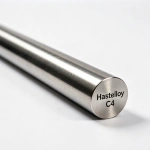
Hastelloy C-4 inherits the twin-environment corrosion resistance of its C-series predecessors — strong reducing acids (HCl, H₂SO₄, HBr, phosphoric acid) and oxidizing halide media (wet chlorine, hypochlorite, chlorine dioxide) — while solving the critical weldability problem that plagued the original Hastelloy C (N10002). By removing tungsten entirely and reducing iron to ≤ 3.0 %, C-4 eliminates the thermodynamic driving force for µ-phase and Ni₄Mo β-phase precipitation that cause post-weld sensitization and knife-line attack in the HAZ.
The titanium addition (≤ 0.70 %) acts as a carbon getter, tying up residual carbon as stable TiC rather than allowing it to combine with chromium at grain boundaries. This is the same stabilization strategy used in AISI 321 stainless steel, here applied at the superalloy level. The combined effect: C-4 survives prolonged thermal cycling through the 650–1,040 °C sensitization window without measurable degradation in corrosion resistance or toughness — a property no earlier C-series alloy could guarantee.
At SHUNFU METAL, C-4 billets are triple-checked for Ti at 0.20–0.60 % by X-ray fluorescence (XRF) and optical emission spectrometry (OES) to ensure the stabilization function is active. Forged rounds are hot-worked at 900–1,150 °C, solution-annealed at 1,065–1,120 °C, water-quenched, and subjected to ASTM A262 Practice C intergranular corrosion (IGC) testing before release. 100 % ultrasonic inspection per ASTM E114 is standard on bar over Ø25 mm.
Equivalent Grades & Applicable Standards — Hastelloy C-4 N06455
| Standard Body | Designation | Applicable Specification / Form |
|---|---|---|
| ASTM / ASME | UNS N06455 | ASTM B574 / SB-574 (rod & bar), ASTM B575 / SB-575 (plate / sheet / strip), ASTM B622 / SB-622 (seamless pipe & tube), ASTM B619 / SB-619 (welded pipe), ASTM B626 / SB-626 (welded tube), ASTM B366 / SB-366 (fittings), ASTM B564 / SB-564 (forgings) |
| EN / DIN | 2.4610 / NiMo16Cr16Ti | DIN 17744 (wrought alloy designations), EN 10095 (heat-resistant strips / bar), EN 10028-7 (pressure vessel plate); Werkstoff Nr. 2.4610 is the primary European identifier |
| AMS | AMS 5608 | AMS 5608 (sheet, strip & plate — solution annealed); aerospace MRO and defense chemical-agent containment |
| ISO | NiMo16Cr16Ti | ISO 9722 (rod, bar & wire), ISO 6208 (plate / sheet / strip), ISO 9725 (seamless tube) |
| GB (China) | NS335 / 00Cr16Mo16 | GB/T 15007 (bar), GB/T 14995 (plate / sheet), GB/T 14992 (wrought Ni-alloy designations) |
| GOST (Russia) | ХН65МВ (functional near-equiv.) | No direct GOST equivalent; ХН65МВ is a near-equivalent Ni-Mo-Cr alloy — verify full elemental ranges before substitution |
| JIS (Japan) | NCF C-4 (special order) | No standardized JIS grade for N06455; typically procured to ASTM B574 in Japanese downstream chemical-plant projects |
| AWS (Welding Filler) | ERNiCrMo-7 / ENiCrMo-7 | AWS A5.14 (bare rod & wire), AWS A5.11 (coated electrode); as-welded use permitted — no PWHT required for N06455 weldments |
Oil & Gas Applications — N06455 Bar Components
- Acid injection pump shafts & impellers
- Matrix acidizing nozzle bodies
- Acid blending manifold internals
- Coiled tubing BHA connector bars
- Acid pump valve seats & bodies
- H₂S scrubber agitator shafts & internals
- Amine absorber tray supports & bolting
- Gas sweetening vessel internals
- Sour gas reboiler tube sheets
- Sulfur recovery reactor bars
- HDS reactor internal fixture bars
- Fired heater tube hanger bars
- Crude unit overhead condenser nozzle bars
- Catalytic reformer quench nozzle bodies
- Vacuum distillation column internals
- FGD absorber agitator shaft bars
- Wet chlorine gas scrubber internals
- Bleach production pump shafts
- Hypochlorite service valve bodies
- Offshore sea-water lift pump internals
- Downhole instrumentation housings
- Subsea chemical injection valve bodies
- HPHT packer seal mandrel bars
- Wellhead adapter spool bars
- Wireline logging tool mandrels
- Dissolvers & waste evaporator internals
- Nitric / HF mixed-acid service shafts
- High-level waste vessel agitators
- Spent fuel storage rack support bars
- Reprocessing plant pump internals
Supply Forms & Dimensions — Hastelloy C-4 N06455 Bar
| Product Form | Size Range | Standard | Condition |
|---|---|---|---|
| Hot-Rolled Round Bar | Ø12 – Ø320 mm | ASTM B574 | Solution annealed + water quenched |
| Cold-Drawn Round Bar | Ø3 – Ø80 mm | ASTM B574 | Annealed or cold-worked; h9/h11 tolerance |
| Hot-Rolled Flat Bar | Thickness 8–200 mm × Width 20–600 mm | ASTM B574 | Solution annealed + water quenched |
| Forged Round Bar | Ø80 – Ø700 mm | ASTM B564 (forgings) | Open-die forged, solution annealed, UT per ASTM E114 |
| Forged Flat Bar / Block | Thickness 50–400 mm × Width ≤ 1,200 mm | ASTM B564 | Forged flat, solution annealed, surface milled |
| Hexagonal Bar | A/F 6 – 80 mm | ASTM B574 | Cold-drawn or hot-rolled; solution annealed |
SHUNFU METAL standard stock lengths: 500–6,000 mm. Custom cut-to-length and rough-machined blanks available. Minimum order quantity: 50 kg. Lead time: 2–6 weeks depending on section size.
Chemical Composition — Hastelloy C-4 per ASTM B574
| Element | Ni | Cr | Mo | Fe | Co | Ti | Mn | Si | C | W | S | P |
|---|---|---|---|---|---|---|---|---|---|---|---|---|
| Min (%) | Bal. | 14.0 | 14.0 | — | — | — | — | — | — | absent | — | |
| Max (%) | — | 18.0 | 17.0 | 3.0 | 2.0 | 0.70 | 1.00 | 0.08 | 0.010 | 0 (absent) | 0.030 | 0.025 |
Mechanical Properties — N06455 Bar under Different Conditions
| Condition | Tensile Strength Rm (MPa) |
0.2% Yield Rp0.2 (MPa) |
Elongation A (%) |
Hardness | Standard / Ref. |
|---|---|---|---|---|---|
| Annealed (min. required) | ≥ 690 | ≥ 283 | ≥ 40 | ≤ 100 HRB | ASTM B574 |
| Annealed (typical) | 760 | 360 | 55 | 85 HRB / ~170 HB | Haynes / industry typical |
| Hot-Finished (typical) | 724 | 310 | 45 | ~82 HRB | ASTM B574 |
| Cold-Drawn (typical) | 830 | 600 | 30 | ~95 HRB | ASTM B574 |
| Annealed @ 200 °C | 680 | 295 | 50 | — | Elevated-temp. typical |
| Annealed @ 400 °C | 650 | 260 | 45 | — | Elevated-temp. typical |
| Thermal Stability Check 1,000 h aging @ 760 °C |
755 | 350 | ≥ 50 % | ~85 HRB | C-4 signature advantage vs C-276 / C |
Physical properties: density 8.64 g/cm³; melting range 1,335–1,380 °C; Charpy V-notch impact (annealed plate, RT) ≈ 280 ft-lbf (379 J).