
Project Description
Hastelloy C (UNS N10002 / W. Nr. 2.4819 / NiCr15Mo16W, Chinese GB: NS331) is the original nickel-chromium-molybdenum-tungsten corrosion-resistant alloy — the “founding ancestor” of the entire C-series family. Developed in the 1930s by Haynes International, it established the landmark Ni-15Cr-16Mo-4W composition formula that became the genetic blueprint for all successor alloys (C-276, C-22, C-2000). Its defining achievement: the first alloy capable of resisting both strongly reducing environments (hydrochloric acid, sulfuric acid) and strongly oxidizing environments (wet chlorine gas, hypochlorite, chlorine dioxide) simultaneously. While modern engineering now favors upgraded C-276 or C-22 for weldable fabrications, N10002 remains specified in maintenance, repair, and legacy equipment replacement across the oil, gas, and chemical processing sectors. SHUNFU METAL supplies N10002 bar from VIM-refined and solution-annealed heats, with full chemical certification per ASTM B336, 100 % ultrasonic inspection per ASTM E114, and EN 10204 3.1 / 3.2 MTR on every shipment.
Hastelloy C / N10002 — Introduction & Background
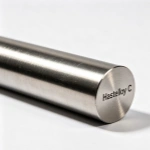
Hastelloy C was the world’s first alloy engineered to survive both oxidizing and reducing corrosive media without surface treatment or inhibitors. The high chromium content (~15 %) forms a dense passive oxide film against oxidizing attack, while the extraordinary molybdenum level (~16 %) provides thermodynamic stability against proton-reduction in reducing acids. Tungsten (3–4.5 %) supplements molybdenum as a large-atom reinforcer of the passive film against pitting and crevice corrosion. This triple-mechanism defense made N10002 the dominant choice for corrosive chemical service from the 1940s through the 1980s.
The alloy’s critical limitation is its relatively high carbon (≤ 0.08 %) and silicon (≤ 1.00 %) content — a consequence of 1930s metallurgical technology. These elements cause rapid chromium carbide and silicide precipitation in the grain boundaries when exposed to sensitization temperatures (650–1,040 °C), particularly in weld heat-affected zones (HAZ), leading to severe intergranular corrosion. Any welded N10002 assembly must receive full solution annealing at 1,175–1,230 °C followed by rapid quench — a requirement that drives modern engineers to specify N10276 (C-276) or N06022 (C-22) for new fabrications. For maintenance replacement of existing N10002 components, SHUNFU METAL provides bar stock with certificate of conformance to the original specification.
SHUNFU METAL melts N10002 in VIM furnaces with real-time optical emission spectrometry, maintaining Mo at 15.0–17.0 % and W at 3.0–4.5 % to the original ASTM B336 composition. Billets are hot-forged at 1,000–1,200 °C, solution-annealed at 1,175 °C, water-quenched, and hardness-verified per ASTM E10. Intergranular corrosion (IGC) testing per ASTM A262 Practice C is available on request. All bars are 100 % ultrasonically inspected per ASTM E114 and supplied with EN 10204 3.1 / 3.2 MTR.
Equivalent Grades & Applicable Standards — Hastelloy C N10002
| Standard Body | Designation | Applicable Specification / Form |
|---|---|---|
| ASTM / ASME | UNS N10002 | ASTM B336 / SB-336 (rod & bar), ASTM B334 / SB-334 (plate / sheet / strip), ASTM B622 / SB-622 (seamless pipe & tube), ASTM B619 / SB-619 (welded pipe), ASTM B626 / SB-626 (welded tube), ASTM B366 / SB-366 (fittings), ASTM B564 / SB-564 (forgings) |
| EN / DIN | 2.4819 / NiMo16Cr15W | DIN 17752 (bar & rod), DIN 17750 (plate / sheet), DIN 17751 (seamless tube), DIN 17744 (wrought alloy designations); note: 2.4819 is sometimes listed as historical W.Nr. — confirm active EN designation with mill |
| AMS | AMS 5530 | AMS 5530 (sheet, strip, plate — solution annealed); aerospace / defense maintenance applications |
| ISO | Ni5505 | ISO 9723 (bar), ISO 9724 (wire), ISO 9725 (seamless tube), ISO 6208 (plate / sheet / strip) |
| GB (China) | NS331 / 0Cr15Ni60Mo16W4 | GB/T 15007 (bar), GB/T 14995 (plate / sheet), GB/T 14992 (wrought nickel alloy designation) |
| GOST (Russia) | ХН65МВУ (approximate) | Near-equivalent Ni-Mo-Cr-W alloy; verify full elemental composition before substitution in critical applications |
| AWS (Welding Filler) | ERNiMo-3 | AWS A5.14 / SFA 5.14; post-weld full solution anneal at 1,175–1,230 °C + water quench mandatory for any welded N10002 assembly |
⚠ Note: Many modern procurement documents that specify “Hastelloy C” now accept N10276 (C-276) as a direct, performance-superior substitute. Always clarify UNS number to avoid ambiguity.
Oil & Gas Applications — N10002 Bar Components
- Acid injection pump shafts & impellers
- Acid pump valve seats & bodies
- Matrix acidizing nozzle bodies
- Coiled tubing BHA connector bars
- Acid blending manifold internals
- H₂S scrubber internals & agitator shafts
- Amine absorber tray supports & bolting
- Sulfur recovery reactor bars
- Gas sweetening vessel internals
- Claus unit heat exchanger tube sheets
- HDS (hydrodesulfurization) reactor bars
- Crude oil desalter electrode shafts
- Catalytic reformer quench rings
- Sour naphtha stripping column internals
- HF alkylation unit agitator shafts
- FGD quencher & absorber internals
- Wet scrubber agitator shafts
- Chlorine dioxide bleaching tower parts
- Incinerator off-gas quench nozzles
- Hypochlorite process valve stems
- OEM replacement bar for existing N10002 equipment
- Pump sleeve & bushing replacement blanks
- Flanged valve stem replacement blanks
- Bolt & stud blanks for legacy reactors
- Bearing journal replacement bars
- Corrosion inhibitor injection quills
- Chemical dosing pump internals
- Seawater intake filter screen frames
- Topsides heat exchanger tube sheets
- Downhole scale inhibitor mandrel bars
Supply Programme — Hastelloy C N10002 Bar & Forged Stock
| Product Form | Size Range | Standard / Condition | Surface |
|---|---|---|---|
| Hot-Rolled Round Bar | Ø 12 – Ø 200 mm | ASTM B336, solution annealed | Black / pickled |
| Cold-Drawn Round Bar | Ø 3 – Ø 60 mm | ASTM B336, solution annealed + drawn | Bright / pickled |
| Hot-Rolled Flat Bar | T: 8–80 mm × W: 20–200 mm | ASTM B334, solution annealed | Black / pickled |
| Forged Round Bar | Ø 60 – Ø 600 mm | ASTM B564, solution annealed + forged | Turned / rough-turned |
| Forged Flat Bar / Slab | T: 50–250 mm × W: 100–600 mm | ASTM B334 / B564, solution annealed | Milled / rough-milled |
| Large Forged Billet | Ø 200 – Ø 650 mm (custom) | Per order, EN 10204 3.2 inspection | As-forged / rough-turned |
Length: standard 1,000–6,000 mm; cut-to-length & rough-machined blanks available. IGC testing per ASTM A262 Practice C and third-party inspection (SGS / BV / TÜV) available on request.
Chemical Composition — Hastelloy C / N10002 per ASTM B336
| Element | Ni | Cr | Mo | W | Fe | Co | V | C | Si | Mn |
|---|---|---|---|---|---|---|---|---|---|---|
| wt % | Balance (~54) | 14.5–16.5 | 15.0–17.0 | 3.0–4.5 | 4.0–7.0 | ≤ 2.5 | ≤ 0.35 | ≤ 0.08 | ≤ 1.00 | ≤ 1.00 |
Red values indicate elements that differ significantly from C-276 (N10276): C ≤ 0.08 % (vs. ≤ 0.010 % in C-276), Si ≤ 1.00 % (vs. ≤ 0.08 % in C-276), and Fe 4.0–7.0 % (vs. ≤ 5.0 %). The higher C and Si are the primary drivers of the mandatory post-weld solution anneal requirement.
Elemental Role Summary
Mechanical Properties — Hastelloy C N10002 Bar
| Condition | Tensile Strength Rm (MPa) | 0.2% Yield Strength Rp₀.₂ (MPa) | Elongation A₅ (%) | Hardness (HRB) | Applicable Spec. |
|---|---|---|---|---|---|
| Solution Annealed (1,175–1,230 °C, WQ) |
≥ 690 | ≥ 283 | ≥ 35 | ≤ 100 HRB | ASTM B336 |
| Hot-Finished / Forged (as-forged + annealed) |
690–870 | 275–380 | 35–50 | 85–95 HRB | ASTM B564 |
| Cold-Drawn (lightly cold-worked) |
760–1,000 | 480–690 | 25–35 | 95–105 HRB | ASTM B336 |
| Physical Properties (20 °C reference) |
Density: 8.94 g/cm³ | Melting range: 1,320–1,350 °C | Elastic modulus: ~205 GPa | Thermal conductivity: ~10.5 W/m·K | Specific heat: ~420 J/kg·K | Electrical resistivity: 1.28 Ω·mm²/m | ||||
⚠ Critical Metallurgical Warning: Hastelloy C (N10002) contains C ≤ 0.08 % and Si ≤ 1.00 %. Any heating in the sensitization range 650–1,040 °C (including welding HAZ, hot forming, or slow cooling) causes rapid chromium carbide and silicide precipitation at grain boundaries, resulting in catastrophic intergranular corrosion. All welded assemblies MUST undergo full solution annealing at 1,175–1,230 °C followed by rapid water quench before exposure to corrosive service. For new fabrications where post-weld anneal is impractical, specify N10276 (C-276) or N06022 (C-22) instead.