
Project Description
Hastelloy B-3 / UNS N10675 / EN 2.4600 is a third-generation nickel-molybdenum solid-solution austenitic alloy that solved the fundamental limitation of its predecessors — thermal instability leading to embrittlement in the 600–900°C range. Introduced by Haynes International in the 1990s, B-3 retains the defining characteristic of the B-series — exceptional resistance to pure reducing acids, particularly HCl at all concentrations and temperatures including boiling — while achieving dramatic improvements in fabricability. Where B-2 (N10665) suffered rapid Ni4Mo / Ni3Mo ordered intermetallic precipitation during welding and thermal cycling, B-3’s optimized chemistry (controlled chromium 1–3%, iron 1–3%, tungsten ≤3%) shifts the TTT curve for deleterious phase formation to significantly longer times. This means B-3 can be multi-pass welded, hot-formed, and subjected to intermediate-temperature process excursions without post-fabrication solution annealing — a capability that B-2 simply cannot match. The practical consequence is lower fabrication cost, reduced risk of in-service SCC, and tolerance to occasional oxidizing transients that would destroy B-2. SHUNFU METAL manufactures Hastelloy B-3 CRA pipe through EAF + VOD / AOD melting with ultra-low carbon targets, solution annealing at 1065°C with rapid water quenching, and 100% PMI, ultrasonic, eddy current, and hydrostatic verification. B-3 is the recommended grade for all new construction — B-2 is reserved for legacy replacement where weld procedure qualification already exists.
Equivalent Grades of Hastelloy B-3 / N10675
| Alloy | UNS | EN / DIN | GB | JIS | ASTM Pipe | Family |
|---|---|---|---|---|---|---|
| Hastelloy B-3 | N10675 | 2.4600 / NiMo29Cr | NS3203 | — | B622 / B619 | Ni-Mo (推荐) |
| Hastelloy B-2 | N10665 | 2.4617 / NiMo28 | NS322 | NW 0665 | B622 / B619 | Ni-Mo (前代) |
| Hastelloy B | N10001 | 2.4800 | — | — | obsolete | Ni-Mo (原版) |
| Alloy C-276 | N10276 | 2.4819 / NiMo16Cr15W | NS3304 | NW 0276 | B622 / B619 | Ni-Cr-Mo (氧化) |
| Alloy C-2000 | N06200 | 2.4675 / NiCr23Mo16Cu | NS3405 | — | B622 / B619 | Ni-Cr-Mo-Cu |
| Alloy 59 | N06059 | 2.4605 / NiCr23Mo16 | NS3311 | — | B622 / B619 | Ni-Cr-Mo |
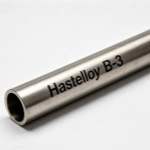
CRA Seamless Pipe
Chemical Process & Industrial Applications of Hastelloy B-3 / N10675
HCl Distillation & Handling
Distillation columns, reboilers, condensers, and transfer piping in pure HCl at all concentrations including azeotropic boiling — the core application for B-series alloys.
Sulfuric Acid Concentration
Heat exchangers and piping in dilute-to-medium H2SO4 concentration plants, including conditions with occasional oxidizing transients that B-2 cannot tolerate.
Acid Regeneration (ARP)
Pumps, valves, and heat exchangers in HCl regeneration plants recovering acid from steel pickling spent liquor — B-3’s thermal stability handles ARP temperature cycling.
Agrochemical Chlorination
Reactor vessels, agitators, and piping in chlorination/hydrolysis processes generating hot concentrated HCl in insecticide and herbicide production.
Acetic Acid Recovery Systems
Distillation and recovery systems for glacial acetic acid and acetic anhydride in PTA plants, including recycle streams with trace oxidizers.
Refinery HF Alkylation
Hydrofluoric acid handling, reactor effluent piping, and acid rerun columns in HF alkylation units producing high-octane gasoline blendstock.
Phosphoric Acid Evaporation
Evaporator tubes and transfer piping in wet-process H3PO4 plants handling reducing acid streams — B-3 tolerates fluoride contamination better than B-2.
Nuclear Fuel Reprocessing
Dissolver vessels and off-gas scrubbers in spent nuclear fuel reprocessing using reducing nitric-hydrofluoric acid dissolver solutions.
Fine Chemical & Pharma API
Multi-purpose reactor and piping systems in pharmaceutical API and fine chemical manufacturing with varying reducing acid campaigns.
Hastelloy B-3 / N10675 Pipe Supply Range
SHUNFU METAL supplies Hastelloy B-3 (N10675 / 2.4600) CRA pipe and tube in seamless and welded forms per ASTM B622 and B619. Seamless pipe from OD 6 mm to 219 mm (1/8″–8″ NB) and welded pipe from OD 5 mm to 1219 mm (1/8″–48″ NB), with wall thickness from 0.5 mm to 50 mm across SCH 5S through XXS. All material is solution-annealed at 1065°C minimum followed by rapid water quenching — the critical step that dissolves Ni-Mo ordered phases and locks in the homogeneous FCC gamma structure. SHUNFU targets carbon at ≤0.008% and silicon at ≤0.08% internal, well below the spec limits of C ≤0.01% and Si ≤0.10%, maximizing the already-superior TTT resistance of the B-3 composition. Products certified to EN 10204 3.1 / 3.2 with full PMI traceability, ultrasonic and eddy current NDT, and hydrostatic testing per ASME B31.3. End finishes: plain, beveled, flanged, or threaded. Also available to Chinese GB/T 15007 (NS3203) and DIN 17752 / EN ISO 6207. Welding is B-3’s greatest advantage: use matching filler ERNiMo-10 (B-3 bare wire) / ENiMo-10 covered electrode; control interpass temperature below 93°C with low heat input; unlike B-2, B-3 weldments in most reducing-acid service do not require post-weld solution annealing — the alloy’s controlled Cr/Fe/W additions prevent HAZ intermetallic precipitation under normal welding conditions. SHUNFU supplies complete WPS / PQR documentation with ASTM G28 Method B corrosion verification on all weld procedure qualification coupons. For the most aggressive boiling HCl service, optional post-weld anneal at 1065°C + rapid quench is available upon request.
Chemical Composition of Hastelloy B-3 / N10675
Composition per ASTM B622 (wt%). The controlled chromium (1–3%), iron (1–3%), and tungsten (≤3%) additions — absent in B-2 — are the key metallurgical innovations that deliver B-3’s thermal stability.
| Element | Ni | Mo | Fe | Cr | W | Co | Mn | Si | C | Al | Ti |
|---|---|---|---|---|---|---|---|---|---|---|---|
| B-3 (N10675) | ≥65 Bal | 27.0–32.0 | 1.0–3.0 | 1.0–3.0 | ≤3.0 | ≤3.0 | ≤3.0 | ≤0.10 | ≤0.01 | ≤0.50 | ≤0.20 |
| SHUNFU Target | ≥65 Bal | 28.0–30.0 | 1.5–2.2 | 1.5–2.2 | 1.0–2.5 | ≤1.5 | ≤2.0 | ≤0.08 | ≤0.008 | 0.15–0.40 | ≤0.10 |
B-3’s metallurgical design represents a deliberate departure from the B-2 philosophy of near-total chromium elimination. Haynes metallurgists discovered that controlled chromium (1–3%), iron (1–3%), and tungsten (≤3%) additions — combined with further reduced carbon (≤0.01% vs B-2’s ≤0.02%) — dramatically slow the kinetics of Ni4Mo and Ni3Mo ordered phase precipitation without compromising reducing-acid corrosion resistance. The Cr and Fe atoms substitute randomly into the FCC nickel lattice, disrupting the long-range Ni-Mo ordering that causes B-2 embrittlement. Tungsten provides additional solid-solution strengthening. The result: B-3’s TTT nose for deleterious phase formation is shifted from minutes (B-2) to hours, enabling as-welded service in most reducing environments without post-weld heat treatment. Aluminum (≤0.50%) and titanium (≤0.20%) serve as microalloy deoxidizers during melting. SHUNFU verifies chemistry on every heat by OES and inert gas fusion (C/S/N/O), confirming Mo content within 28–30% and Cr/Fe/W ratios within the optimized window for maximum TTT resistance. ASTM G28 Method B verification ensures corrosion rate ≤0.5 mm/year on solution-annealed samples.
Mechanical Properties of Hastelloy B-3 / N10675
B-3 is a solid-solution alloy supplied in the annealed condition — it cannot be hardened by heat treatment. SHUNFU anneals at 1065°C minimum with rapid water quenching. Typical values are well above ASTM minimums due to the additional W solid-solution strengthening.
| Form / Condition | Tensile Strength (MPa) | Yield Strength 0.2% (MPa) | Elongation (%) | Hardness |
|---|---|---|---|---|
| Seamless Pipe (B622, Ann.) | ≥758 (typ. 883) | ≥350 (typ. 400) | ≥40 (typ. 58) | ≤100 HRB |
| Plate (B333, Ann.) | ≥758 (typ. 883) | ≥350 (typ. 414) | ≥40 (typ. 58) | ≤100 HRB |
| Sheet (B333, Ann.) | ≥758 (typ. 862) | ≥350 (typ. 421) | ≥40 (typ. 53) | ≤100 HRB |
| Temp (°C) | YS (MPa) | UTS (MPa) |
|---|---|---|
| 100 | 372 | 841 |
| 200 | 331 | 793 |
| 300 | 303 | 765 |
| 400 | 283 | 745 |
| Density | 9.22 g/cm³ |
| Melting Range | 1370–1418°C |
| Elastic Modulus | 216 GPa |
| Thermal Conductivity | 11.2 W/m·K |
| CTE 20–200°C | 10.6 μm/m·°C |
| Poisson Ratio | 0.30 |
| Max Service Temp | 427°C (oxidizing) |
| Specific Heat | 372 J/kg·K |
B-3 vs B-2 — the practical differences: B-3’s tungsten solid-solution strengthening produces typical tensile strengths ~20–30 MPa higher than B-2 at ambient temperature, while the Cr/Fe/W-modified matrix retains strength at elevated temperatures comparably well. The critical advantage is sustained ductility after thermal exposure: B-3 retains ≥35% elongation after 100 hours at 700°C (a condition that reduces B-2 to <5% elongation due to Ni4Mo ordering). This translates directly to lower fabrication risk and greater tolerance to process upsets. B-3 also resists chloride SCC, maintains excellent cryogenic toughness, and is non-magnetic (μ ≤1.002). SHUNFU validates mechanical integrity through batch tensile testing per ASTM E8, Rockwell B hardness per ASTM E18, grain size per ASTM E112 (target ASTM 4–7), and ASTM G28 Method B intergranular corrosion verification. All dimensional tolerances per ASME B36.19M / B36.10M. Hydrostatic test at 1.5× design pressure per ASME B31.3 on every pipe length. Exclusion notice: B-3 is not rated for NACE MR0175 sour H2S service — for sour environments specify Hastelloy C-276 (N10276) or C-22 (N06022).