
Project Description
Hastelloy B-2 / UNS N10665 / EN 2.4617 is a nickel-molybdenum solid-solution austenitic alloy engineered for maximum resistance to pure reducing acids, particularly HCl at all concentrations and temperatures including the boiling point. With nominally 28% molybdenum and near-zero chromium (≤1%), B-2 operates on a fundamentally different corrosion mechanism than Ni-Cr-Mo alloys — it relies on a molybdenum-rich passive film (MoO2 / MoO42−) stable in reducing acids but catastrophically vulnerable to even trace oxidizing contaminants (Fe3+, Cu2+, dissolved O2, HNO3). Developed by Haynes International in the 1970s as a dramatic improvement over the original Hastelloy B (N10001), B-2 achieved tighter carbon (≤0.02%) and silicon (≤0.10%) limits that suppressed Ni4Mo intermetallic ordering and knife-line attack in weld HAZs. However, B-2 retains a susceptibility to embrittlement after sustained exposure in the 600–900°C range — its TTT curve for ordered phase precipitation is rapid enough that multi-pass welding without intermediate solution annealing can cause SCC in aggressive HCl service. For applications involving thermal cycling, occasional oxidizing excursions, or thick-section multi-pass welding, Hastelloy B-3 (N10675) is the recommended upgrade. SHUNFU METAL manufactures Hastelloy B-2 CRA pipe through EAF + AOD melting, solution annealing at 1065°C with forced rapid quench, and 100% PMI + NDT verification. Critical selection rule: B-2 must only be specified for confirmed reducing, contamination-free HCl, H2SO4, H3PO4, or organic acid service — any possibility of oxidizing contaminants mandates switching to B-3 or C-276.
Equivalent Grades of Hastelloy B-2 / N10665
| Alloy | UNS | EN / DIN | GB | JIS | ASTM Pipe | Family |
|---|---|---|---|---|---|---|
| Hastelloy B-2 | N10665 | 2.4617 / NiMo28 | NS322 | NW 0665 | B622 / B619 | Ni-Mo |
| Hastelloy B-3 | N10675 | 2.4600 / NiMo29Cr | NS3203 | — | B622 / B619 | Ni-Mo (升级) |
| Hastelloy B | N10001 | 2.4800 | — | — | obsolete | Ni-Mo (原版) |
| Alloy C-276 | N10276 | 2.4819 / NiMo16Cr15W | NS3304 | NW 0276 | B622 / B619 | Ni-Cr-Mo (替换) |
| Alloy C-2000 | N06200 | 2.4675 / NiCr23Mo16Cu | NS3405 | — | B622 / B619 | Ni-Cr-Mo-Cu |
| Nimofer 6928 | N10665 | 2.4617 | NS322 | NW 0665 | B622 / B619 | Ni-Mo (VDM) |
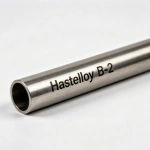
CRA Seamless Pipe
Chemical Process Applications of Hastelloy B-2 / N10665
HCl Synthesis & Distillation
Synthesis reactor tubes, absorption columns, reboilers, and transfer piping in pure HCl at all concentrations to boiling — the primary application driving B-2 material selection.
Sulfuric Acid 0–60% Handling
Dilution coolers, storage/transfer piping, and heat exchangers in reducing H2SO4 service at elevated temperature — provided oxidizing contaminants are absent.
Acid Regeneration (ARP)
Pumps, heat exchangers, and piping in HCl regeneration plants recovering acid from steel pickling spent liquor under controlled reducing conditions.
Wet-Process Phosphoric Acid
Evaporator tubes and reactor components in H3PO4 plants with moderate fluoride content, where reducing conditions are maintained and C-family alloys underperform.
Acetic Acid & Organic Acids
Reactor vessels, distillation columns, and heat exchanger tubes in glacial acetic acid manufacture and organic acid concentration plants.
Pharma Intermediate Synthesis
Piping and vessels in pharmaceutical intermediate manufacturing where confirmed reducing HCl or H2SO4 streams require maximum acid resistance without chromium passivation.
Alkylation Catalyst Systems
AlCl3 catalyst handling in ethylbenzene production where HCl evolution from catalyst hydrolysis creates aggressive reducing-acid conditions.
Pulp & Paper Digesters
Digester linings, extraction screens, and acid piping in sulfite pulping processes generating reducing SO2/H2SO4 cooking liquors.
Vacuum Salt Production
Brine preheater and evaporator tubes where HCl is injected for pH control and reducing chloride conditions demand Mo-rich Ni alloys.
Hastelloy B-2 / N10665 Pipe Supply Range
SHUNFU METAL supplies Hastelloy B-2 (N10665 / 2.4617) CRA pipe and tube in seamless and welded forms per ASTM B622 and B619. Seamless pipe from OD 6 mm to 219 mm (1/8″–8″ NB) and welded pipe from OD 5 mm to 1219 mm (1/8″–48″ NB), with wall thickness from 0.5 mm to 50 mm across SCH 5S through XXS. All material is solution-annealed at 1065°C minimum followed by forced rapid water quenching to dissolve Ni4Mo ordered intermetallic phases — a critical step validated by ASTM G28 Method B intergranular corrosion rate testing. SHUNFU targets carbon at ≤0.015% and silicon at ≤0.08% internal (spec ≤0.02% C / ≤0.10% Si) to maximize resistance to knife-line attack. Products certified to EN 10204 3.1 / 3.2 with full PMI traceability, ultrasonic and eddy current NDT, and hydrostatic testing per ASME B31.3. End finishes: plain, beveled, flanged, or threaded. Also available to Chinese GB/T 15007, JIS H4552 (NW 0665), and DIN 17752 / EN ISO 6207. Welding note: Use matching filler ERNiMo-7 (B-2 bare wire) / ENiMo-7 covered electrode; control interpass temperature below 93°C; post-weld solution annealing at 1065°C + rapid quench is mandatory for critical HCl service to dissolve HAZ intermetallic phases and restore full corrosion resistance. SHUNFU supplies complete WPS / PQR documentation with ASTM G28 Method B corrosion test results for weld procedure qualification coupons.
Chemical Composition of Hastelloy B-2 / N10665
Composition per ASTM B622 (wt%). SHUNFU maintains tighter internal melt targets — C ≤0.015% and Si ≤0.08% — to minimize Ni-Mo ordering kinetics and maximize HAZ corrosion resistance.
| Element | Ni | Mo | Fe | Cr | Co | Mn | Si | C | S |
|---|---|---|---|---|---|---|---|---|---|
| B-2 (N10665) | Bal | 26.0–30.0 | ≤2.0 | ≤1.0 | ≤1.0 | ≤1.0 | ≤0.10 | ≤0.02 | ≤0.03 |
| SHUNFU Target | Bal | 27.5–29.0 | ≤1.2 | ≤0.5 | ≤0.5 | ≤0.6 | ≤0.08 | ≤0.015 | ≤0.015 |
Hastelloy B-2 achieves its unique corrosion resistance through the radical step of near-total chromium elimination — ≤1% Cr versus 14.5–22% in C-family alloys. This removes the Cr2O3 passive film and replaces it with a molybdenum-dominant passive layer (predominantly MoO2) that is thermodynamically stable in reducing acids but dissolves instantly in oxidizing conditions. The 26–30% Mo content — the highest in any commercial wrought nickel alloy family — provides corrosion rates below 0.13 mm/year in pure boiling HCl at all concentrations, a performance level unattainable by any chromium-bearing alloy. The ≤0.02% C and ≤0.10% Si limits are the critical metallurgical achievement distinguishing B-2 from the original Hastelloy B (which permitted up to 0.05% C and 1.0% Si and suffered severe weld decay). Low carbon suppresses grain-boundary M6C carbide precipitation, while ultra-low silicon slows the Ni4Mo ordering kinetics that produce embrittlement. SHUNFU verifies chemistry on every heat by OES and inert gas fusion (C/S/N), confirming Ni-Mo balance within 27.5–29.0% Mo for optimal corrosion performance.
Mechanical Properties of Hastelloy B-2 / N10665
B-2 is a solid-solution alloy — it cannot be hardened by heat treatment and responds only to cold work. SHUNFU supplies in the solution-annealed condition at 1065°C minimum + rapid water quench.
| Form / Condition | Tensile Strength (MPa) | Yield Strength 0.2% (MPa) | Elongation (%) | Hardness |
|---|---|---|---|---|
| Seamless Pipe (B622, Ann.) | ≥760 (typ. 860) | ≥350 (typ. 400) | ≥40 (typ. 55) | ≤100 HRB |
| Welded Pipe (B619, Ann.) | ≥760 | ≥350 | ≥40 | ≤100 HRB |
| Plate (B333, Ann.) | ≥760 | ≥350 | ≥40 | ≤100 HRB |
| Temp (°C) | YS (MPa) | UTS (MPa) |
|---|---|---|
| 100 | 365 | 835 |
| 200 | 325 | 790 |
| 300 | 298 | 755 |
| 400 | 278 | 735 |
| Density | 9.22 g/cm³ |
| Melting Range | 1330–1380°C |
| Elastic Modulus | 217 GPa |
| Thermal Conductivity | 11.4 W/m·K |
| CTE 20–200°C | 10.3 μm/m·°C |
| Poisson Ratio | 0.31 |
| Max Service Temp | 427°C (oxidizing) |
| Specific Heat | 373 J/kg·K |
B-2 retains excellent toughness at cryogenic temperatures and resists chloride SCC in the annealed condition. Critical limitation: exposure to 600–900°C for more than a few minutes — as in uncontrolled welding, stress-relief heat treatment, or process upsets — causes Ni4Mo ordering and catastrophic loss of ductility. For this reason, B-2 components must be rapidly cooled from annealing temperature and never stress-relieved. SHUNFU validates mechanical integrity through batch tensile testing at room temperature per ASTM E8, Rockwell B hardness per ASTM E18, grain size per ASTM E112 (target ASTM 4–7), and ASTM G28 Method B intergranular corrosion rate ≤0.5 mm/year on certified test coupons. All dimensional tolerances per ASME B36.19M and B36.10M. Hydrostatic test at 1.5× design pressure per ASME B31.3 on every pipe length.