
Project Description
Hastelloy B (UNS N10001 / W. Nr. 2.4800 / NiMo28) is a nickel-molybdenum solid-solution alloy distinguished by one of the highest molybdenum contents (26–30 %) among commercial wrought nickel alloys. Minimal chromium (≤ 1.0 %) and iron (2–4 %) are deliberately maintained at low levels to prevent the formation of β-phase Ni₄Mo precipitates and to preserve outstanding reducing-acid corrosion resistance. The high Ni-Mo matrix provides exceptional resistance to hydrochloric acid at all concentrations and temperatures, and to non-oxidizing media including sulfuric, acetic, phosphoric, and hydrofluoric acids. Ultra-low carbon (≤ 0.02 %) minimises intergranular carbide precipitation in heat-affected zones, enabling use in the welded condition without post-weld annealing in most cases. In oil and gas, Hastelloy B bar is specified wherever acid stimulation (HCl matrix acidizing), sour-gas acid gas scrubbing, or refinery acid processing exposes equipment to pure reducing-acid attack. SHUNFU METAL supplies N10001 bar from VIM+VAR-refined heats, solution-annealed at 1,150 °C ± 15 °C with rapid water quench, 100 % ultrasonically tested, with EN 10204 3.1 / 3.2 MTR on every shipment.
Hastelloy B / N10001 — Introduction
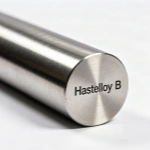
Hastelloy B is the original nickel-molybdenum reducing-acid alloy, now succeeded by improved variants B-2 (N10665) and B-3 (N10675) that offer better thermal stability, yet the original B grade (N10001) remains widely specified for existing equipment, legacy designs, and applications that demand the broad ASME pressure-vessel code coverage provided by ASME SB-335 and SB-333. The FCC austenitic microstructure delivered by proper solution annealing is inherently free of sensitisation; iron content is controlled to 2–4 % and silicon to ≤ 0.10 % to suppress β-phase (Ni₄Mo) formation between 700–870 °C — the primary metallurgical risk for this alloy family. Corrosion rates in boiling 20 % HCl are typically below 0.02 mm/year; in 50 % acetic acid at 80 °C below 0.05 mm/year, making it the benchmark alloy for acid pickling, acid-gas absorption, and H₂SO₄ handling systems in refineries.
SHUNFU METAL melts Hastelloy B billets under vacuum (VIM) to achieve iron ≤ 4 %, silicon ≤ 0.10 %, and carbon ≤ 0.02 %, then re-melts by VAR to achieve radial compositional uniformity critical for large-diameter forgings. Hot forging at 1,020–1,150 °C is followed immediately by solution annealing at 1,150 °C ± 15 °C and rapid water quench to freeze the fully austenitic single-phase structure. Each bar lot undergoes 100 % ultrasonic testing per ASTM E114, intergranular corrosion (IGC) screening per ASTM A262 Practice E on request, and hardness verification per ASTM E10. Third-party inspection by SGS, Bureau Veritas, or TÜV available on request.
Equivalent Grades & Applicable Standards — Hastelloy B N10001
| Standard Body | Designation | Applicable Specification / Form |
|---|---|---|
| ASTM / ASME | UNS N10001 | B335 / SB-335 (rod & bar), B333 / SB-333 (plate / sheet / strip), B619 / SB-619 (welded pipe), B622 / SB-622 (seamless pipe & tube), B626 / SB-626 (welded tube), B366 / SB-366 (fittings), B564 / SB-564 (forgings) |
| EN / DIN | 2.4800 / 2.4482 / NiMo28 | DIN 17752 (bar), DIN 17750 (plate / sheet / strip), DIN 17751 (seamless pipe & tube), DIN 17744 (general wrought forms) |
| AMS | AMS 5759 / AMS 5795 | AMS 5759 (bar, rod, wire — annealed); AMS 5795 (sheet, strip, plate) |
| BS (UK) | NA11 | BS 3072 (sheet & plate), BS 3073 (strip), BS 3074 (seamless tube), BS 3075 (wire), BS 3076 (bar) |
| GB (China) | NS3201 / NS143 | GB/T 14992 (wrought nickel alloy designation), GB/T 15007 (bar) |
| AWS (Welding) | ERNiMo-7 / ENiMo-7 | AWS A5.14 (filler metal), AWS A5.11 (welding electrode); GTAW low-heat-input recommended |
| Trade Names | HASTELLOY® B / Nicrofer® 2.4800 | Same UNS N10001 / W. Nr. 2.4800 composition; note B-2 (N10665) and B-3 (N10675) are separate improved grades |
Oil & Gas Applications — N10001 Bar Components
- HCl acid pump impellers & housings
- Acid injection valve bodies & stems
- Coiled tubing BHA tool bars
- Matrix acidizing nozzle bodies
- Acid storage tank fittings & bars
- H₂S acid-gas absorber trays
- Amine unit reboiler tubesheet bars
- FGD quencher & absorber internals
- HCl scrubber vessel internals
- Sour condensate separator shafts
- HF alkylation unit pump shafts
- Sulfuric acid alkylation piping bars
- Crude pickling line agitator shafts
- H₂SO₄ reactor valve spindles
- HCl recovery column down-comers
- Chemical injection pump body bars
- Acid de-scaler nozzle & manifolds
- Phosphoric acid evaporator bars
- Pipeline pigging tool bars (HCl service)
- Pressure gauge & instrument housings
Supply Forms & Dimensions — Hastelloy B Bar
| Form | Standard | Size Range | Condition |
|---|---|---|---|
| Hot-rolled Round Bar | ASTM B335 / DIN 17752 | Ø 6 – Ø 250 mm | Solution annealed + water quenched |
| Cold-drawn Round Bar | ASTM B335 / AMS 5759 | Ø 6 – Ø 80 mm | Annealed or cold-drawn + annealed |
| Hot-rolled Flat Bar | ASTM B333 / DIN 17750 | T: 6–120 mm × W: 20–450 mm | Solution annealed |
| Forged Round Bar | ASTM B564 / DIN 17752 | Ø 50 – Ø 650 mm | Forged + solution annealed + water quench |
| Forged Flat Bar / Billet | ASTM B564 / DIN 17752 | T: 30–350 mm × W: 50–700 mm | Forged + solution annealed |
Standard length: 1,000–6,000 mm; custom lengths to 8,000 mm available. Centreless-ground finish (h9/h11 tolerance) available for rounds ≤ Ø 200 mm. Important: N10001 must not be used in oxidising environments (ferric / cupric salts, nitric acid, wet halogens) — consult SHUNFU METAL for service compatibility review.
Chemical Composition — Hastelloy B per ASTM B335 / B333
| Ni | Mo | Fe | Cr | Co | C | Mn | Si | V | S | P |
|---|---|---|---|---|---|---|---|---|---|---|
| Bal. (≥ 58.0) |
26.0–30.0 | 2.0–4.0 | ≤ 1.0 | ≤ 2.5 | ≤ 0.02 | ≤ 1.0 | ≤ 0.10 | ≤ 0.60 | ≤ 0.030 | ≤ 0.040 |
| All values in weight %. Mo = 26–30 % is the primary alloying element. Fe ≤ 4 % and Si ≤ 0.10 % are tightly controlled to suppress β-phase (Ni₄Mo) formation. C ≤ 0.02 % minimises intergranular carbide sensitisation. | ||||||||||
Mechanical Properties — N10001 Bar
| Condition | Tensile Strength Rm (MPa / ksi) |
0.2% Yield Strength Rp0.2 (MPa / ksi) |
Elongation A₅ (%) |
Hardness (HBW / HRC) |
|---|---|---|---|---|
| Annealed Bar (typical) 1,150 °C, water quench |
690–760 / 100–110 | 275–345 / 40–50 | ≥ 40 | 180–220 HBW |
| ASTM B335 Minimum (Bar) As-required per specification |
≥ 690 / ≥ 100 | ≥ 241 / ≥ 35 | ≥ 40 | ≤ 241 HBW |
| Hot-Finished Forged Bar Solution annealed, air or water cool |
≥ 720 / ≥ 104 | ≥ 260 / ≥ 38 | ≥ 40 | 185–230 HBW |
| Cold-drawn Bar (annealed) Cold-drawn + final anneal |
≥ 690 / ≥ 100 | ≥ 310 / ≥ 45 | ≥ 35 | 190–240 HBW |
Physical constants at 20 °C: density 9.22–9.24 g/cm³; modulus of elasticity 200–205 GPa; thermal conductivity 10.2 W/m·K; thermal expansion coefficient 12.3 µm/m·°C (20–300 °C); melting range 1,330–1,380 °C. Warning: Hastelloy B N10001 is susceptible to rapid attack in oxidising media (Fe³⁺, Cu²⁺ salts, aerated HNO₃). Verify process stream composition before specifying this alloy.