
Project Description
434 (UNS S43400, EN 1.4113 / X6CrMo17-1, JIS SUS434, GOST 08Х17М) is a molybdenum-bearing ferritic stainless steel and a direct upgrade from 430. The addition of 0.75–1.25 % molybdenum elevates pitting resistance, crevice corrosion resistance, and strength beyond standard 430, making 434 a cost-effective choice where chloride-bearing or mildly acidic service conditions rule out plain chromium ferritics. Compared with 430, 434 demonstrates measurably lower corrosion rates in salt-spray testing and improved resistance to reducing organic acids encountered in refinery process streams. Its ferritic microstructure delivers immunity to chloride SCC—a failure mode that plagues austenitic 304/316 in hot saline service—and its lower thermal expansion coefficient (11.9×10⁻⁶/K at 20–100°C) ensures dimensional stability under temperature cycling. SHUNFU METAL supplies 434 bar to the petroleum sector for components that require magnetic properties, thermal stability, and reliable corrosion performance without the nickel premium of austenitic grades. Every heat is produced under ISO 9001:2015 and API Q1 certified quality systems with full melt-to-shipment traceability. At SHUNFU METAL’s facility, 434 bar is produced from electric-arc-furnace or AOD-refined heats with strict control over tramp elements and inclusion content, ensuring consistent machinability and surface finish across every production lot.
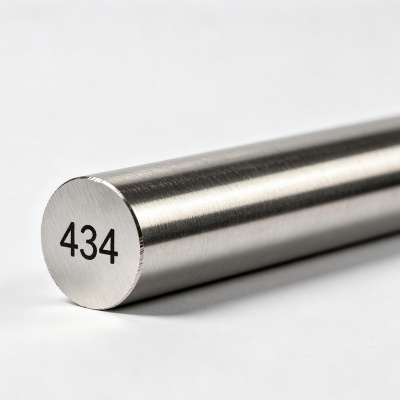
434 Bar in Oil & Gas Applications
Mildly Sour Flowline Fittings
434 bar machined into couplings, tees, and elbows for low-H₂S crude gathering networks where molybdenum-enhanced pitting resistance extends service intervals over plain 430.
Produced-Water Pump Shafts
Ferritic 434 resists chloride stress corrosion cracking in saline produced-water circuits. Pump shafts turned from 434 bar avoid the SCC risk inherent to 304/316 in hot chloride service.
Chemical Injection Quills
Quills and lances for corrosion-inhibitor injection into process streams, where 434’s Mo content resists the mildly acidic carrier fluids and ensures dimensional stability under thermal cycling.
Heat Exchanger Baffle Plates
434 bar machined into support baffles and tie-rod spacers for shell-and-tube exchangers in desalter and crude preheat service. The alloy’s low thermal expansion coefficient reduces differential movement between the baffle and tube bundle across thermal cycles, minimizing fretting wear at tube-to-baffle contact points.
Storage Tank Fasteners & Internals
Bolts, studs, and support brackets inside crude and intermediate-product storage tanks, where magnetic retrievability simplifies maintenance and the Mo addition handles condensation corrosion.
Compressor Valve Components
Valve seats, guards, and unloader rings for reciprocating compressors in gas-gathering stations. 434’s magnetic characteristic is exploited in solenoid-actuated valve designs.
Instrumentation Standoffs & Mounts
Pressure-transmitter and gauge standoffs in corrosive atmospheres. 434 bar machined into mounting blocks resists atmospheric chloride attack and retains calibration through thermal stability.
Flare-Tip Support Hardware
Structural fasteners and spacers in elevated flare systems exposed to marine atmospheres and intermittent acidic condensation, where 434’s Mo-enhanced atmospheric corrosion resistance outperforms 430.
Refinery Sampling Probes
Fixed and retractable sampling probes for process-side monitoring. 434 bar provides adequate corrosion resistance for hydrocarbon streams with trace moisture and sulfur species at moderate temperatures. The magnetic ferritic structure also allows probe retrieval via magnetic tooling in confined vessel entries.
434 Bar Supply — Dimensions & Conditions
SHUNFU METAL stocks and produces 434 bar in a broad dimensional envelope under ISO 9001 and API Q1 certified quality systems. Incoming billets are verified by OES before rolling or forging, and finished bars ship with full 3.1 certification. Hot-rolled bar is supplied in the annealed-and-pickled condition; cold-drawn bar is available either as-drawn for maximum strength or re-annealed for restored ductility. Forged bar receives a post-forge full anneal to homogenize the microstructure and eliminate residual stresses.
| Form | Diameter / Thickness (mm) | Length (mm) | Condition |
|---|---|---|---|
| Hot-Rolled Round | 16 – 300 | 3000 – 12000 | Annealed / Pickled |
| Cold-Drawn Round | 5 – 80 | 2000 – 6000 | Cold Drawn / Annealed |
| Hot-Rolled Flat | Thk 6 – 80, W 50 – 400 | 3000 – 12000 | Annealed / Pickled |
| Forged Round | 100 – 600 | 2000 – 8000 | Forged + Annealed |
| Forged Flat / Block | Thk 40 – 250, W 100 – 600 | 2000 – 6000 | Forged + Annealed |
Chemical Composition of 434 to ASTM A276
SHUNFU METAL sources only Mo-compliant heats with full-spectrum OES verification at incoming inspection. The molybdenum range is the critical differentiator from 430—it is what gives 434 its superior pitting and crevice corrosion performance in chloride and salt-spray environments. The deliberate absence of nickel (aside from permitted residual) keeps raw-material cost stable and decoupled from nickel market volatility, making 434 a price-competitive upgrade over 430 with performance approaching 304 in many non-oxidizing media.
| Element | C | Mn | Si | P | S | Cr | Mo |
|---|---|---|---|---|---|---|---|
| Wt % | ≤0.12 | ≤1.00 | ≤1.00 | ≤0.040 | ≤0.030 | 16.00–18.00 | 0.75–1.25 |
Iron balance. Ni permitted up to 0.60 %. EN 10088-3 tightens C to ≤0.08 % and Mo to 0.90–1.40 %. The Mo addition yields a Pitting Resistance Equivalent (PRE) of approximately 18.5–20.5, a meaningful step above 430 (PRE ≈ 16–17).
Mechanical Properties of 434 — Annealed Condition
Properties below represent ASTM A276 minimum requirements for annealed 434 bar. Annealing is performed at 780–850 °C followed by air cooling or slow furnace cooling; this treatment dissolves chromium carbides and restores maximum ductility and corrosion resistance. At SHUNFU METAL, every batch is hardness-tested and tensile-certified before release. The alloy is not hardenable by heat treatment—unlike martensitic grades—and strength gains are achieved exclusively through cold working. Hot working is performed in the 850–1250 °C range.
| Property | Value |
|---|---|
| Tensile Strength, Rm | ≥ 450 MPa (65 ksi) |
| Yield Strength, Rp0.2 | ≥ 205 MPa (30 ksi) |
| Elongation, A | ≥ 22 % |
| Reduction of Area, Z | ≥ 60 % |
| Hardness | ≤ 183 HB / ≤ 83 HRB |
| Modulus of Elasticity (20°C) | 200 GPa |
| Density (20°C) | 7.7 g/cm³ |
Typical annealed tensile strength reaches 538 MPa with elongation around 32 %. Cold-drawn bar achieves higher strength at the expense of ductility. Consult SHUNFU METAL for cold-worked property curves.