
Project Description
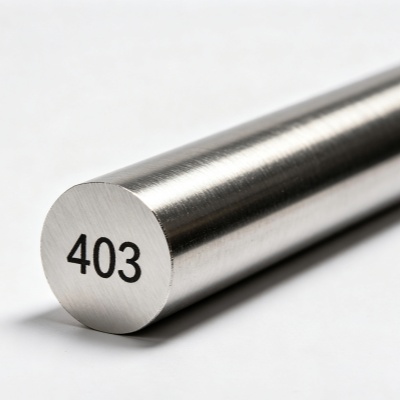
403 / UNS S40300 (1.4000 / X7Cr13 / SUS403 / 08X13 / 1Cr12Mo) is a martensitic stainless steel with nominally 12% chromium and controlled carbon (max 0.15%) — the workhorse grade for steam and gas turbine blades, compressor blades, high-temperature bolting, and valve components in the petroleum and power-generation industries. Specifically formulated for moderate corrosion resistance combined with high mechanical properties at elevated temperatures up to 700°C, 403 is the blade-material standard across OEM specifications including GE, Siemens, and Mitsubishi Heavy Industries for land-based and aero-derivative turbine equipment widely deployed in oil and gas compression, LNG liquefaction, and refinery power-generation trains. SHUNFU METAL supplies 403 / 1.4000 / X7Cr13 stainless steel bar under ISO 9001 and API Q1 certified quality systems, with AOD refining and full heat-treatment documentation, serving compressor and turbine overhaul workshops, valve manufacturers, pump OEMs, and high-temperature fastener producers.
403 (S40300 / 1.4000) — The 12% Cr Turbine and Compressor Blade Steel
403 is the original 12% chromium martensitic stainless steel, first standardized for steam turbine blading in the 1940s and still specified today for rotating and stationary blade rows in both steam turbines and gas-turbine compressors. With nominally 12–13% chromium and carbon controlled to a maximum of 0.15% (ASTM) or 0.08% (EN 1.4000), 403 offers a carefully balanced profile: sufficient chromium for atmospheric and steam corrosion resistance up to 760°C, low enough carbon to avoid the excessive as-quenched hardness and low toughness of higher-carbon grades (410, 420), and good damping capacity that helps suppress blade vibration — a critical attribute in turbomachinery. The grade is readily hardenable by oil or air quenching from 900–980°C and temperable over a broad temperature range (200–760°C), allowing a single chemistry to cover blade-root hardness requirements, rotor-disc bolting yield-strength targets, and valve-spindle surface-hardness specifications. SHUNFU METAL refines each 403 heat through AOD processing with ladle-refining adjustments that bring phosphorus to ≤ 0.025% and sulfur to ≤ 0.010% — tighter than the standard ≤ 0.040% P and ≤ 0.030% S limits — ensuring clean steel for dynamic rotating components where inclusion-initiated fatigue is a design consideration. The ISO 9001 framework governs raw-material verification, cast-level spectrometric chemistry, heat-treatment chart recording, mechanical test sampling per ASTM A370 / EN ISO 6892-1, and ultrasonic inspection per ASTM E2375 — with API Q1 supplementaries (independent witness testing, full lot traceability, and five-year retained reference samples) applied as standard for all oil and gas rotating-equipment shipments.
Compared to its Cr13 family neighbors, 403 sits at the lower-carbon end of the martensitic series: its 0.15% C max gives lower as-quenched hardness (45–50 HRC max) than 410 (0.15% C, 42–48 HRC) or 420 (0.15%+ C, 48–55 HRC), but this translates directly into better impact toughness, higher damping, and lower notch sensitivity — all critical for rotating blades operating at high centrifugal stress with superimposed vibratory loading. The ferritic designation 1.4000 (EN X6Cr13) with 0.08% C max represents the most formable and weldable variant; the martensitic AISI 403 with 0.15% C max provides greater hardening response for strength-critical components. SHUNFU METAL’s AOD practice delivers the chemistry precision needed to certify to both EN and ASTM standards from a single heat, and the ISO 9001 / API Q1 quality framework ensures the documentation rigor required for safety-critical rotating equipment.
Equivalent Grades of 403 Across International Standards
| Standard / Specification | Designation |
|---|---|
| ASTM A276 / A479 / A473 | 403 (UNS S40300) |
| AMS 5611 / AMS 5612 | 403 (Aerospace Bars & Forgings) |
| SAE J405 | 51403 |
| EN 10088-2 / 10088-3 | X6Cr13 (1.4000) |
| DIN 17440 (obsolete, reference) | X7Cr13 / X7Cr14 |
| JIS G4303 / G4304 | SUS403 |
| GOST 5632-72 | 08X13 / 08KH13 (08Х13 / 0Х13 / ЭИ496) |
| GB/T 1220 / GB/T 8732 | 0Cr13 / 1Cr12Mo / 12Cr12Mo |
| BS 970 Part 1 | 403S17 |
| NF A35-574 | Z6C13 / Z8C12 |
| SS 14 | 2301 |
| ISO 15510 | X6Cr13 |
Note: EN 1.4000 (X6Cr13, C ≤ 0.08%) is classified as ferritic; ASTM 403 (S40300, C ≤ 0.15%) is classified as martensitic. In commercial bar practice for turbine and compressor applications, the two specifications are routinely treated as equivalents for the annealed, QT650, and QT700 conditions, with the principal distinction being carbon content. GB 1Cr12Mo (C 0.10–0.15, Cr 11.5–13.0, Mo 0.30–0.60) is the Mo-enhanced Chinese turbine-grade variant specified under GB/T 8732 for steam turbine blade forgings and bar stock. GOST 08X13 (0X13, ЭИ496) is the Russian high-temperature corrosion-resistant designation widely used for turbine blades in CIS-region power-generation and compressor equipment. SHUNFU METAL certifies to ASTM S40300 as the primary standard with EN 1.4000, GB 1Cr12Mo, GOST 08X13, and JIS SUS403 dual/multi-certification available upon request.
Oil & Gas Industry Applications
403 / 1.4000 / X7Cr13 stainless steel bars serve in oil and gas applications where the combination of moderate corrosion resistance, good elevated-temperature strength up to 650–700°C, high damping capacity, and magnetic properties makes it the standard choice — primarily in turbomachinery for gas compression and LNG liquefaction trains, steam turbine blading for refinery and petrochemical co-generation plants, high-temperature fasteners for flanged connections in process piping, and valve internals in moderate-temperature hydrocarbon and steam service. SHUNFU METAL supplies bars to turbine and compressor OEMs and their aftermarket repair networks, API valve-trim manufacturers, pump and rotating-equipment workshops, and high-temperature bolting distributors — all under ISO 9001 and API Q1 certification with full EN 10204 3.1 material certification.
Steam Turbine Blades
Rotating and stationary blade rows for refinery co-generation, LNG plant steam-turbine drivers, and petrochemical process-train steam turbines operating at 400–540°C steam conditions.
Gas Turbine Compressor Blades
Axial-compressor rotor and stator blades for pipeline gas-turbine compressors, LNG liquefaction gas-turbine drivers, and refinery fluid catalytic cracking (FCC) air blowers.
Compressor Impellers & Diffusers
Centrifugal compressor impellers, diffuser vanes, and labyrinth seals for pipeline booster compressors, gas-gathering compression, and refinery recycle-gas compressor service.
High-Temperature Bolting
Turbine-casing studs and nuts, flange bolting for high-temperature steam and process piping, valve-bonnet bolting, and high-temperature pressure-retaining fastener assemblies.
Valve Stems & Spindles
Quenched-and-tempered gate, globe, and check-valve stems and spindles for moderate-temperature (< 500°C) hydrocarbon, steam, and boiler-feedwater service in refinery and petrochemical plants.
Pump Shafts & Wear Sleeves
Boiler-feed pump shafts, condensate pump shafts, and mechanical-seal sleeves and wear rings for moderate-temperature (< 400°C) hydrocarbon and water-service centrifugal pumps.
Turbine Rotor Discs & Spacers
Forged and machined rotor discs, inter-stage spacer rings, and blade-retaining rings for small and medium-size industrial steam and gas turbines in oil and gas rotating-equipment trains.
Valve Trim Internals
Hardened-and-tempered seat rings, discs, and guide bushings for control valves and pressure-relief valves in moderate-temperature (< 500°C) steam, hydrocarbon, and process-gas service.
Expansion Bellows & Flexible Elements
Thin-gauge formed and welded expansion bellows, flexible couplings, and diaphragm seals for high-temperature exhaust, steam, and process-piping thermal-expansion compensation.
Supply Range of 403 / 1.4000 / X7Cr13 Stainless Steel Bar
SHUNFU METAL supplies 403 / S40300 / 1.4000 in hot-rolled, forged, and cold-finished bar forms for turbine-blade manufacturers, compressor OEMs, aftermarket repair workshops, valve-trim shops, pump-component producers, and high-temperature fastener manufacturers. Hot-rolled round bars are produced from continuously cast billet or ingot with controlled reduction ratios ≥ 4:1 ensuring center soundness for rotating-component safety; forged bars use open-die press forging with upset ratios ≥ 3:1 for full structural consolidation in heavy disc and shaft sections. Every production lot undergoes 100% ultrasonic inspection per ASTM E2375 / EN 10228-3 Class B, macrostructure evaluation, and mechanical testing. Under ISO 9001 and API Q1, each bar carries hard-stamped heat number and full traceability with EN 10204 3.1 certification; API Q1 lot traceability with five-year retained reference samples is standard for all rotating-equipment shipments.
| Product Form | Diameter / Section Range | Length | Surface / Condition |
|---|---|---|---|
| Hot-Rolled Round Bar | ⌀8 mm – ⌀250 mm | 3,000 – 6,000 mm | Annealed / Peeled / Black |
| Forged Round Bar | ⌀100 mm – ⌀800 mm | 2,000 – 8,000 mm | Annealed / Rough Machined |
| Hot-Rolled Flat Bar | 3–80 mm thick × 30–400 mm wide | 2,000 – 6,000 mm | Black / Ground / Machined |
| Forged Flat / Block | 30–300 mm thick × 150–800 mm wide | 1,000 – 5,000 mm | Annealed / Rough Machined |
| Forged Rings / Discs | OD 200 – 2,000 mm | Per drawing | As-Forged / Rough Machined |
| Cold-Finished / Ground Bar | ⌀5 mm – ⌀100 mm | 1,000 – 4,000 mm | Centerless Ground / Polished |
Bars supplied in the annealed condition (700–780°C slow-cool, HB ≤ 200) for customer machining with in-house hardening, or in quenched-and-tempered condition per ASTM A276 or EN 10088-3 (QT650/QT700). Forging-ring and forged-disc products (OD 200–2,000 mm) available for turbine rotor-disc and compressor-impeller blanks; upgraded with upset ratios ≥ 3:1 and full macrostructure and inclusion-rating reports. For turbine-blade stock, controlled inclusion ratings (ASTM E45 Method A, category D thin ≤ 2.0) and tight diameter tolerances (±0.25 mm for rolled bar, ±0.10 mm for cold-finished) are maintained as standard. Non-standard diameters, stepped shafts, and cut-to-length pieces on inquiry. PKO/PE anti-rust coating, VCI wrapping, and sea-worthy timber crate packing standard for export. Third-party inspection by SGS, TÜV, Bureau Veritas, or Lloyd’s Register upon request; ultrasonic, dye-penetrant, and magnetic-particle inspection reports available for rotating-component stock.
Chemical Composition of 403 (ASTM A276 / EN 10088-3 1.4000)
The chemical composition of 403 is defined under two major standards: ASTM A276 UNS S40300 (0.15% C max, Cr 11.5–13.0%) and EN 10088-3 X6Cr13 1.4000 (0.08% C max, Cr 12.0–14.0%). The ASTM standard permits higher carbon for greater hardening response; the EN standard specifies tighter carbon and wider chromium for enhanced corrosion resistance and formability. The Chinese GB grade 1Cr12Mo adds molybdenum (0.30–0.60%) for elevated-temperature creep resistance — a key differentiator for turbine-blade forgings operating at 500–540°C steam conditions. GOST 08X13 (08KH13, 0Kh13) is the CIS-region turbine-grade designation with 0.08% C max and optional Ti ≤ 0.20% for carbide stabilization. SHUNFU METAL’s AOD practice achieves P ≤ 0.025% and S ≤ 0.010% for rotating-component stock — substantially tighter than the standard limits of 0.040% P and 0.030% S — with spectrometric cast-level verification and product analysis on every shipment lot.
| Element | ASTM A276 403 (S40300) | EN 10088-3 X6Cr13 (1.4000) |
|---|---|---|
| Carbon (C) | ≤ 0.15 | ≤ 0.08 |
| Silicon (Si) | ≤ 0.50 | ≤ 1.00 |
| Manganese (Mn) | ≤ 1.00 | ≤ 1.00 |
| Phosphorus (P) | ≤ 0.040 | ≤ 0.040 |
| Sulfur (S) | ≤ 0.030 | ≤ 0.015 (rec.) |
| Chromium (Cr) | 11.5 – 13.0 | 12.0 – 14.0 |
| Nickel (Ni) | 0.60 (typical) | — |
All values in weight percent (wt%). Cast analysis per respective standard. ASTM 403 also includes residual Ni typical 0.60% (not a specification requirement). GB 1Cr12Mo adds Mo 0.30–0.60%, Ni 0.30–0.60%, C 0.10–0.15 to the base 12% Cr chemistry for elevated-temperature steam turbine blade forgings per GB/T 8732. GOST 08X13 (08KH13) specifies C ≤ 0.08, Cr 12–14, Si ≤ 0.80, Mn ≤ 0.80, Ni ≤ 0.60, S ≤ 0.025, P ≤ 0.030, Ti ≤ 0.20. SHUNFU METAL’s AOD practice achieves P ≤ 0.025% and S ≤ 0.010% for all rotating-component-grade bars; multi-certification to ASTM S40300 + EN 1.4000 + GB 1Cr12Mo + GOST 08X13 is available from common heats where chemistry overlaps all specification ranges. Iron (Fe) = balance.
Mechanical Properties — Annealed, QT650, QT700 & GOST QT Conditions
403 / S40300 / 1.4000 develops its mechanical properties through oil or air quenching from 900–980°C followed by tempering over a broad range (200–760°C). The grade is NOT through-hardening in heavy sections (oil quench required above ~25 mm diameter), a consideration for large forged shafts and discs. Tempering at 650–750°C (QT650/QT700 conditions) produces the best balance of strength, ductility, and toughness for rotating components; low-temperature tempering (200–400°C) yields higher hardness (up to ~45 HRC) for wear surfaces. The 427–593°C tempering range must be avoided due to temper embrittlement (loss of impact toughness and corrosion resistance). The annealed condition (700–780°C slow-cool, HB ≤ 200) provides maximum machinability and formability. SHUNFU METAL performs all heat treatment in calibrated multi-zone furnaces with chart-recorder validation under ISO 9001 and API Q1 protocols, providing batch-level properties certification per EN 10204 3.1.
| Condition / Heat Treatment | Tensile Rm (MPa) | Yield Rp0.2 (MPa) | Elong. A (%) | Hardness HB |
|---|---|---|---|---|
| +A Annealed (700–780°C, slow cool), all sections | 400 – 600 | 220 – 240 | ≥ 19 | ≤ 200 |
| 403 ASTM Annealed (typical at Ø 25 mm) | 485 | 310 | 25 | 139 (80 HRB) |
| +QT650 Quenched (900–980°C, OQ) + Tempered 650–750°C, ≤ 160 mm | 650 – 850 | ≥ 450 | ≥ 15 | — |
| +QT700 Quenched (900–980°C, OQ) + Tempered 500–650°C, ≤ 160 mm | 700 – 850 | ≥ 500 | ≥ 13 | — |
| GOST QT (08X13) Quenched (1,000–1,050°C, OQ) + Tempered 700–800°C, bar | ≥ 590 | ≥ 410 | ≥ 20 | 187 – 229 |
| GB 1Cr12Mo QT (typical at 464 MPa yield) | ≥ 717 | ≥ 464 | ≥ 13 | ≤ 214 |
Mechanical properties per EN 10088-3 for +A, +QT650, +QT700 conditions. ASTM 403 annealed data from published manufacturer typical values. GOST 08X13 data per GOST 5949-75 for bars. GB 1Cr12Mo data per GB/T 8732 for heat-resisting steel bars, solution-treated and aged condition. Quenching medium: oil (preferred for sections > 25 mm) or forced air (acceptable for sections ≤ 25 mm). Tempering range 200–760°C; the 427–593°C range must be avoided in all conditions due to temper embrittlement and loss of corrosion resistance. Hardening response: peak ~45 HRC after oil quenching from 980°C with 200°C temper; ~35–40 HRC after 500°C temper; ~25–30 HRC after 700°C temper. Physical properties (20°C): density 7.80 g/cm³; elastic modulus 200 GPa (20°C), 185 GPa (400°C); thermal conductivity 21.5 W/m·K (at 500°C); thermal expansion coefficient 9.9 μm/m·K (0–100°C), 11.1 μm/m·K (20–300°C), 11.8 μm/m·K (20–400°C); specific heat capacity 460 J/kg·K; electrical resistivity 0.57 Ω·cm; Curie temperature ~720°C. Magnetic in all conditions. Forging range: 1,100–760°C (start 1,100–1,150°C, finish ≥ 760°C) with slow post-forge cooling in vermiculite or furnace to avoid air-hardening cracking. SHUNFU METAL’s technical team provides application-specific heat treatment consultation, including tempering-temperature selection for target hardness vs toughness balance, and can supply EN 10204 3.2 / third-party witness testing upon request.