
Project Description
254SMO (UNS S31254), also designated as 1.4547, X1CrNiMoCuN20-18-7, and 015Cr20Ni18Mo6CuN, is a high-alloy super-austenitic stainless steel engineered for exceptional corrosion resistance in the most aggressive chloride-containing environments encountered in offshore oil and gas operations. With 6.0–6.5% molybdenum and a calculated pitting resistance equivalent number (PREN) exceeding 43, 254SMO offers substantially better resistance to pitting, crevice corrosion, and stress corrosion cracking than standard austenitic grades such as 316L (PREN ~24) and even many duplex stainless steels. SHUNFU METAL, certified to ISO 9001:2015 and API Q1, manufactures 254SMO bars through controlled electric arc furnace (EAF) melting with AOD refining, tightly controlling the critical molybdenum, nitrogen, and copper additions to deliver consistent seawater-grade corrosion performance verified by in-house OES on every heat.
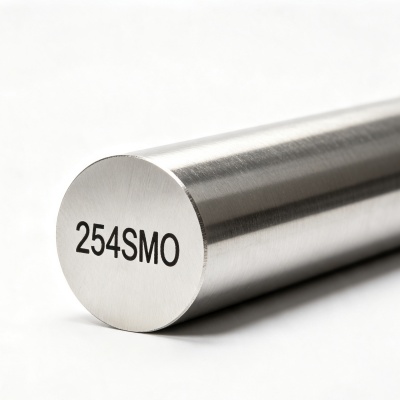
254SMO Stainless Steel Bar — Overview
Originally developed by Outokumpu (Avesta) for bleach plant and seawater handling equipment, 254SMO has become a standard material in the offshore petroleum industry for seawater piping systems, subsea hydraulic tubing, umbilical tubes, produced water handling, ballast water systems, and chemical injection lines. The alloy achieves its outstanding corrosion resistance through a carefully balanced composition — high chromium (19.5–20.5%) for general corrosion resistance, high molybdenum (6.0–6.5%) for pitting and crevice corrosion resistance, and deliberate nitrogen (0.18–0.22%) and copper (0.50–1.00%) additions that respectively increase strength and enhance resistance to sulfuric acid environments. Unlike precipitation hardening grades, 254SMO is supplied in the solution-annealed condition (1150–1200°C, water quenched), providing a fully austenitic microstructure with excellent toughness and ductility. SHUNFU METAL supplies 254SMO bars with full MTC documentation per EN 10204 Type 3.1, including intergranular corrosion testing per ASTM A262 Practice E when specified.
254SMO Equivalent Grades — International Standards
| Standard | Designation |
|---|---|
| ASTM A479 / A276 / A182 | UNS S31254 (F44 forging grade) |
| EN 10088-3 / DIN | 1.4547 / X1CrNiMoCuN20-18-7 |
| Trade Name (Japan) | NAS 254 (Nippon Steel) |
| GOST 5632 | 03Х20Н18М6К |
| GB/T 1220 | 015Cr20Ni18Mo6CuN |
SHUNFU METAL supplies 254SMO bars certified to ASTM A479, ASTM A276, ASTM A182 F44, and EN 10088-3, with full heat traceability and API Q1 documentation as standard. No direct JIS standard equivalent exists; the trade name NAS 254 is recognized in Japanese procurement specifications.
SHUNFU METAL
254SMO Applications — Oil & Gas Industry
The exceptional chloride pitting and crevice corrosion resistance (PREN > 43) of 254SMO makes it the material of choice for seawater-exposed and produced-water handling equipment throughout offshore platforms, subsea installations, and coastal petroleum facilities. SHUNFU METAL supplies 254SMO bars to manufacturers serving the following oil and gas applications, with every production lot verified against ASTM A479 and ASTM A182 requirements:
Supply Range — 254SMO Bar Dimensions
SHUNFU METAL maintains dedicated production capability for 254SMO bars across hot-rolled, cold-finished, and forged product forms, processed through ISO 9001:2015 controlled workflows. The high-alloy nature of 254SMO demands precise temperature control during hot working to avoid sigma phase formation; SHUNFU METAL’s in-house metallurgical team ensures full solution annealing (1150–1200°C) followed by rapid water quenching to restore the fully austenitic microstructure. The following dimensional ranges are offered as standard:
| Product Form | Diameter / Thickness Range | Width Range | Length (Standard) | Surface Finish |
|---|---|---|---|---|
| Hot Rolled Round | 10 mm – 300 mm | — | 3000 – 6000 mm | Black / Pickled |
| Cold Finished / Peeled Round | 3 mm – 100 mm | — | 2000 – 6000 mm | Peeled / Polished |
| Hot Rolled Flat | 10 mm – 120 mm | 50 mm – 400 mm | 2000 – 6000 mm | Pickled |
| Forged Round | 100 mm – 800 mm | — | 1000 – 6000 mm | Rough Machined / Black |
| Forged Flat / Block | 50 mm – 350 mm | 100 mm – 800 mm | 1000 – 5000 mm | Rough Machined / Black |
All bars are supplied with EN 10204 Type 3.1 Mill Test Certificates documenting heat number, full chemical analysis (including nitrogen and copper), mechanical test results, solution annealing verification, and dimensional compliance. Intergranular corrosion testing per ASTM A262 Practice C (Huey test) or Practice E (Streicher test) is available upon request for sour service qualification.
254SMO Chemical Composition per ASTM A479
254SMO derives its exceptional corrosion resistance from its ultra-high molybdenum content (6.0–6.5%), the highest among commercially available austenitic stainless steels for bar products. The synergistic combination of chromium, molybdenum, and nitrogen yields a PREN exceeding 43, while the deliberate copper addition (0.50–1.00%) provides supplementary resistance to sulfuric acid attack in process environments. At SHUNFU METAL, every heat is verified by in-house optical emission spectrometry (OES) against ASTM A479 UNS S31254 limits, with critical molybdenum and nitrogen contents confirmed prior to release for processing:
| Element | C | Mn | Si | P | S | Cr | Ni | Mo | N | Cu |
|---|---|---|---|---|---|---|---|---|---|---|
| Wt % | 0.020 max | 1.00 max | 0.80 max | 0.030 max | 0.010 max | 19.50–20.50 | 17.50–18.50 | 6.00–6.50 | 0.18–0.22 | 0.50–1.00 |
Composition conforms to ASTM A479 UNS S31254 and EN 10088-3 Grade 1.4547. The PREN value calculated as %Cr + 3.3(%Mo) + 16(%N) = 19.5 + 3.3(6.25) + 16(0.20) ≈ 43.3, representing a step change in pitting resistance compared to 316L (PREN ~24) and 317L (PREN ~28). SHUNFU METAL’s API Q1 certified traceability links every finished bar to its original heat analysis, with molybdenum, nitrogen, and copper verification included on every MTC.
254SMO Mechanical Properties — Solution Annealed Condition
Unlike precipitation hardening stainless steels, 254SMO achieves its mechanical properties through solid solution strengthening from its high alloy content, particularly the interstitial nitrogen (0.18–0.22%) which significantly elevates yield strength compared to conventional 300-series austenitics. The alloy is supplied in the solution-annealed condition (1150–1200°C followed by rapid water quenching), which ensures a fully austenitic microstructure free of deleterious sigma or chi intermetallic phases. SHUNFU METAL performs in-house tensile testing (ASTM E8) and hardness testing (ASTM E18) on every production lot, with full results documented on the MTC:
| Property | Minimum | Typical | Test Method |
|---|---|---|---|
| Tensile Strength (MPa / ksi) | 650 / 94 | 750 / 109 | ASTM E8 |
| Yield Strength 0.2% (MPa / ksi) | 300 / 44 | 380 / 55 | ASTM E8 |
| Elongation in 4D (%) | 35 | 45 | ASTM E8 |
| Reduction of Area (%) | — | 65 | ASTM E8 |
| Hardness (HB / HRB) | HB 210 max | HRB 90 | ASTM E18 / E10 |
Values per ASTM A479 for bar products in the solution-annealed condition. The nitrogen-enhanced yield strength (300 MPa minimum) of 254SMO is approximately 40% higher than that of standard 316L (170 MPa), providing a substantial design advantage for pressure-containing seawater components without sacrificing the excellent ductility (35% minimum elongation) required for fabrication and cold forming.
Key properties at service temperature: 254SMO maintains excellent toughness down to cryogenic temperatures and resists sigma phase embrittlement up to approximately 400°C in continuous service, making it suitable for both arctic offshore and high-temperature process applications. SHUNFU METAL’s ISO 9001:2015 accredited laboratory validates all mechanical properties on representative test specimens from each heat treatment batch, with API Q1 ensuring full material traceability from melt to end user. Optional Charpy V-notch impact testing per ASTM A370 is available for subsea and low-temperature qualification requirements.