
Hydrogen Embrittlement Resistant Stainless Steel
A technical review of how stainless steels behave in high-pressure hydrogen: SSRT and fatigue test data, the role of Ni equivalent and austenite stability, and why grades such as 316L, 310S and HRX19 resist hydrogen embrittlement.
4140 Plasma Nitriding vs Oxynitriding: Wear and Corrosion Windows
By Harris, Technical Team, SHUNFU METAL One Grade, Four Standard Systems AISI 4140 is the world's most widely specified chromium-molybdenum alloy steel, but the same steel travels under different names in different markets: EN 42CrMo4 (1.7225)
4140 Marine Corrosion Fatigue: How Pitting Kills Bolt Life
By Harris, Technical Team, SHUNFU METAL One Grade, Four Standard Systems AISI 4140 is the world's most widely specified chromium-molybdenum alloy steel, but the same steel carries different names in different markets: EN 42CrMo4 (1.7225) in
4140 QT Bars in Large Diameters: Crack-Free Process Windows
By Harris, Technical Team, SHUNFU METAL One Grade, Four Standard Systems AISI 4140 is the world's most widely specified chromium-molybdenum alloy steel, yet the same steel travels under different names in different markets: EN 42CrMo4 (1.7225)
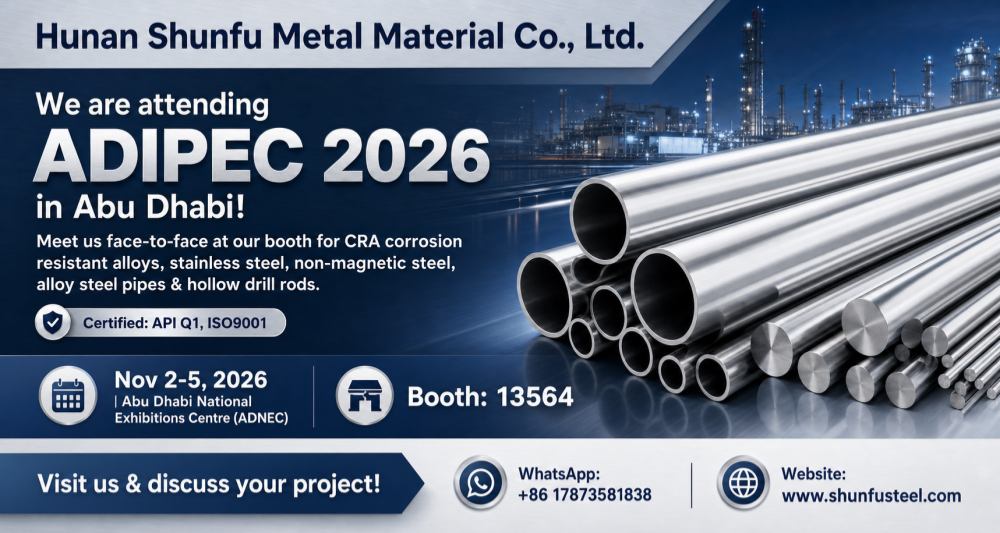
Hunan Shunfu Metal at ADIPEC 2026 — Booth 15108, Abu Dhabi
Hunan Shunfu Metal to Exhibit at ADIPEC 2026 — Visit Us at Booth 15108 Hunan Shunfu Metal Material Co., Ltd. is pleased to confirm our participation in ADIPEC 2026 — the Abu Dhabi International Petroleum Exhibition
P92 Ingot Cracking: Why Pouring Parameters Beat Chemistry at the Mold
P92 Casts Differently Because It Transforms Differently CSEF grade P92 is the 9% chromium, tungsten-bearing martensitic steel behind ultra-supercritical power-plant piping. Under ASME and ASTM it is SA-335 P92 (seamless pipe), with the European tube designation