
42CrMo is a commonly used alloy structural steel recognized for its excellent mechanical properties and adaptability to heat treatment. It is widely used in the manufacturing of mechanical components and engineering machinery. Heat treatment is a key process for enhancing the performance of 42CrMo. This article will introduce the characteristics and applications of 42CrMo from the perspectives of heat treatment processes and hardness.
42CrMo is a high-strength alloy structural steel with good overall mechanical performance, making it suitable for manufacturing parts and equipment that require high strength, wear resistance, corrosion resistance, and hardness
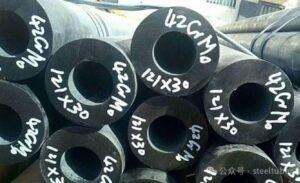
42CrMo Structural Steel Pipes
Due to its excellent mechanical properties and adaptability to heat treatment, this material is widely used in various industrial fields, including construction machinery, automotive parts, oil and gas machinery, and aerospace. The heat treatment process has a significant impact on the performance of 42CrMo. It is a key factor in determining its properties, as different heat treatment processes can lead to variations in the material’s hardness, strength, and toughness.
The heat treatment process for 42CrMo involves heating the steel to a specific temperature, followed by holding and cooling, which causes phase transformations in the material to alter its microstructure and properties. The primary heat treatment processes for 42CrMo include four standard methods: annealing, normalizing, quenching, and tempering.
Main Heat Treatment Processes and Effects of 42CrMo Steel Tubes:
- Annealing: Used to relieve internal stress and improve machinability.
- Normalizing: Enhances the material’s strength and hardness.
- Quenching: Increases strength, hardness, and wear resistance.
- Tempering: Reduces brittleness and improves toughness
The typical delivery hardness of 42CrMo is around 240–270 HB. After normalizing, the hardness can rise to 280–320 HB. Quenched hardness can reach 50–55 HRC, and after tempering, it typically returns to around 50 HRC. Each heat treatment method results in different levels of hardness, strength, and toughness.
Hardness Changes of 42CrMo Steel Tubes Under Different Heat Treatments:
- Untreated: Approximately 180–200 HB
- Annealed: Around 220–230 HB
- Normalized: Around 250–300 HB
- Quenched + Tempered: Around 280–340 HB
Quenching and Tempering (Q&T):
This process involves heating 42CrMo to 850–880°C, holding it at that temperature, and then cooling it rapidly in water or oil. This treatment forms a uniform martensitic structure, enhancing hardness and strength while maintaining good toughness. Q&T-treated 42CrMo exhibits high tensile and yield strengths, making it suitable for parts that require high strength and fatigue resistance. Quenched and tempered 42CrMo exhibits improved wear and impact resistance, making it an ideal choice for components that require high durability and toughness.
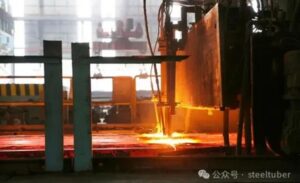
Quenching and Tempering of 42CrMo
Hardness and Mechanical Properties
After heat treatment, 42CrMo typically reaches a hardness of 260–300 HB, though this can vary depending on the specific heat treatment method and the shape of the workpiece. Tempered 42CrMo has relatively high hardness, meeting the requirements of many mechanical components. On the other hand, 42CrMo treated with quenching + tempering has slightly lower hardness but better toughness, making it suitable for manufacturing parts that require both high strength and toughness.
Applications of 42CrMo Steel
Due to its excellent mechanical properties and adaptability to heat treatment, 42CrMo is widely used in various industries, including construction machinery, automotive components, petroleum equipment, and aerospace. For example, when manufacturing heavy-load parts like engine crankshafts, transmission gears, and wind turbine main shafts, using 42CrMo ensures both strength and longevity.
As a commonly used alloy structural steel, 42CrMo can achieve different hardness and performance levels through heat treatment. Tempering and quenching, followed by tempering, are two standard processes. Choosing the appropriate treatment based on performance requirements ensures the part meets its intended application. With a typical hardness range of 260–300 HB, 42CrMo offers outstanding mechanical properties and versatility across many fields.
Characteristics of 42CrMo Steel
42CrMo steel belongs to ultra-high-strength steels. It offers high strength, good toughness, and excellent hardenability. It shows no obvious temper brittleness and, after tempering, has a high fatigue limit and strong resistance to repeated impact. It also maintains good low-temperature impact toughness. This steel is suitable for making medium to large plastic molds that require a balance of strength and toughness.
It also features:
- High strength
- Excellent hardenability
- Good toughness
- Minimal deformation during quenching
- High creep and long-term strength at high temperatures
42CrMo steel is used to manufacture larger and stronger forgings compared to 35CrMo steel, such as:
- Large gears for locomotives
- Turbocharger transmission gears
- Pressure vessel gears
- Rear axles
- Highly stressed connecting rods and spring clamps
- Deep well drill pipe joints and fishing tools (for wells deeper than 2000m)
- Press brake molds
10 Examples of 42CrMo Heat Treatment Methods and Corresponding Hardness
- Annealing – 760±10°C, furnace cooled to 400°C then air cooled → Hardness: HB 220–230
- Normalizing – 860±10°C, air cooled → Hardness: HB 250–300
- Quenching + Tempering – 840±10°C water/oil quenched (depending on complexity), tempered at 680–700°C → Hardness: HB <217
- Quenching + Tempering – 840±10°C oil quenched, tempered at 470°C → Hardness: HRC 41–45
- Quenching + Tempering – 840±10°C oil quenched, tempered at 480°C → Hardness: HRC 35–45
- Quenching + Tempering – 850°C oil quenched, tempered at 510°C → Hardness: HRC 38–42
- Quenching + Tempering – 850°C oil quenched, tempered at 500°C → Hardness: HRC 40–43
- Quenching + Tempering – 850°C oil quenched, tempered at 510°C → Hardness: HRC 36–42
- Quenching + Tempering – 850°C oil quenched, tempered at 560°C → Hardness: HRC 32–36
- Quenching + Tempering – 860°C oil quenched, tempered at 390°C → Hardness: HRC 48–52
Heat Treatment Process Steps for 42CrMo
- Preheating
Preheating is a crucial step to ensure uniform temperature throughout the workpiece and to avoid stress or deformation during austenitizing. The preheating temperature is typically 700–800°C, with the duration depending on the size and quantity of the parts. The temperature should be raised gradually to prevent cracking or distortion. - Austenitizing
Austenitizing dissolves ferrite in the steel, transforming it into austenite and preparing the structure for proper hardening during cooling. The typical austenitizing temperature ranges from 900 to 950°C, with the holding time adjusted based on part size and furnace load. It’s essential to maintain a uniform temperature in the furnace to prevent internal stress and deformation. - Cooling
This step determines the final mechanical properties of the steel. Standard cooling methods include oil quenching or water quenching, with the cooling speed carefully controlled to prevent cracking or deformation and achieve the desired mechanical performance. - Tempering
The final step aims to eliminate residual stress and improve toughness and stability. The tempering temperature is typically 500–650°C, with holding times varying based on part size and load. Cooling after tempering is generally performed slowly, using air cooling or furnace cooling, to minimize stress and prevent cracking.
